



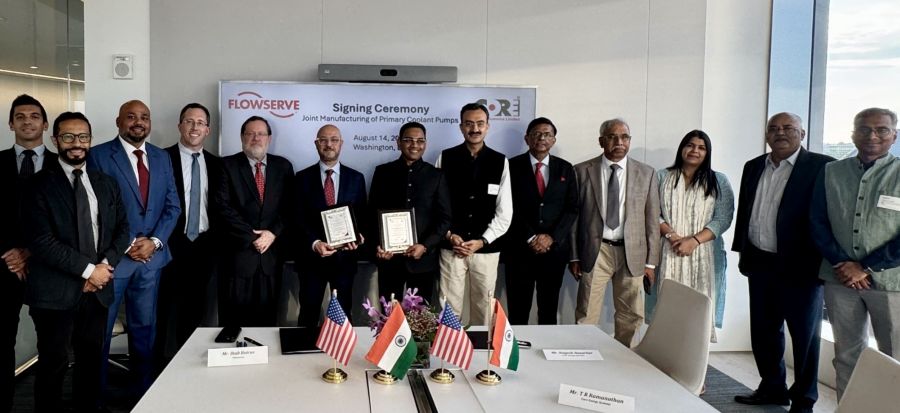
Amid escalating trade tensions and a full-blown tariff war, India and the United States have taken a significant step forward in their strategic partnership, delivering the first-ever nuclear technology transfer under the U.S.–India 123 Civil Nuclear Agreement. The pact marks a notable shift in bilateral ties even as trade frictions intensify.
The signing ceremony took place in Washington, DC, at the end of August last week. And it was in the presence of top executives from Flowserve US and CORE Energy Systems Ltd, officials from the U.S. Department of Energy, and representatives of the Indian Embassy.
Tariff Tensions Soar
Recent months have seen U.S. tariffs on Indian goods spike to a staggering 50 per cent, targeting industries like textiles, gems, jewellery, seafood, and machinery. However, both governments remain in dialogue, eyeing a possible trade agreement to ease the stalemate.
Historic First in Nuclear Tech Transfer
Despite the stormy trade climate, India and the U.S. advanced strategic civil nuclear cooperation. Flowserve US Corporation and CORE Energy Systems Ltd. have formalised a ground-breaking agreement to transfer Primary Coolant Pump (PCP) technology to India, a key component for reactor safety and efficiency.
The deal, approved by the U.S. Department of Energy under 10 CFR Part 810 and India’s Department of Atomic Energy, enables Flowserve to share advanced, safety-critical nuclear pump designs for local manufacturing in Coimbatore, India, a first under the 123 Agreement.
“This achievement… marks a significant step forward in India’s nuclear growth and the global clean energy transition,” said Ihab Botros, Vice President and General Manager, Engineered Pumps, Flowserve US.
Aligning with India’s Energy Vision
India currently operates 25 reactors (8.9 GW), with 6.6 GW more under construction. However, its long-term goal is even more ambitious: 100 GW of nuclear capacity by 2047, to support the nation’s Viksit Bharat and Net Zero targets.
This technology localisation will help strengthen India’s domestic supply chain, enable private sector participation, and reduce reliance on foreign imports, aligning with the “Atmanirbhar Bharat” and “Make in India” initiatives.
“For over two decades, CORE has driven India’s strategic engineering journey,” said Nagesh Basarkar, CMD of CORE Energy Systems. “This collaboration strengthens national supply‑chain resilience.”
Diplomatic Momentum
The agreement echoes a promise made by Prime Minister Narendra Modi and President Donald Trump during PM Modi’s February 2025 visit to the U.S., where both leaders reaffirmed their commitment to deepening civil nuclear ties through localisation and technology transfer.
This technology transfer stands as a rare signal of strategic cooperation, directly contrasting the current protectionist trade environment.
What It Means
This move represents more than just an industrial agreement; it is a symbol of resilience and long-term strategic alignment between two major democracies. As both countries are dealing with short-term economic disputes, deepening partnerships in critical infrastructure sectors like nuclear energy may pave the way for a more balanced and multifaceted relationship.
Huma Siddiqui


