



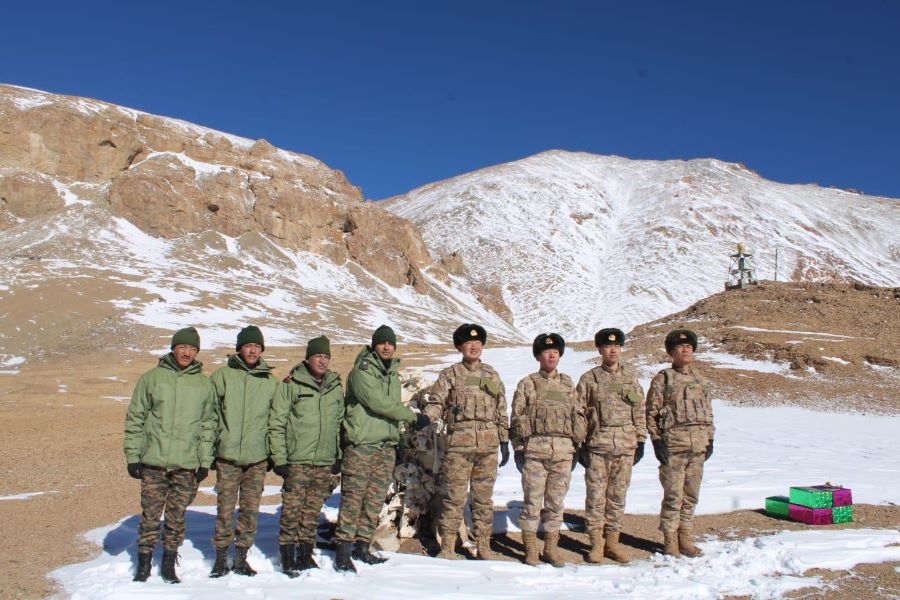
As winter approaches the icy heights of eastern Ladakh, the Indian Army is set to maintain its forward posture along the Line of Actual Control (LAC), signalling a cautious but calculated stance despite recent diplomatic overtures between New Delhi and Beijing.
While relations between the two Asian giants have shown signs of a thaw in recent weeks, after talks between Prime Minister Narendra Modi and President Xi Jinping on the sidelines of the recently concluded Shanghai Cooperation Organisation (SCO) in Tianjin, the ground realities along the LAC remain largely unchanged. As a result, the Indian Army has begun its winter deployment with no reduction in troop strength or operational readiness.
Status Quo on the Ground
According to officials, the Indian military posture will continue to mirror the Chinese presence across the border, maintaining what is described as a “state of equilibrium.” Despite a joint announcement last October regarding disengagement at key friction points in Depsang and Demchok, no significant shift has occurred in the overall deployment dynamics since then.
The ‘three-D’ strategy proposed by India: disengagement, de-escalation, and de-induction, has only partially progressed. While disengagement was achieved in some areas last year, the subsequent steps remain elusive.
“There has been no meaningful de-escalation or de-induction from either side. The force levels are essentially the same as last winter,” a senior Army officer said. “Until there is a visible reduction in Chinese infrastructure and troop presence, we will not take any chances.”
Patrolling Resumes, But With Limits
Both sides have agreed to resume joint patrolling in areas such as the Depsang Plains and Demchok, regions that had witnessed intense standoffs since 2020. However, sources in the security establishment stress that this is only a preliminary move and should not be mistaken for a full resolution.
Patrolling, which traditionally halts during winter due to extreme weather and snow-blocked passes, is expected to pause again once the high-altitude terrain becomes impassable. In the meantime, discussions on further disengagement will continue through diplomatic and military channels.
Progress has been more visible in Pangong Tso, Galwan Valley, and Gogra — locations where troops will now patrol up to their “mutually agreed perceived LAC.” Yet, this underscores the core issue: both countries have differing perceptions of where the LAC lies, making permanent resolution complex.
Why the Indian Army Won’t Ease Up
Despite the thaw in top-level talks and symbolic steps like the dismantling of a Chinese tent at Demchok, trust remains in short supply. The Chinese People’s Liberation Army (PLA) continues to expand its military infrastructure along the LAC, raising Indian concerns about long-term intent.
High-altitude airstrips, reinforced bunkers, road networks, and logistics hubs have been steadily built or expanded across the Tibetan plateau, enabling quick troop mobilisation. Indian officials see these developments as indicative of a strategy that extends beyond defensive posture.
In response, India has not only kept troop levels high but has also ramped up its surveillance capabilities. UAVs, high-resolution satellite imagery, high-altitude radars, and thermal imaging devices now form a critical part of border monitoring, particularly in the sensitive sectors of Ladakh and Arunachal Pradesh.
“The risk of sudden escalation can’t be ruled out, especially in winter, when there’s less human movement and more chances for misinterpretation,” a former Indian Army commander said. “We can’t afford to be reactive; the deterrent posture must be visible.”
Diplomatic Engagements
Recent diplomatic meetings between Modi and Xi on the sidelines of the BRICS Summit and the SCO Summit have rekindled hope for a structured resolution. The Foreign Secretary Vikram Misri later said that both sides agreed to maintain peace through existing mechanisms and resume talks on border delimitation.
Yet, Indian officials remain cautious. While the leadership dialogues are essential, history has shown that progress on the ground often lags behind diplomatic optimism.
“There’s a reason we say ‘trust but verify,’” a senior official at South Block noted. “We welcome the dialogue, but the Army’s job is to prepare for all contingencies.”
A Cautious Winter
For the Indian Army, winter deployments are not merely logistical exercises but strategic commitments. Troop rotations, supply chain fortification, and readiness drills are already underway across forward posts. Stockpiles of essentials, fuel, food, ammunition, and medical supplies have been moved in via air and road before snowfall renders many routes inaccessible.
Ultimately, the decision to hold the line highlights India’s long-term strategic view. While diplomacy continues, defence remains the bedrock of New Delhi’s approach to the unresolved boundary dispute.
Huma Siddiqui


