

As India prepares to unveil a new Defence Acquisition Procedure (DAP 2025) by year’s end, policymakers and industry leaders at the India Defence Conclave in New Delhi called for a sharper focus on innovation, speed, and self-reliance in procurement.
The session, titled “Reforming Defence Procurement: Ease of Business & Speed of Acquisition,” underscored the government’s intent to simplify defence acquisition while aligning it with India’s broader goal of technological sovereignty.
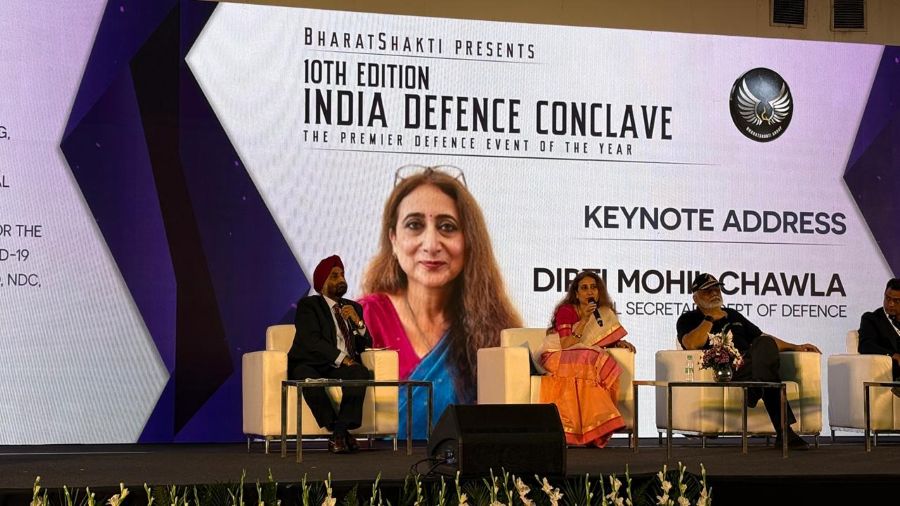
Delivering the keynote, Dipti Mohil Chawla, Additional Secretary in the Ministry of Defence, said the next phase of reform must make “ease of doing business” and “timeliness” central to procurement, without compromising accountability.
“We have evolved from procedure-centric manuals to a more enabling system. DAP 2025 will be about making sure the right equipment reaches our armed forces at the right time,” she said.
Chawla described Prime Minister Narendra Modi’s “JAI” mantra — Jointness, Atmanirbharata and Innovation — as the guiding principle for DAP 2025. “When we say Jai Hind, we must also think of how we can jointly innovate and achieve self-reliance in defence,” she told delegates, urging both the armed forces and private manufacturers to be realistic about their expectations and delivery capabilities.
Adding an international dimension to the discussion, participants highlighted an ongoing Russian initiative to establish high-tech cooperation in India. Innopraktika, a Russian organisation, is setting up a technology hub in partnership with the Chamber for Indo-Russo Technology Collaboration (CIRTC). The initiative aims to promote Russian digital solutions and support Indian efforts to develop indigenous systems, particularly in the fields of artificial intelligence and advanced computing.
Its stated mission is to help India achieve “technological sovereignty” by reducing dependence on Western technology and co-developing “Made in India” products with Russian expertise. The hub will promote startup collaborations, shared standards, and technology transfer across both defence and civilian applications.
10th India Defence Conclave | Knowledge Session III | Reforming Defence Procurement
It aligns closely with the direction articulated by Chawla and echoed by industry participants, who stressed that foreign partnerships must complement, not compromise, India’s Atmanirbhar Bharat vision. “Bilateral cooperation, especially when it strengthens our ability to build at home, is welcome,” said one senior official at the conclave.
Sanjeev Kulkarni, a technologist and entrepreneur, CEO of Optimus Logic and Board Member at SessionAI (USA), brought a global perspective to the debate. Drawing on three decades in Silicon Valley and India’s technology sector, he warned that bureaucratic lag could undermine innovation. Kulkarni’s company, which designed India’s first 5G handset, also operates in defence electronics — a field heavily dependent on fast-moving civilian supply chains.
“Chipsets evolve in cycles of one or two years,” he said. “If defence trials and procurement take longer than that, by the time you sign the contract, your technology is already outdated. We cannot afford that mismatch.”
He also urged the government to “align procurement processes with modern supply-chain realities” and to recognise that defence innovation today is inseparable from commercial technology. “Speed and quantity are everything for small firms,” he said. “Without timely contracts and assured volumes, even the most innovative startups cannot survive.”
Moderating the discussion, Rajinder S. Bhatia, Chairman of Defence Business at the Kalyani Group and President of the Society of Indian Defence Manufacturers (SIDM), noted that India’s total defence production had doubled from ₹75,000 crore in 2019 to ₹1.5 lakh crore in 2024–25, with exports rising fivefold in the same period.
“Yet the procurement process must evolve further,” he said. “Our acquisition cycle cannot be longer than the technology cycle, or we will end up with obsolescent equipment.”
Bhatia confirmed that DAP 2025 would integrate objective parameters to assess manufacturing and technology readiness, allowing faster, parallel testing through expanded test infrastructure and third-party certification. These steps, he said, would “reduce bottlenecks and bring fairness without paralysis.”
Responding to industry concerns, Chawla defended the role of procedure as a safeguard against potential risks.
“Procedure is not the villain,” she said firmly. “It is the enabling framework that allows objective decision-making with taxpayers’ money. We are responsible for transparency, level playing field, and value for money — but we must not let procedure overtake purpose.” She added that DAP 2025 would institutionalise measures to accelerate trials and introduce “accelerated pathways” for critical technologies.
Industry voices agreed that the challenge lay not in the intent but in execution. Air Marshal (Retd.) S.B. Deo, founder of JSR Dynamics, stated that MSMEs continue to face financing constraints and lengthy delays. “Cash is king. Any delay of even 10 days in certification means huge losses. We must make the system faster and friendlier to small innovators,” he said.
The consensus at the conclave was clear: reforms must marry procedural integrity with technological urgency. As Russia’s Innopraktika prepares to co-invest in India’s innovation landscape and DAP 2025 moves towards finalisation, the contours of a new procurement ecosystem are emerging — one where India’s push for Atmanirbharata converges with its search for strategic technology partnerships.
Ramananda Sengupta

In a career spanning three decades and counting, I’ve been the foreign editor of The Telegraph, Outlook Magazine and the New Indian Express. I helped set up rediff.com’s editorial operations in San Jose and New York, helmed sify.com, and was the founder editor of India.com. My work has featured in national and international publications like the Al Jazeera Centre for Studies, Global Times and Ashahi Shimbun. My one constant over all these years, however, has been the attempt to understand rising India’s place in the world.
I can rustle up a mean salad, my oil-less pepper chicken is to die for, and it just takes some beer and rhythm and blues to rock my soul.