


Preface
This is the 10th year of BharatShakti being operational. Along with a host of other engrossing activities that we have initiated on our platform, we are also reproducing a series of old nuggets that we had published as Opinion pieces in these intervening years. They recall our objective at BharatShakti of providing you a deep insight and intellectually enriching reading on issues that are of strategic import for our defence and its core strength- the defence and aerospace industry. We do hope you will read and relish this journey
This article was first published on September 21, 2025
………………………………………………………………………………….
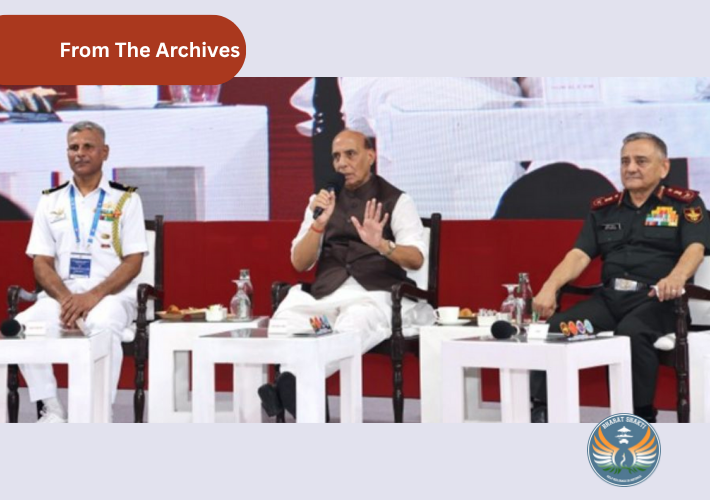
India’s long-discussed theatre command reform is finally edging closer to reality. The Combined Commanders’ Conference in Kolkata (September 15–17), attended by Prime Minister Narendra Modi and senior security policymakers, has injected fresh momentum into the project by approving a set of foundational reforms that could reshape the country’s warfighting architecture.
At a time when modern conflict spans land, air, sea, cyber, space, and the information domain, the absence of integrated command structures is increasingly seen as a vulnerability. India’s current service-specific silos create duplication, slow decision-making, and dilute combat potential in precisely the kind of fast-paced, multi-domain environment adversaries are preparing for.
From Concept to Imperative
The idea of theatre commands is not new – India has debated it for over two decades, with the Andaman & Nicobar Command as its only tri-service experiment. But changing realities, particularly China’s growing joint theatre model and Pakistan’s integrated approach to hybrid warfare, have turned the reform from an aspiration into an operational necessity.
As retired Army officer Lt Col Manoj K Channan observes, “Theatre commands are not just organisational changes; they are operational imperatives. With adversaries leveraging speed and multi-domain tactics, India’s response capability must be built on unified command, not parallel silos.”
The First Building Blocks: JOCC and Joint Training
Among the most significant announcements in Kolkata was the creation of a Joint Operations Command Centre (JOCC) under the Integrated Defence Staff. Demonstrated through live air defence simulations, the JOCC is envisioned as a permanent tri-service war room, designed to deliver real-time situational awareness, integrate operational planning, and ensure the faster execution of joint missions.
Its necessity was underscored by Operation Sindoor earlier this year, when all three service chiefs had to operate from the Army’s war room in an improvised setup. The JOCC is, in effect, the first institutional step toward proper integration.
Parallel to command structures, the establishment of a Tri-Service Education Corps marks a cultural and intellectual investment in jointness. Harmonising training standards and curricula across services, it aims to instil a shared operational ethos from the earliest stages of an officer’s or Agniveer’s career. Channan argues this must be taken further: “Joint Agniveer Training Centres could ensure that cohesion begins at the foundation, not halfway through a career.”
Logistics: The Achilles’ Heel
If command integration is the architecture, logistics is the bloodstream. Currently, each service runs its own inventories and supply chains -creating inefficiencies that could cripple wartime agility.
“During war, it is logistics, not just firepower, that determines operational success,” Channan notes. Unified logistics hubs, joint supply nodes, and shared maintenance would not only cut duplication but also free up resources for modernisation priorities.
The Political and Institutional Challenge
The road ahead is not without obstacles. The Air Force Chief AP Singh has flagged concerns about rushing into theatre commands without first testing the JOCC model. The Army and Navy, meanwhile, appear more prepared to embrace structural reform. Budgetary constraints, infrastructure requirements, and entrenched service cultures also pose barriers.
The biggest obstacle remains inter-service rivalry – particularly the debate over command precedence and leadership rotation in joint structures. Without a political decision to break the deadlock, reforms risk stalling.
A phased implementation, experts suggest, may be the most realistic path forward: begin with joint logistics, training, and the JOCC; then move toward full-fledged theatres once confidence and trust are established.
Strategic Stakes
India is among the few major powers without integrated theatre commands. The U.S. and China have moved toward joint structures that allow them to generate combat power more effectively across domains. Delays in India’s transition risk leaving the armed forces structurally disadvantaged in the very contingencies – rapid, multi-domain, high-technology conflict – they are most likely to face.
The Kolkata conference signalled that India is no longer treating theatre commands as a distant aspiration. The challenge now is whether political will, military buy-in, and budgetary resources can align fast enough to turn these first steps into a decisive leap.
Huma Siddiqui