


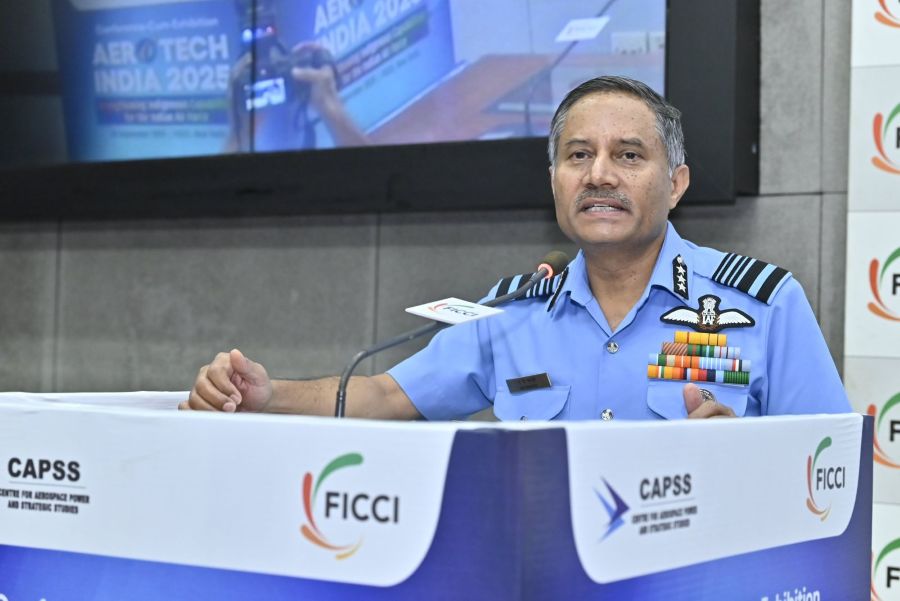
Full-scale indigenisation, not partial efforts, must underpin India’s defence preparedness if the nation intends to maintain strategic autonomy and operational readiness in future conflicts. It was the core message delivered by Air Marshal Awadhesh Kumar Bharti, Deputy Chief of the Air Staff, while addressing industry leaders, policymakers, and defence experts at Aero Tech India 2025, organised by FICCI in collaboration with the Centre for Air Power and Strategic Studies (CAPSS).
Calling for a decisive push towards 100% indigenisation, Air Marshal Bharti warned that even a marginal reliance on imported critical components could severely handicap the nation’s defence production during emergencies. “A 99 per cent indigenisation rate still leaves us vulnerable if key elements are sourced from abroad,” he cautioned. “We must aim for complete self-reliance within clear, achievable timeframes.”
‘Afterburner’ Innovation Needed
Urging both public and private stakeholders to accelerate innovation cycles, Bharti emphasised the need to move beyond the conceptual phase. “Cruise mode won’t cut it anymore. It is time to hit the afterburner,” he said, underlining delays in translating ideas into operational capabilities.
In his address, he also offered a structured vision of future warfare, dividing it into multiple phases with distinct technological and strategic demands. In the pre-kinetic phase, he identified the need for robust, survivable, and integrated ISR (intelligence, surveillance, reconnaissance) capabilities across multiple domains. It includes AI-powered data processing, quantum-resilient communications, and space-integrated sensors.
Future Wars: Human-Machine Collaboration
Looking ahead to active combat scenarios, Bharti described a battlefield dominated by advanced technologies such as sixth-generation fighter systems, autonomous platforms, and man-unmanned teaming. He stressed that the next era of warfare will hinge on seamless collaboration between human operators and AI-enabled machines.
However, the Deputy Chief flagged weapon seeker technology as a key weakness in India’s defence ecosystem. Despite advancements in weapon platforms, he noted that insufficient attention has been paid to the development of indigenous seekers, which are critical for precision targeting.
From Hypersonics to Counter-Drone Systems
He emphasised the importance of prioritising research and development investments in several key areas. He urged industry players to concentrate on quantum computing to enhance security in defence communications, the development of scramjet propulsion systems for hypersonic missiles, and core aero-engine advancements for both combat and transport aircraft.
Additionally, he emphasised the importance of innovation in directed energy weapons and advanced counter-drone technologies, recognising these as essential components for maintaining a technological edge in defence capabilities.
He also warned of overcrowding in the unmanned systems space, recommending that Indian innovators shift their focus toward platform survivability, multi-sensor integration, and advanced payload capabilities.
Industry Leaders Echo Call for Strategic Self-Reliance
Air Vice Marshal Anil Golani, Director General of CAPSS, pointed to the progress already made through indigenisation lists, stating that over 14,000 imported components have been replaced with local alternatives. Government initiatives have redirected Rs 2.5 lakh crore in procurement toward domestic manufacturers, with more expected as the sixth indigenisation list nears release.
FICCI committee member Gagan Kumar Sangal echoed the urgency for self-reliance. “This is not just about domestic capability; it is about strategic compulsion. We must innovate faster and collaborate across sectors,” he said.
Another FICCI member and President of Zen Technologies, Kishore Atluri, noted the ongoing transformation of India’s defence landscape. “From a heavy reliance on foreign hardware, we are now moving toward indigenous design, development, and manufacturing. The Indian Air Force is no longer just a consumer; it is becoming an innovator,” he observed.
Team BharatShakti

Dr Ravi Shankar has over two decades of experience in communications, print journalism, electronic media, documentary film making and new media.
He makes regular appearances on national television news channels as a commentator and analyst on current and political affairs. Apart from being an acknowledged Journalist, he has been a passionate newsroom manager bringing a wide range of journalistic experience from past associations with India’s leading media conglomerates (Times of India group and India Today group) and had led global news-gathering operations at world’s biggest multimedia news agency- ANI-Reuters. He has covered Parliament extensively over the past several years. Widely traveled, he has covered several summits as part of media delegation accompanying the Indian President, Vice President, Prime Minister, External Affairs Minister and Finance Minister across Asia, Africa and Europe.