



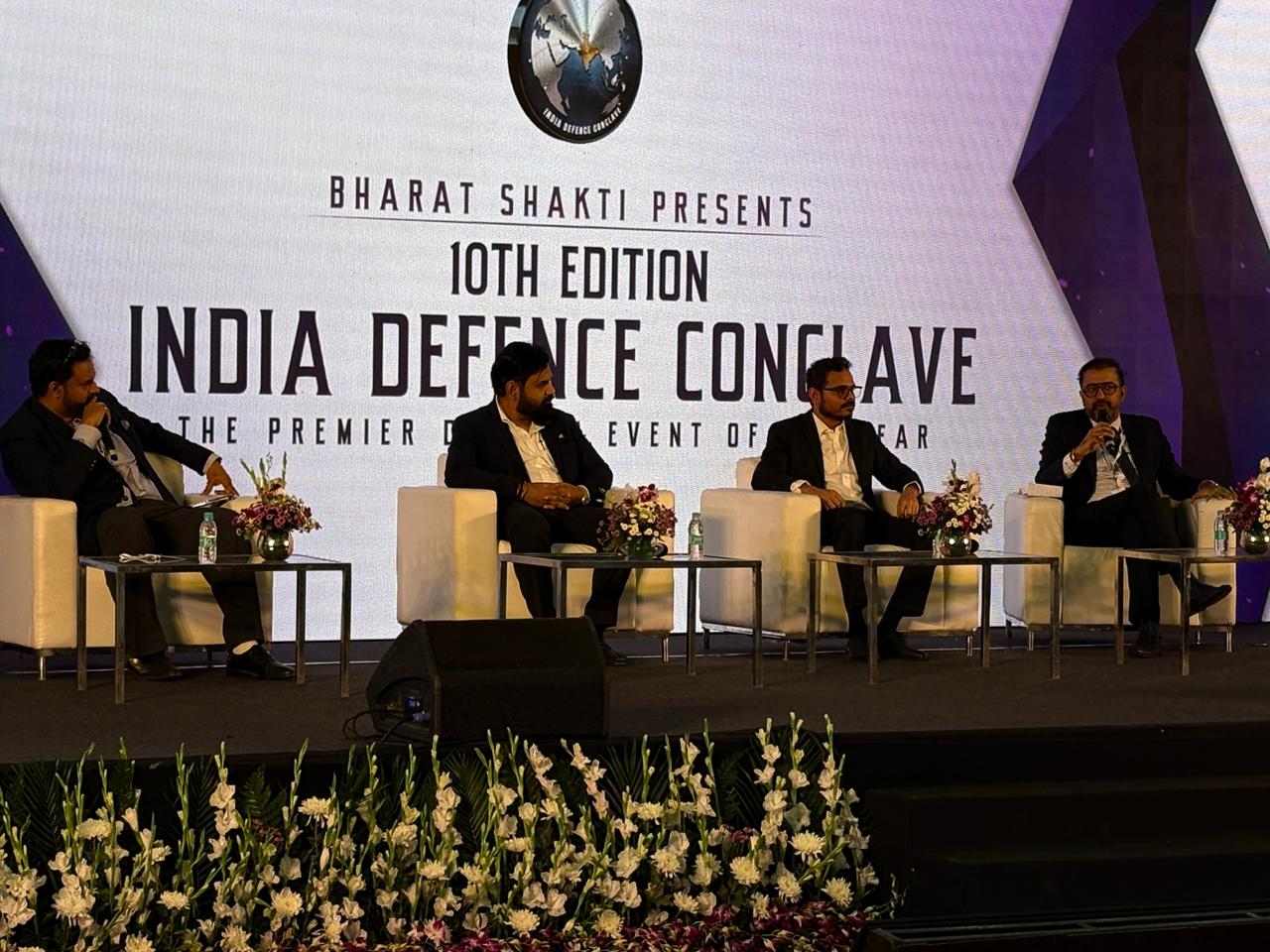
Innovation is fast emerging as the new battlefield advantage, and India’s ability to lead in defence technology may well define its strategic edge in the decades ahead. This was the central message at a thought-provoking discussion on “Innovation: Shaping India’s Defence Edge,” at the 10th edition of India Defence Conclave, moderated by Anagh Singh, Technology and National Security Specialist, who spoke with Ashim Ashok Patil, MD & CEO, Infotek Software & Systems (i-TEK RFID); Vivek Mishra, CEO, Raphe mPhibr; and Anirudh Suri, venture capitalist and author of The Great Tech Game.
Singh noted that innovation today is not merely a policy buzzword but the “centrepiece of India’s industrial and national security strategy”, shaping how the country builds, scales, and sustains its defence capability in an increasingly contested technological landscape.
Sharing his entrepreneurial journey, Vivek Mishra of Raphe mPhibr reflected on nearly a decade of developing advanced systems for India’s security forces. “When we returned to India, we wanted to create technologically advanced energy and defence systems for our forces,” Mishra said. “What we quickly learned is that innovation needs not just ideas, but human capital, financial capital, and constant dialogue with users.”
Mishra observed that while India’s innovation environment has improved dramatically since 2016, challenges remain in funding and research investment. “The government has played its part, now it’s time for private capital to take bigger bets. Defence innovation cannot rely only on public funding,” he said, calling for greater risk-taking from investors and corporate houses.
10th India Defence Conclave | Knowledge Session V | Innovation: Shaping India’s Defence Edge
Closing the Gap between Capital and Context
Anirudh Suri pointed out that while India’s start-up ecosystem has flourished in sectors like fintech and mobility, defence tech has lagged behind due to a “chicken-and-egg problem” between investors and the armed forces.
“Private capital has yet to fully understand India’s defence needs,” Suri said. “There’s a cultural and informational gap, investors sitting in Mumbai or Bengaluru don’t always grasp the operational context of India’s military challenges. That understanding has to deepen if we want serious capital to flow into deep-tech and defence innovation.”
He added that defence-tech entrepreneurs often struggle with the perception of having only one customer, the government, unlike commercial sectors with multiple markets. “Globally, companies like Palantir or Anduril began with defence use cases but diversified later. India’s defence start-ups must also be encouraged to build dual-use technologies that serve both military and civilian applications,” he said.
Deep Tech Needs Deep Talent
Ashim Ashok Patil, whose company i-TEK RFID has worked extensively in manufacturing and secure identification technologies, stressed on the critical role of talent and training in sustaining innovation.
“India’s greatest asset is its young human capital, but we need to direct it toward deep tech,” Patil said. “There’s a shortage of engineers who understand materials science, advanced electronics, and software integration for defence systems. It is not just about coding, it is about building.”
He noted that companies often spend months retraining recruits, and called for stronger academic–industry linkages to create talent pipelines focused on defence applications. “Every engineer doesn’t need to build a missile. Even developing a small subsystem can have a huge impact if done with precision,” he said.
User-Centric Innovation and Ecosystem Building
Panelists agreed that the user must remain at the center of innovation. Mishra stressed that many technologies fail to scale because they are built in isolation. “We can design an excellent drone or AI system, but unless it’s tested and evolved in the field with soldiers, it will never be truly useful,” he said.
He called for much stronger interaction between innovators and the armed forces, suggesting that the feedback loop between the services and industry must grow “tenfold” for India to stay ahead of technological change.
Bridging Worlds
Suri proposed a bold step, integrating more technology experts directly into the armed forces and encouraging veterans to transition into defence entrepreneurship. “The U.S. defence ecosystem thrives because engineers, soldiers, and entrepreneurs work in overlapping circles,” he noted. “India must foster that cross-pollination. Veterans understand the battlefield; technologists understand innovation. Together, they can build the future.”


