



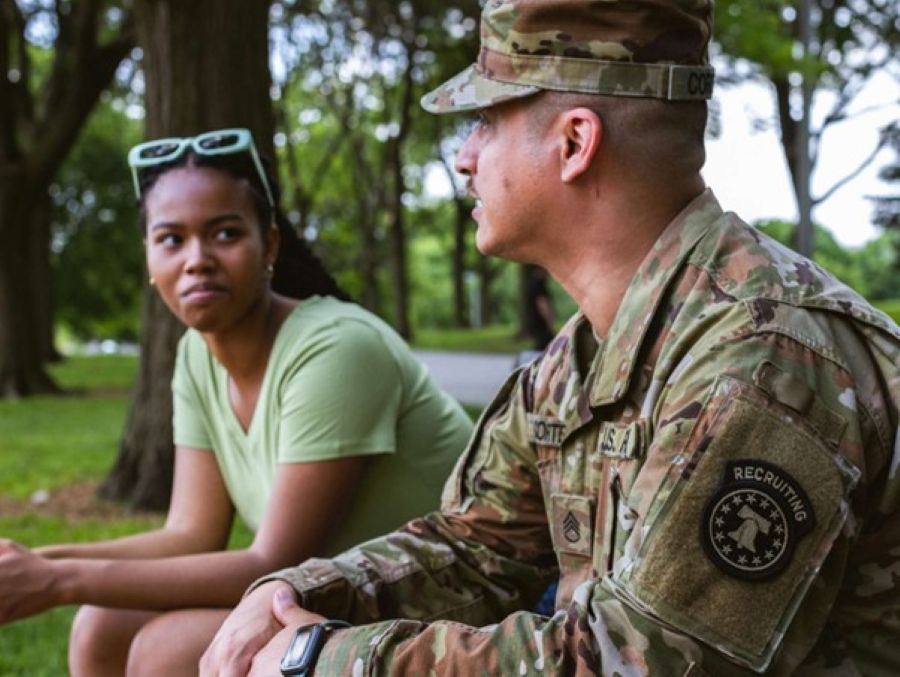
A stark new report from the Centre for a New American Security (CNAS) argues that the U.S. military’s recruiting challenges are not a temporary dip caused by economic cycles or messaging failures, but the result of a long-running decline in Americans’ willingness to serve.
In Short Supply: Identifying and Addressing the Root Causes of Declining Propensity for Military Service, Katherine L. Kuzminski and Taren Sylvester warn that the United States faces a structural manpower problem that will increasingly constrain military readiness if left unaddressed.
The report illustrates today’s recruiting difficulties within a demographic and social context that is steadily working against the all-volunteer force. While recent recruiting performance has improved due to policy interventions and targeted incentives, CNAS cautions that these gains mask deeper vulnerabilities.
The population of Americans turning 18 is projected to shrink by roughly 13 per cent between 2025 and 2041, tightening the overall pool of potential recruits. More troubling, surveys show that the share of young Americans who say they would even consider military service has fallen sharply — from 16 per cent in 2003 to just 10 per cent in 2022 — suggesting that future shortfalls may be harder to reverse through traditional measures.
A central argument of the report is that the military’s long-standing focus on eligibility has obscured a more consequential problem: declining propensity. Only about 23 per cent of American youth currently meet military eligibility standards, but the armed forces have historically been able to recruit successfully despite such constraints because the willingness to serve was higher.
As that willingness erodes, CNAS argues, even significant reforms to eligibility criteria or recruiting practices may prove insufficient. Without a broader cultural shift toward service, the pool of potential volunteers will continue to contract.
The report places this decline within a wider pattern of disengagement among young Americans. College enrollment has fallen by nearly 9 per cent since 2017, while labour-force participation among those aged 20 to 24 has dropped from above 70 per cent to the low 60s.
These trends suggest that military service is not uniquely affected but is part of a broader retreat from traditional markers of adulthood, civic participation, and institutional commitment. In this environment, the military is increasingly competing not only with civilian employers, but with a growing reluctance among young people to commit to any demanding, long-term path.
CNAS also highlights the growing civil-military gap as a key driver of declining propensity. Young Americans who have direct exposure to military life — through family members, friends, or community ties — are far more likely to view service favourably.
Yet as the proportion of veterans in society continues to shrink, fewer families have firsthand experience with the military. It reduces the number of trusted voices capable of encouraging service or countering misconceptions, making military careers feel distant and unfamiliar to much of the population.
Adult attitudes further shape this environment. Survey data cited in the report show that concerns about physical danger, psychological harm, and long-term well-being weigh far more heavily on decisions than political or ideological disagreements.
Fear of death or injury, post-traumatic stress disorder, and uncertainty about post-service opportunities all discourage parents and mentors from recommending military service to young people. These concerns persist even as public respect for individual service members remains relatively high.
The erosion of trust in American institutions compounds the problem. While confidence in the military has declined less sharply than trust in civilian leadership, the report finds that broader scepticism toward government and public institutions dampens overall enthusiasm for service. When institutions are perceived as unresponsive or untrustworthy, the services they offer appear less meaningful or worthwhile, particularly to younger generations already disengaged from civic life.
Rather than framing the issue solely as a recruiting failure, CNAS calls for a whole-of-society response. The report urges national leadership to reinforce the military’s legitimacy and professionalism, emphasising clear missions and the responsible use of force.
It also recommends expanding early exposure programs that allow young Americans to experience military life before committing, reducing uncertainty and correcting misperceptions about service.
Within the Department of Defence, the authors argue for sustained investment in quality-of-life improvements, flexible talent-management systems, and clearer pathways that align service with individual skills and aspirations. Such reforms, the report suggests, are essential not only to attract recruits but to retain them in an increasingly competitive labour market.
At the same time, CNAS stresses that responsibility does not rest solely with the Pentagon. Congress, state governments, schools, and local communities all play a role in shaping perceptions of service. Policies that ease transitions for military families, improve recruiter access, and visibly reward service are framed as necessary signals that the nation values those who choose to serve.
Taken together, the report presents a sobering assessment: America’s manpower challenge is structural, generational, and deeply tied to broader social change. The question of whether the United States is “running out of soldiers” is less about numbers in any given year and more about whether the social foundations of the all-volunteer force can be sustained.
Without concerted effort to rebuild trust, exposure, and willingness to serve, CNAS warns, the gap between military requirements and available volunteers will only widen in the decades ahead.
Ramananda Sengupta

In a career spanning three decades and counting, I’ve been the foreign editor of The Telegraph, Outlook Magazine and the New Indian Express. I helped set up rediff.com’s editorial operations in San Jose and New York, helmed sify.com, and was the founder editor of India.com. My work has featured in national and international publications like the Al Jazeera Centre for Studies, Global Times and Ashahi Shimbun. My one constant over all these years, however, has been the attempt to understand rising India’s place in the world.
I can rustle up a mean salad, my oil-less pepper chicken is to die for, and it just takes some beer and rhythm and blues to rock my soul.