


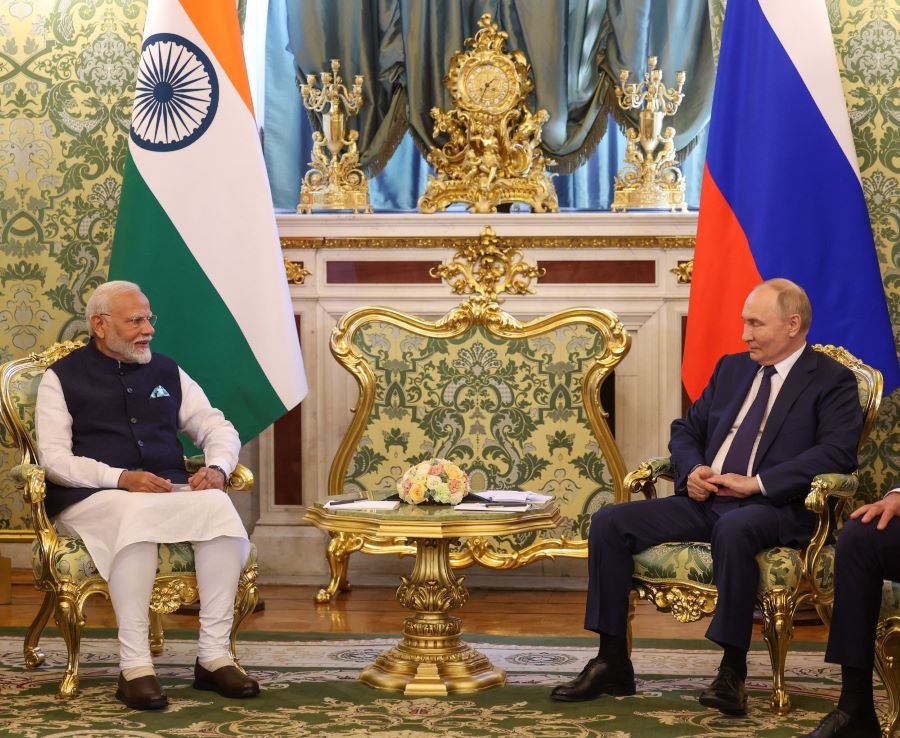
Prime Minister Narendra Modi and President Vladimir Putin will meet tomorrow, September 1, in Tianjin, China, on the sidelines of the Shanghai Cooperation Organisation (SCO) summit. While many issues are on the table, it’s clear that defence cooperation, security concerns, and energy ties will dominate the agenda, ahead of Putin’s much-anticipated December visit to New Delhi.
Defence Cooperation: Strengthening Strategic Ties
India’s defence relationship with Russia is one of its oldest and most critical strategic alliances. In Tianjin, discussions are expected to focus on the S-400 air defence system, which has proven to be a game-changer for India’s security. The system, which has already been partially delivered, played a crucial role during India’s recent military standoff with Pakistan and will be further integrated into India’s broader air defence network.
The two leaders are also expected to explore new avenues for co-production and technology transfer. Sukhoi jets, T-90 tanks, and missile defence systems will likely be high on the agenda, to further enhance India’s indigenous manufacturing capabilities through collaboration with Russian firms.
Another significant area of focus will be joint research and development (R&D) for advanced weaponry, including drone countermeasures, hypersonic technology, and cyber defence. As both nations face evolving security threats—from traditional military tensions to emerging cyber and hybrid warfare—Russia’s expertise will play a key role in India’s efforts to modernize its armed forces.
Russia and India: A Strategic Defence Alliance
Beyond military hardware, India and Russia share a broader vision of strategic autonomy in a rapidly changing world. India’s defence modernisation plan, which includes high-tech systems such as drone defence and cyber warfare capabilities, is closely intertwined with its partnership with Russia. Russia’s technology transfer, particularly in areas such as jet engines, artillery systems, and missile defence, is helping India reduce its dependency on Western arms manufacturers and pursue a more self-reliant defence strategy.
The S-400 system, which India began receiving in late 2022, has already shown its worth in the India-Pakistan standoff, where it provided a critical line of defence. Russia’s role as a defence partner will also be discussed, with particular focus on joint production and co-development of key defence technologies, such as the Sukhoi fighter jets.
Energy Security: Navigating Global Pressures
As global energy markets face volatility, Russia’s role in securing India’s energy future is more critical than ever. India has been actively importing Russian oil despite pressure from Western powers, particularly the United States, which has imposed sanctions on Russian energy exports. Putin’s visit in December will provide a critical opportunity to solidify these energy ties and secure long-term oil supplies.
India is also looking to Russia as a partner in clean energy technologies and critical minerals. The two countries are expected to discuss rare earth metals, which are essential for India’s technology sector, and find ways to secure a reliable supply chain for these critical resources.
Geopolitical Implications
The geopolitical context of these discussions cannot be ignored. The U.S. has ramped up pressure on India, accusing it of undermining Western sanctions by purchasing Russian oil. President Trump’s remarks earlier this year, calling India a “dead economy,” only heightened tensions. However, Russia has steadfastly supported India’s right to engage in trade based on its national interests—an issue likely to be a key focus of the talks between Modi and Putin.
Kremlin spokesperson Dmitry Peskov reiterated this stance, calling out any external influence on India’s foreign policy as unacceptable. India’s sovereignty in matters of trade and foreign relations is a cornerstone of its approach, and Russia’s support in this regard ensures that India has a reliable partner in navigating a complex international order.
Ukraine Conflict: India’s Role in Peace Negotiations
While India maintains a neutral stance on the ongoing Russia-Ukraine conflict, there is growing diplomatic momentum around the possibility of India playing a more active role in facilitating dialogue between Russia and Ukraine. Ukrainian President Volodymyr Zelensky has expressed interest in visiting India, and discussions between Modi and Putin in December are likely to touch upon how India can leverage its relations with both Moscow and Kyiv to help de-escalate the war.
Strengthening India-Russia Ties
As India and Russia move forward into the next decade, their partnership remains crucial to both nations’ long-term security and prosperity. With defence, energy, and technology cooperation at the heart of their bilateral agenda, the upcoming Putin-Modi summit promises to chart a course for even closer collaboration in these critical areas.
Huma Siddiqui