India’s long-anticipated Project 75(I) submarine programme appears to be entering its decisive phase, with Navy Chief Admiral Dinesh Tripathi confirming that discussions are at an “advanced” Contract Negotiation Committee (CNC) stage and that the “contract conclusion will happen soon.”
His remarks came during the annual media briefing ahead of Navy Day, signalling major forward movement on a project that has seen years of delays.
Also Read: Negotiations Begin on P 75(I) Submarine Deal, Signing Still a Long Haul
Notably, BharatShakti had earlier reported that the contract is expected to be signed in the first quarter of 2026, even as internal targets within the defence establishment hope to finish negotiations by the end of this fiscal year.
One of the World’s Largest Conventional Submarine Deals
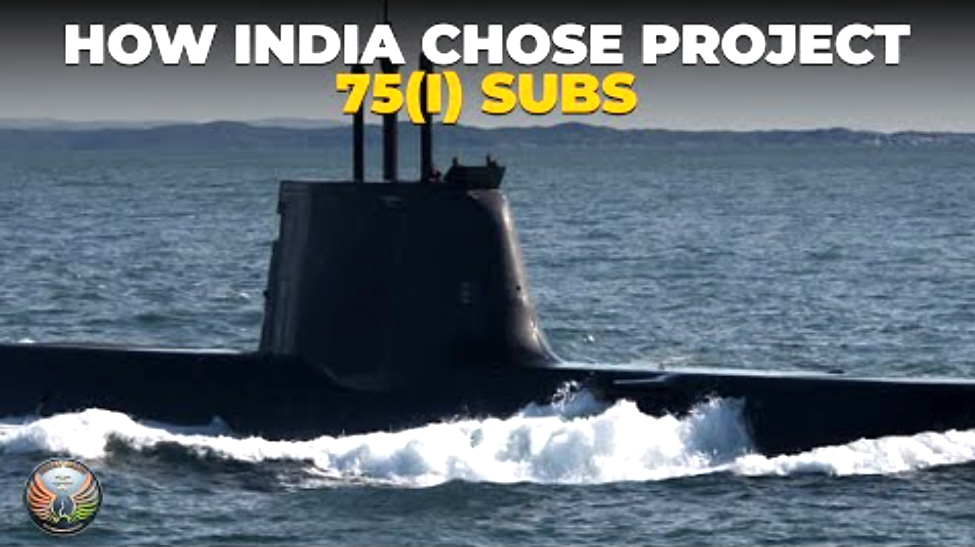
Project 75(I) aims to deliver six next-generation diesel-electric submarines equipped with advanced stealth features and an Air Independent Propulsion (AIP) system for longer underwater endurance.
Defence officials say the programme, initially valued at Rs 43,000 crore when the Acceptance of Necessity was granted in 2018, is now expected to cost around Rs 90,000 crore despite recent price reductions, placing it among the most expensive conventional submarine contracts ever signed globally.
Negotiations are currently focused on cost restructuring, workshare, indigenisation levels, and ensuring genuine transfer of sensitive submarine design technology.
Design, Timelines and Production Challenges
As per the request for proposal, the first submarine must be delivered 7 years after contract signing, with 45% indigenous content, followed by one each year until the programme reaches 60% localisation.
Even with a timely signing, the first P75(I) submarine is likely to join the fleet around 2032.
Sources caution that design verification, technical consultations, and the integration of complex systems, especially AIP, could extend timelines a bit.
The submarine design, originally envisioned as an entirely new platform, has evolved into an enlarged, enhanced variant of the German Type 214, incorporating angular surfaces to reduce sonar visibility. Final design approval is reportedly close.
German Industry Partnerships Boost ‘Make in India’
To support India’s indigenisation push, ThyssenKrupp Marine Systems (TKMS) has signed key agreements with domestic defence firms:
- VEM Technologies: Will handle Indian integration and testing of heavyweight torpedoes, supported by TKMS subsidiary ATLAS ELEKTRONIK.
- CFF Fluid Control Ltd: Will enable local production of towed sonar systems essential for anti-submarine warfare.
TKMS is also exploring long-term cooperation with DRDO and other agencies to establish production and testing facilities in India, potentially turning the country into a regional hub for submarine systems.
CNC Negotiations Progress After Delays
The CNC, comprising officials from the Ministry of Defence, the Navy, Defence Finance, and MDL, is working through complex issues, including pricing, technology transfer, and localisation targets.
Two contracts will eventually be signed:
MoD–MDL, covering construction responsibilities, and
MDL–TKMS, covering design, technology transfer, and specialised systems.
Officials stress that real design-level know-how must be transferred to ensure India can build the next generation of submarines independently.
Learning From the Scorpene Era
The Navy remains cautious after Project 75 (Scorpene), which saw significant delays and cost escalations. The contract, signed in 2005, was intended to deliver submarines starting in 2012, but the first was inducted only in 2017, and the last as recently as 2025.
P75(I) is expected to avoid these pitfalls through stronger oversight, clearer technology-transfer guarantees, and a more structured production ecosystem.
Indo-German Defence Ties Deepen
The progress on P75(I) coincides with increased Indo-German defence engagement. German Foreign Minister Johann Wadephul recently reaffirmed Berlin’s commitment to supporting India’s strategic autonomy and defence-industrial growth, with submarine collaboration emerging as a major pillar.
Key milestones ahead include:
- Completion of CNC negotiations
- Finalisation of the submarine design
- Signing of the MoD–MDL and MDL–TKMS contracts
- Establishment of new production and testing facilities
If timelines hold, Project 75(I) will not only expand India’s submarine fleet but also re-establish India’s domestic capability to design and build advanced undersea platforms, a critical step in strengthening the Navy’s strategic depth.
Huma siddiqui