


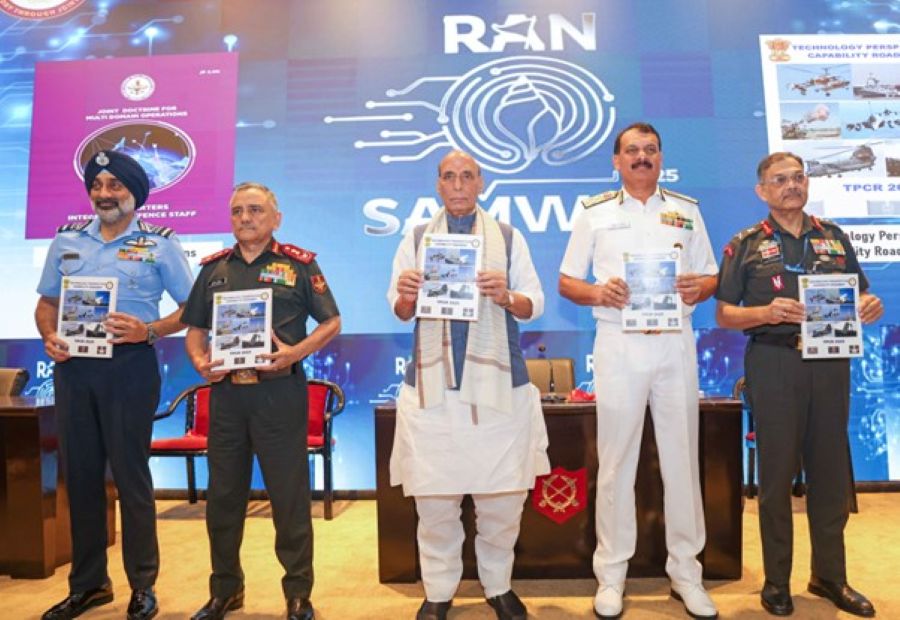
The inaugural edition of Ran Samwad, a high-profile military conclave at the Army War College in Mhow, concluded on Wednesday with a decisive shift in India’s doctrinal thinking. Marked by the release of three new joint doctrines, including the first ever for Special Forces (SF) operations, the event underscored India’s push for jointness and integration as it prepares for the transition to theatre commands.
Together with the “Technology Perspective & Capability Roadmap 2025” (TPCR), these doctrines form the backbone of a broader effort to align India’s armed forces with the demands of multi-domain and hybrid warfare.
Special Forces: Beyond Kinetics, Into the Information Battlespace
The most striking outcome was the unveiling of the Joint Doctrine for Special Forces Operations by Chief of Defence Staff (CDS) General Anil Chauhan. For the first time, Indian SF have been formally tasked with operating not only in the physical domain but also in the contested arena of perception.
The doctrine calls for Special Forces to play a proactive role in information warfare, conducting both offensive and defensive information campaigns, countering propaganda, and shaping narratives. It explicitly acknowledges the human mind as the “emerging battlespace,” where adversaries exploit social media, deep fakes, and psychological operations to undermine national resolve.
The emphasis is not academic. In Operation Sindoor, approximately 15 per cent of the effort was directed at countering hostile disinformation, General Chauhan revealed earlier this year. Army Chief General Upendra Dwivedi added that while Pakistan failed on the battlefield, it succeeded in portraying a narrative of victory at home, highlighting how perception management can offset battlefield reverses.
This experience has fed directly into the doctrine, which elevates narrative management from a peripheral function to a core operational imperative.
Towards a Joint Special Operations Command?
Another significant thread running through the doctrine is the gradual evolution of the Armed Forces Special Operations Division (AFSOD). Currently, a 3,000-strong tri-service formation comprising the Army’s Para SF, Navy’s MARCOS, and Air Force’s Garuds, AFSOD is envisioned to expand in size, scope, and operational role.
The doctrine hints at the possibility of transforming AFSOD into a Special Operations Command (SOC) directly reporting to the Chiefs of Staff Committee (COSC) – a structural leap that would put India on par with countries such as the US, which operate dedicated SOCOM-type commands.
Training Reform: Towards Joint Service Training Institutes
The doctrine also identifies training reform as central to future SF effectiveness. While each service currently operates its own training schools, the new vision is to upgrade these into Joint Service Training Institutes (JSTIs), each becoming a Centre of Excellence in a specific skill set, supported by pooled resources but retaining service-level control.
The focus is on preparing SF for night and adverse-weather operations, insertion and extraction from complex platforms like submarines and aircraft, and terminal guidance for long-range precision munitions. Joint training in electronic warfare, cultural awareness, and psychological resilience is also emphasised, signalling a shift from tactical excellence to full-spectrum capability.
The Larger Jointness Agenda
Ran Samwad 2025 was not just about SF. In total, three doctrines were unveiled in Mhow – for Special Forces operations, Airborne & Heliborne Operations, and Multi-Domain Operations (MDO). Together with three others released earlier this month – on Cyberspace Operations, Amphibious Operations, and Integrated Logistics – they represent a surge of doctrinal consolidation under HQ IDS.
The Technology Perspective & Capability Roadmap 2025 (TPCR) complements these doctrines by outlining a 10-year plan to bridge capability gaps and align defence R&D and industry with the military’s modernisation trajectory, ensuring that doctrine and technology advance in lockstep.
Takeaway
Ran Samwad’s significance lies in its post-Sindoor recalibration of India’s military thinking. The seminar highlighted that modern conflict is no longer confined to territory, firepower, and manoeuvre. Instead, information dominance, interoperability, and joint structures are emerging as decisive variables.
By assigning SF a frontline role in information warfare, signalling a possible upgrade of AFSOD into a full-fledged SOC, and mandating joint training reform, the doctrines released in Mhow mark a structural and philosophical shift in India’s approach to warfare.
In effect, Ran Samwad 2025 has drawn the blueprint of an Indian military that must be as agile in managing perceptions as it is in delivering kinetic punch – an acknowledgement that in the wars of tomorrow, victory will be decided as much in the mind as on the battlefield.
Ravi Shankar, Mhow

Dr Ravi Shankar has over two decades of experience in communications, print journalism, electronic media, documentary film making and new media.
He makes regular appearances on national television news channels as a commentator and analyst on current and political affairs. Apart from being an acknowledged Journalist, he has been a passionate newsroom manager bringing a wide range of journalistic experience from past associations with India’s leading media conglomerates (Times of India group and India Today group) and had led global news-gathering operations at world’s biggest multimedia news agency- ANI-Reuters. He has covered Parliament extensively over the past several years. Widely traveled, he has covered several summits as part of media delegation accompanying the Indian President, Vice President, Prime Minister, External Affairs Minister and Finance Minister across Asia, Africa and Europe.