


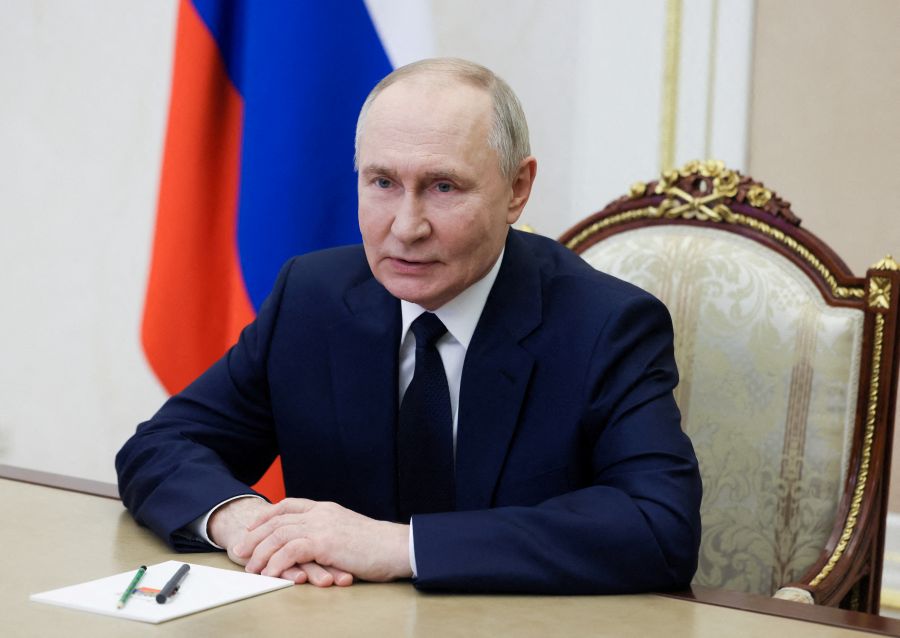
With President Vladimir Putin’s state visit to India now officially confirmed for December 4–5, officials on both sides are preparing for what is expected to be the most consequential defence-focused summit since the 2018 S-400 deal. The announcement has drawn attention to a suite of advanced military platforms Russia is likely to put on the table, as well as to the specific capabilities India aims to secure as it recalibrates its long-term force posture.
The groundwork for these discussions was laid earlier this month at the 5th Meeting of the Working Group on Military Cooperation under the India–Russia Intergovernmental Commission on Military and Military Technical Cooperation (IRIGC-M&MTC). Senior officers from the Integrated Defence Staff and the Russian General Staff used the forum to review ongoing projects and map out new proposals for joint research, co-production and technology transfer.
What Russia Is Expected to Offer
Su-57E Stealth Fighter
Moscow is preparing to make an aggressive pitch for the Su-57E, the export variant of its fifth-generation fighter. Russian officials have indicated that India could be offered levels of localisation “unprecedented” in its defence exports, including licensed production and transfer of critical manufacturing know-how for stealth structures, engines and sensor fusion systems.
A recent Russian technical audit of Hindustan Aeronautics Limited (HAL) facilities concluded that India already possesses about half the industrial infrastructure necessary for Su-57E assembly. For Russia, positioning India as a manufacturing hub for components would broaden its export resilience amid Western sanctions; for India, the offer touches on the most difficult segments of fighter jet production, stealth shaping, composites, and low-observable coatings, which would feed directly into the AMCA programme.
S-500 ‘Prometey’ Air and Missile Defence System
Following India’s successful fielding of the S-400, Russian officials are signalling their readiness to discuss the next-generation S-500 system. The platform is designed to intercept ballistic missiles, hypersonic vehicles, and high-altitude aerial threats at ranges of roughly 600 km, well beyond the S-400 envelope.
This offer aligns with Russia’s interest in keeping India within its missile defence ecosystem at a time when competition from Western and Israeli suppliers has grown.
Renewed Naval Cooperation and Undersea Platforms
Moscow is also expected to reassure New Delhi on timelines and technical pathways for the customised Akula-class (Project 971) nuclear-powered attack submarine being prepared for lease as INS Chakra-III. While delays linked to sanctions and shipyard constraints remain, Russia is likely to propose expanded cooperation on nuclear propulsion technologies, sonar suites and weapons integration.
Sources indicate they may also offer upgraded Yasen-class components or modular technologies that India could adapt for its indigenous SSN programme.
Joint R&D Packages in Electronic Warfare, Counter-Drone Systems and Precision Weapons
Russia is bundling a set of R&D partnerships, radar modules, electronic attack pods, directed-energy counter-UAV systems and long-range precision munitions designed to show that cooperation is moving away from platform-centric deals toward technology-sharing ecosystems.
India Is Looking for Capability, Autonomy and Strategic Optionality
Indian officials stress that New Delhi’s primary interest is not in purchasing more Russian hardware, but in access to technologies that close gaps in stealth manufacturing, high-end air defence, and nuclear propulsion domains where Russia is still willing to offer more latitude than Western partners.
Technology Leverage for AMCA and Indigenous SSNs
The Su-57E proposal is being examined less as a fleet acquisition and more for its potential to accelerate AMCA, particularly in areas such as internal bay layout, radar-absorbent materials, and sensor fusion algorithms. Similarly, operational experience with Akula-class submarines remains critical for training and doctrine as India builds its own SSN line.
Strategic Insurance Amid a Shifting Geopolitical Balance
The deepening India-U.S. defence relationship has not lessened India’s reliance on Russian-origin systems, which still make up more than half of its inventory.
The Kremlin understands this dynamic: offering India high-end technologies at favourable terms allows Moscow to reinforce its relevance as India diversifies suppliers.
Cost-Effective Modernisation and Flexible Industrial Arrangements
Russia continues to offer platforms at price points below those of Western equivalents, with fewer political strings attached. India wants modular co-production arrangements that can integrate local electronics, mission systems and weapons, something Russia has shown willingness to accommodate.
Sustaining Critical Capabilities While Indigenous Programmes Mature
Whether in stealth fighters, ballistic missile defence or nuclear submarines, India seeks “bridging solutions”: platforms or technologies that maintain capability while its own R&D pipelines, AMCA, long-range air-defence systems, SSNs, approach maturity.
A Partnership Evolving Under Pressure
Putin’s December visit will unfold amid structural change: India is diversifying its defence sources, Russia is seeking reliable partners amid sanctions, and both sides feel the pull of major-power competition.
Huma Siddiqui