


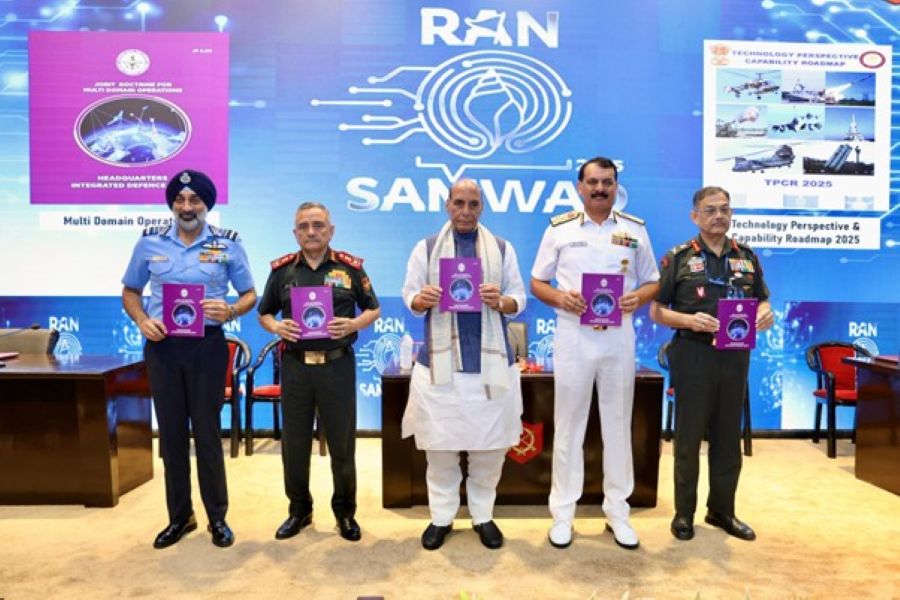
At Ran Samwad 2025 in Mhow, Defence Minister Rajnath Singh cautioned that India must prepare for sudden and unpredictable wars that could stretch from weeks to several years. He underlined that while India covets no foreign land, it will go to any extent to defend its own.
“India has never been a nation that seeks war. We have never initiated aggression against anyone. However, the present geopolitical reality is quite different. Even though we do not harbour any aggressive intent, if someone challenges us, it becomes imperative that we respond with strength,” he said.
“He made clear that India does not covet foreign land. “We do not want anyone’s land, but we are ready to go to any extent to protect our land,” Singh said, addressing an audience that included Chief of Defence Staff Gen Anil Chauhan, Air Chief Marshal A P Singh, and Navy Chief Admiral Dinesh K Tripathi.
The Unpredictability of Modern Wars
Calling today’s wars volatile and uncertain, Singh warned: “In today’s era, wars have become so sudden and unpredictable that it is very difficult to predict when any war will end and how long it will last. That is, if any war stretches for two months, four months, a year, two years, even five years, then we should be fully prepared for it.”
He emphasised that national security could no longer be left solely to the armed forces. “It has become an issue of a whole-of-nation approach,” he said.
Lessons from Operation Sindoor
Drawing lessons from Operation Sindoor, Singh lauded the armed forces’ speed and bravery. He described the operation as a turning point. “It was indeed a striking demonstration of technology-driven warfare. Be it offensive or defensive techniques, operational practices, quick and efficient logistics, the seamless integration of our forces, or intelligence and surveillance, Operation Sindoor gave us a wealth of lessons.”
The Minister added that it highlighted the growing role of indigenous systems. “Its achievements have once again underlined that in the times to come, self-reliance is an absolute necessity. We have indeed made significant progress on the path of self-reliance, but there is still a long way ahead.”
Future Wars
Singh said the doctrines of war were changing too rapidly to be fixed in any permanent pattern. “In just the past 10–20 years, the pace of these changes has been so rapid that fixing any permanent pattern has become almost impossible. It would not be wrong to say, ‘The age we live in has just one doctrine – that there is none.’”
He pointed to cyber, space and AI-driven systems as decisive elements of future battlefields. “Sheer numbers of soldiers or the size of weapon stockpiles are no longer enough. Modern battles are no longer confined to land, sea and air; they now extend into outer space and cyberspace. Therefore, what we require today is not just defensive preparedness but also a proactive strategy.”
On the role of technology, he noted: “In today’s world, the element of surprise has become even more powerful, because it is now coupled with technological warfare. Technology is advancing at such a pace that by the time we fully grasp one innovation, another emerges, completely altering the course of warfare.”
Building Capacity and Self-Reliance
The minister pointed to recent steps taken to build capabilities, including the raising of the Rudra Brigade, ShaktiBaan Regiment, Divyastra Battery, Drone Platoon and Bhairav Battalion. He praised the Navy’s expansion with INS Himgiri and INS Udaygiri, and the Air Force’s induction of long-range missiles, next-generation weapons and counter-drone systems.
He also highlighted reforms in defence production. “Our defence production, which was only Rs 46,425 crore in 2014, has now increased to a record of over Rs 1.5 lakh crore. The contribution of over Rs 33,000 crore from the private sector demonstrates that private industries are also becoming partners in the Atmanirbhar Bharat campaign. The result of this partnership is that India’s defence exports, which were less than Rs 1,000 crore ten years ago, have now increased to a record of over Rs 24,000 crore.”
He cited indigenous advances, such as the Light Combat Aircraft Tejas, the Advanced Towed Artillery Gun System, the Akash Missile, and the Indigenous Aircraft Carrier, while noting ongoing work on fifth-generation fighters and jet engines. He also mentioned DRDO’s recent successes in testing an Integrated Air Defence Weapon System and a High-Powered Directed Energy Weapon.
Defining the Battlefield: Joint Doctrines
Closing his address, Singh stressed the need for India to set the terms of conflict. “Today, in the world, whichever nation decides the battlefield is the one that controls the game and its rules. Our endeavour must be to define the battlefield and the rules of the game ourselves, compelling the adversary to fight there, so that the lead advantage always remains with us.”
At the event, Singh also released the Joint Doctrine for Multi-Domain Operations (MDO) and the Technology Perspective & Capability Roadmap 2025 (TPCR). While the MDO Doctrine charts the integrated employment of the armed forces across land, sea, air, space, cyber and cognitive domains, TPCR lays out India’s long-term modernisation path over the next decade, guiding industry and R&D towards greater indigenisation, reduced imports, and future readiness.
Doctrines can be accessed at https://ids.nic.in/content/doctrines
Ravi Shankar, Mhow

Dr Ravi Shankar has over two decades of experience in communications, print journalism, electronic media, documentary film making and new media.
He makes regular appearances on national television news channels as a commentator and analyst on current and political affairs. Apart from being an acknowledged Journalist, he has been a passionate newsroom manager bringing a wide range of journalistic experience from past associations with India’s leading media conglomerates (Times of India group and India Today group) and had led global news-gathering operations at world’s biggest multimedia news agency- ANI-Reuters. He has covered Parliament extensively over the past several years. Widely traveled, he has covered several summits as part of media delegation accompanying the Indian President, Vice President, Prime Minister, External Affairs Minister and Finance Minister across Asia, Africa and Europe.