



Editor’s Note
This article examines the evolving character of artillery firepower, focusing on India’s push to extend ranges through ramjet-assisted projectiles and next-generation long-range rockets, alongside the induction of loitering munitions like Sheshnag. It argues that enhanced reach, precision, and lower cost per engagement are reinforcing artillery’s centrality in modern warfare, as demonstrated in conflicts from Ukraine to Gaza.
Manoeuvre and firepower have always been the two basic elements on battlefields over the ages. Despite technologies’ invasive strides in warfighting, these two elements, i.e., the manoeuvre forces – infantry, mechanised forces, and armour; and secondly, the firepower means, i.e., Artillery, primarily, have a decisive effect on operations. In addition to tube and rocket artillery, a new entrant to this family of firepower means is Loitering ammunition.
For the Indian Army, Artillery modernisation is an important aspect of force modernisation and has involved several major areas beyond guns, howitzers, and rockets. It’s also focused on ammunition, precision delivery, extended range, rocket-assisted shells, mobility and more. This article will dwell upon the increase in the range of artillery ammunition, as also the advent of loiter ammunition in the artillery’s arsenal
Long Range Artillery Shells
155mm is the standard bore for artillery guns in NATO countries. Indian armed forces have also adopted 155mm as their standard bore. A lot of effort has gone into increasing the range of 155 mm guns. However, by and large, 45 km is the maximum achievable range at mean sea level. The ranges are enhanced by an additional 15 to 20 km when a few guns fire assisted munitions. Should the guns be deployed at higher altitudes, a substantial increase in range is observed as the shell traverses a rarefied atmosphere that offers less resistance.
The reason for pursuing the goal of a longer range by Gunners has strategic implications. The longer the Artillery ranges, the more missile forces and aircraft would be relieved from the task of providing fire power to our forces ahead. As a corollary, it would also free them to engage the enemy’s areas deeper inside and degrade their strategic assets.
Rocket-assisted artillery shells are being attempted in India. These shells have ramjets installed in them. When the momentum of the initial velocity imparted to the shell at firing begins to fade, the ramjets compensate by generating additional thrust to carry the shell; a substantial increase in range is the objective for now. IIT Madras is among the lead players in the development of this technology. As of now, one gun system has been used for ammunition trials. LT Gen PR Shankar (Retd Director General Artillery, IA) confirmed that the trials have been very successful and have covered the firing of all changes except that for maximum range. A 30-50% increase in range is well on the cards. The Rocket Assisted Projectile concept could also be tried for rocket artillery.
Exponential Increase in Rocket Artillery Range
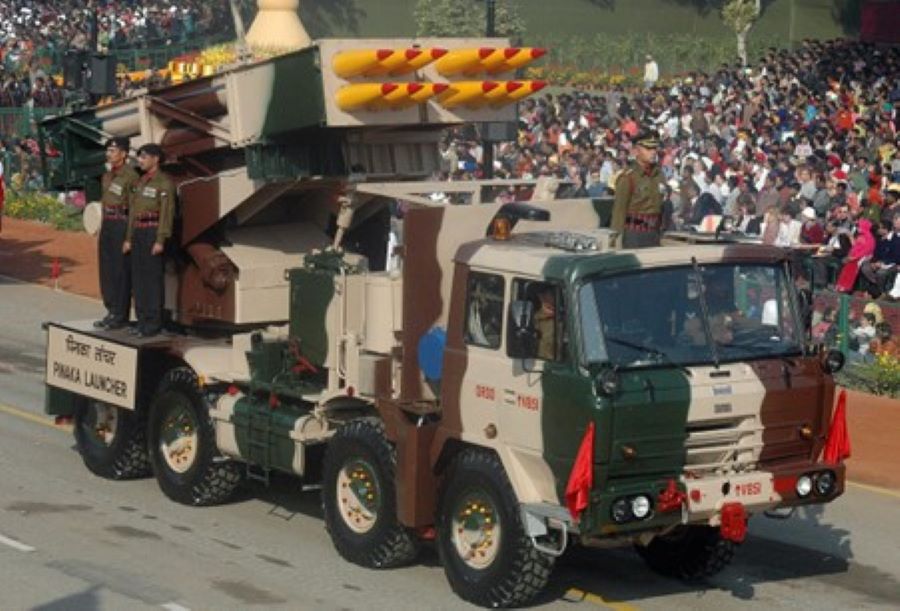
The Rocket Artillery resources the Indian forces have include the BM-21, old Russian equipment, the Indian Pinaka, and the Russian Smerch. The BM21 Multi-Barrel Rocket Launcher has been in service with the Indian Army for decades.
Pinaka’s development and accuracy are expected to improve as its planned phased rollout progresses. As of now, Long-Range Guided Rockets can range up to 120 km with the desired degree of precision. The ranges and accuracies will improve further with DRDO pursuing a goal of 300 km. Lt Gen PR Shankar expects the concept of RAP being built into rockets, providing our rocket forces a huge leap in engagement ranges.
Globally, the American HIMARS 142 Rocket System is considered the best and can range up to 300 km. Its accuracy, with certain munitions, is up to 10 meters. In December 2025, China carried out an extensive exercise, Justice Mission 2025, with the objective of capturing Taiwan. The equipment that caused the most concern among Chinese commanders was the HIMARS.
Loitering Munition
Loitering munitions are essentially drones that carry munitions. Such drones can keep a target under observation for a limited time before attacking and destroying it. Artillery salvoes or drone attacks loaded with explosives would be most effective when the target is in a vulnerable posture. The operator of the Loitering ammunition awaits such an opportune moment based on data received from the drone, and then launches the drone for the attack.
The Indian version of the loitering ammunition is called Sheshnag. Such munitions are also referred to as suicide or Kamikaze drones. These can fly a specified distance and hover around the target for a specified period. Loitering munition development faces the challenge of increased endurance and heavier payloads. Tube-launched versions are being tested to overcome some of the current limitations.
Cost of Engagement
An enemy objective can be engaged by multiple means, including artillery, airpower or missiles. However, the cost equation runs steeply upwards if missiles or aircraft are used. In comparison, the cost is disproportionately lower when the same objective is engaged with artillery salvos.
The need to lower the cost per engagement is a fundamental driver of the pursuit of longer-range fire-delivery means. Given the lower costs, artillery allows repeated engagements, enhancing the possibility of inflicting repeated casualties and increased disruption in the enemy’s ranks, compared to other means of long-distance, effective engagement, i.e., missiles and aircraft.
Epilogue
Gaza is an example of the pre-eminence of firepower, with Israel having kept its losses limited to 471 killed and close to 3000 injured till the end of December 2025. Gaza is a typical battle in a built-up area scenario, where the attacker typically pays very heavily in terms of body bags sent home. It’s the extensive use of firepower that’s kept the Israeli casualties low. Of course, such an approach runs the risk of higher collateral damage.
The Ukraine war is the best example of the predominance of firepower. Manoeuvre elements on both sides, make their moves only after deliberate addressing of the objectives by Artillery. The ability to engage at long ranges has large payoffs even in a defensive battle. It gives a defender the advantage of repeated re-engagements before the enemy columns can move up to be effective in the contact battle. In fact, firepower is driving the frontlines more decisively today.
Brig SK Chatterji (Retd)

Editor, Bharatshakti.in


HIMARS with Ukraine has done considerable damage to Russians.Shortage of it’s Ammunition has however restricted it’s full exploitation.
Introduction of a similar Rocket assisted artillery ammunition witth ranges beyond 120 kms will give a shot in the arm of Indian artillery and the Armed Forces.
Trials of Rocket assisted artillery ammunition and loitering ammunition are both very welcome news and we hope and wish that the trials to meet all the operational objectives .