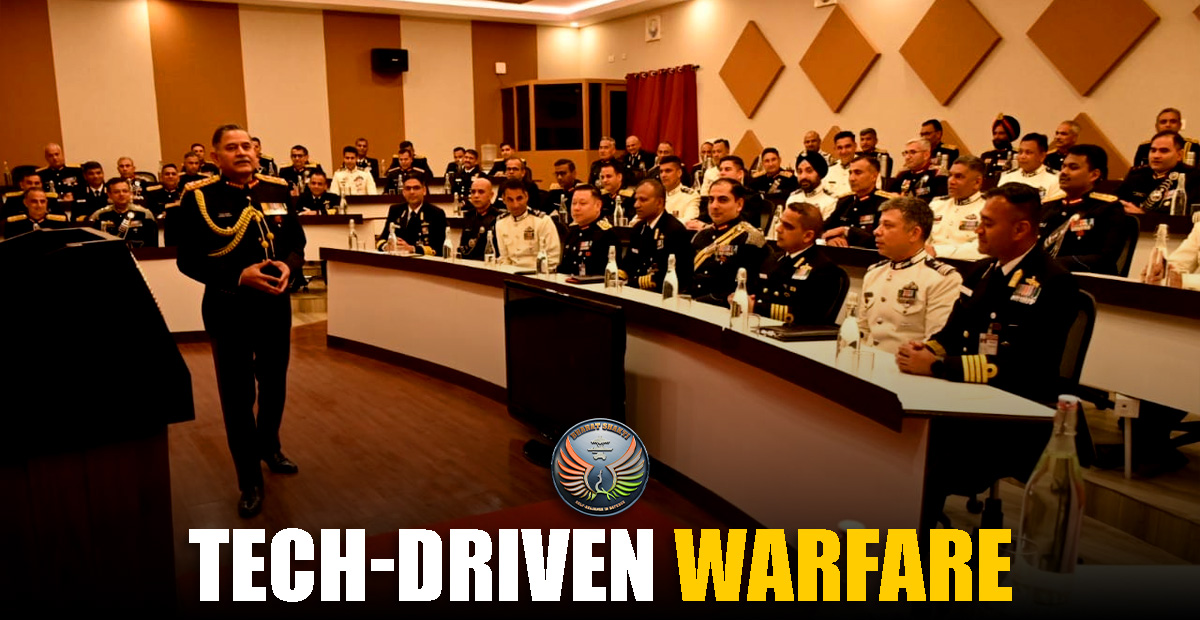
Following renewed debates on the road to theaterisation after Operation Sindoor, the Ministry of Defence (MoD) has unveiled a sweeping 15-year plan that pitches some of the most ambitious military acquisitions in India’s history. At the heart of the Technology Perspective and Capability Roadmap (TPCR) 2025, released on September 4, is the Navy’s quest for a nuclear-powered aircraft carrier, backed by emerging technologies across land, air, sea, cyber and space domains.
The roadmap, billed as the third in its series, following 2013 and 2018, outlines requirements for over 200 categories of systems and platforms. It is both a strategic vision statement and a call to India’s private sector to step up research and development, build modular technologies, and cut reliance on foreign suppliers such as Russia, France and the United States.
“As the nation stands on the threshold of embracing greater challenges and responsibilities in the forthcoming decades, it is but imperative that the Services be equipped accordingly. Greater private-public sector partnership is thus the road ahead,” the MoD notes in the document.
The Carrier as the Symbol of Ambition
The centrepiece of TPCR 2025 is the Navy’s third aircraft carrier, envisaged as a nuclear-propelled platform—a first for India. This bold step would free the carrier from conventional refuelling constraints, enabling extended deployments across the Indo-Pacific.
To support its operations, the Navy has flagged the need for 10 nuclear propulsion systems to power the carrier and future surface combatants. The carrier will also be equipped with electromagnetic aircraft launch systems (EMALS)—a cutting-edge technology that allows heavier aircraft, including unmanned combat aerial vehicles, to operate from its deck.
The air wing itself is designed to showcase India’s growing defence-industrial maturity. It will field twin-engine deck-based fighters under development by Hindustan Aeronautics Ltd, alongside multi-role deck helicopters. It would mark the first time an Indian-designed combat aircraft takes its place aboard an Indian carrier.
Complementary naval counters include 10 next-gen destroyers and frigates, 7 corvettes, 5 fleet support ships of 44,000 tonnes each, and 20 autonomous underwater vehicles for anti-submarine warfare. In parallel, the Navy is exploring lithium-ion battery systems for submarines, which will enable a technological leap in endurance and stealth.
Together, these moves underscore the Navy’s intent to field a carrier battle group that is indigenous, nuclear-powered, and future-ready.
Army: Preparing for Hypersonic and AI-Enabled Land Battles
Supporting this maritime ambition, the Army’s counters focus on firepower, mobility and AI-driven situational awareness. The roadmap includes:
- 500 scramjet-propelled hypersonic missiles for high-speed precision strikes.
- 1,800 next-generation battle tanks integrated with UAV and satellite networks.
- 400 light tanks tailored for high-altitude operations like Ladakh, armed with counter-drone and electronic warfare suites.
- 50,000+ ATGMs, including tank-mounted and next-gen variants with over 90% hit accuracy.
- 70 MALE/HALE UAVs and 800+ loitering munitions to bolster precision engagement.
- AI-enabled battlefield networks for over 4,000 users, supported by 60,000 software-defined radios and electronic denial systems against drone swarms.
The Army’s vision reflects a shift from sheer numbers to networked, high-tech land warfare, underpinned by hypersonics, robotics and artificial intelligence.
Air Force: Expanding into Space and Energy Weapons
If the carrier represents the Navy’s leap forward, the Air Force is positioning itself as India’s spearhead into space and directed energy warfare. Its requirements include:
- 150+ stealth UCAVs with supersonic speeds, 15 km operating ceilings and internal weapons bays.
- 20 stratospheric airships and 75 high-altitude pseudo-satellites (HAPS) for persistent surveillance and communication relay.
- 350+ medium-altitude long-endurance drones with 24-hour persistence.
- 5 programmable RF sensor satellites for secure, resilient networks.
- Tactical high-energy lasers, directed energy weapons, and high-power electromagnetic systems—with potential applications against aircraft, missiles and even satellites.
- 250+ anti-swarm drone systems to defend bases and high-value assets.
This focus reflects a recognition that future battles will extend far beyond the atmosphere, demanding space resilience and energy dominance.
Beyond Numbers: Indigenisation as the Core
While the figures are striking, the TPCR 2025 is more than a procurement wish list. It positions the Indian industry at the centre of defence transformation. Through frameworks such as iDEX, Make, and TDF, the document advocates for a co-development model, integrating DRDO and private enterprises with the armed forces’ operational requirements.
Crucially, it reflects an MoD intent to redefine India’s military-industrial base around indigenous technologies rather than imported platforms. The nuclear-powered carrier, indigenous twin-engine fighters, stealth UCAVs and directed energy weapons exemplify this shift.
Strategic Implications
The 15-year roadmap comes at a time when India is recalibrating its military posture amidst rising threats in the Indo-Pacific and along its land borders. The nuclear-powered carrier is both a symbol of ambition and a platform for power projection, while the Army’s pursuit of hypersonics and AI-enabled armour, and the Air Force’s push into space and energy weapons, together represent an integrated vision for future combat.
For the industry, TPCR 2025 presents both opportunities and challenges. By clearly enumerating the Services’ requirements, it sets the bar for R&D investments, modular production, and innovation pipelines. For India’s strategic planners, it provides the blueprint for building a force that is future-ready, indigenised, and theatre-capable.
Ravi Shankar

Dr Ravi Shankar has over two decades of experience in communications, print journalism, electronic media, documentary film making and new media.
He makes regular appearances on national television news channels as a commentator and analyst on current and political affairs. Apart from being an acknowledged Journalist, he has been a passionate newsroom manager bringing a wide range of journalistic experience from past associations with India’s leading media conglomerates (Times of India group and India Today group) and had led global news-gathering operations at world’s biggest multimedia news agency- ANI-Reuters. He has covered Parliament extensively over the past several years. Widely traveled, he has covered several summits as part of media delegation accompanying the Indian President, Vice President, Prime Minister, External Affairs Minister and Finance Minister across Asia, Africa and Europe.