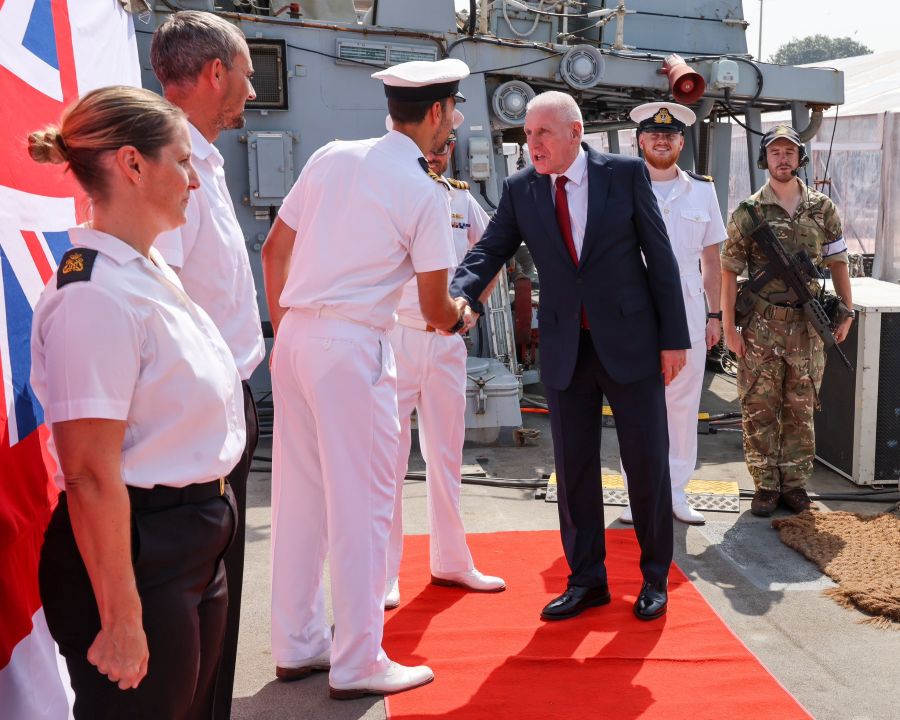
The United Kingdom and India are entering what UK Defence Minister Lord Vernon Coaker described as an “era of defence co-production,” as both nations deepen strategic and industrial cooperation amid the ongoing deployment of the UK Carrier Strike Group (CSG25) to the Indo-Pacific.
Speaking during a high-profile reception, “Alive with Opportunity: A UK-India Partnership Celebration” — held on board HMS Richmond at the Mumbai Port on Friday — Lord Coaker highlighted the growing maturity and trust in the bilateral defence relationship. The event, hosted by the British Deputy High Commission in Mumbai, marked the CSG’s India visit and coincided with UK Prime Minister Keir Starmer’s first official trip to the country earlier this week.
The reception brought together senior Indian and UK officials, including India’s Minister of State for Defence Sanjay Seth. It featured a Defence Capability Showcase demonstrating advanced UK technologies with potential for collaboration under India’s ‘Make in India’ and ‘Atmanirbhar Bharat’ initiatives.
“An Era of Defence Co-Production”
Reflecting on the outcomes of the visit, Lord Coaker noted that the bilateral relationship was transitioning from one of defence trade to defence co-development and co-production, underpinned by shared economic and security objectives.
“It was a pleasure to visit India during a week which saw the UK-India partnership reach new heights. The UK Carrier Strike Group conducted Exercise Konkan with the Indian Navy, led by their indigenous aircraft carrier INS Vikrant,” he said.
“We are now entering the era of defence co-production, which will provide mutual benefits to both countries. The various initiatives demonstrate the growing depth and trust in our relationship, which is even more important to promote peace, security and stability in an increasingly uncertain world.”
Lord Coaker also underscored that defence industrial partnerships are increasingly becoming a driver of economic growth — a sentiment aligned with the UK government’s “defence as an engine for growth” approach.
Strategic and Economic Context
The CSG25’s engagement in India, featuring joint operations between HMS Prince of Wales and INS Vikrant during Exercise Konkan, reinforced the interoperability between the two navies and showcased the expanding scope of UK-India maritime collaboration. The UK’s defence capability showcases further outlined potential cooperation in electric propulsion systems, advanced missile technology, and shipbuilding solutions, complementing India’s emphasis on indigenisation.
Strategic and Industrial Depth
Beyond tactical cooperation, the visit carried substantive industrial and strategic outcomes. Two major agreements were signed:
- A £350 million contract for the supply of UK-manufactured Lightweight Multirole Missiles (LMMs) to the Indian Army — a deal that strengthens India’s precision-strike capabilities while sustaining high-skill jobs in the UK defence sector.
- A £250 million collaboration for the joint development of electric propulsion systems for naval vessels — marking a key step in next-generation maritime technology co-development between the two nations.
Together, these pacts signal a maturing defence-industrial partnership, one that moves beyond buyer-seller dynamics toward shared innovation and capability building.
UK Signals Long-Term Indo-Pacific Commitment
UK Defence Minister Lord Vernon Coaker framed the cooperation as a convergence of economic and security imperatives.
“This partnership helps keep us secure at home and strong abroad, while the trade links promise a valuable boost to the UK economy – demonstrating once again that defence is an engine for growth,” he said.
His remarks reflect London’s broader “Global Britain” posture — a recalibrated engagement model that positions the UK as an enduring Indo-Pacific actor. With UK defence spending projected to rise to 2.6% of GDP by 2027, the government is clearly investing in maintaining a forward presence and reinforcing alliances with like-minded powers such as India.
India’s Central Role in the UK’s Indo-Pacific Vision
Echoing this strategic intent, British High Commissioner to India Lindy Cameron emphasised India’s pivotal role in shaping regional stability and global governance.
“The visit of the UK’s Carrier Strike Group to India was a testament to the strength of the relationship between our two countries… Together the UK and India are now focused on the future with our shared vision for 2035,” she noted.
Her comments point to an evolving 2035 roadmap that aligns the two countries’ priorities in defence, technology, and critical supply chains — areas increasingly central to global power competition.
From advanced joint naval operations to expanding industrial linkages, the UK-India defence partnership is entering a more strategic and technology-driven phase. Lord Coaker’s remarks in Mumbai captured this transition succinctly, framing it as a shift toward sustained co-production, capability sharing, and strategic trust in pursuit of stability and prosperity across the Indo-Pacific.
Huma Siddiqui