


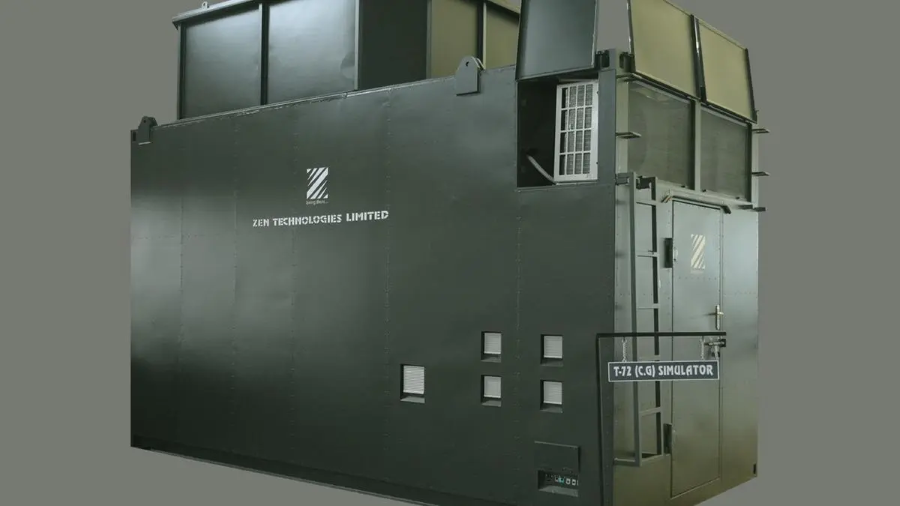
Zen Technologies has bagged a Rs 108-crore contract from the Ministry of Defence (MoD) to supply indigenous Tank Crew Gunnery Training Simulators, the company announced on Tuesday. The order is seen as the outcome of recent procurement reforms that prioritise and safeguard genuine domestic intellectual property in defence manufacturing.
According to company officials, deliveries are expected to be completed within a year, even though the MoD has allowed up to 24 months for the acquisition programme.
The high-fidelity simulator system is designed for training tank commanders and gunners. Replicating the turret environment with realistic sights, control panels and instruments, it supports drills across multiple gunnery modes, ammunition types and both static and moving target scenarios. The system can be deployed in a containerised configuration or installed permanently, and includes an instructor station, a motion platform to simulate terrain effects and recoil, and a mock turret with realistic controls and visuals.
Zen Technologies Chairman and Managing Director Ashok Atluri said the order validates years of sustained R&D and reflects the maturing of India’s defence procurement ecosystem.
“Over a decade ago, we supplied our first tank simulators to the Indian Army. Back then, procurement systems weren’t built to support single indigenous vendors. Today, this order proves what’s possible when policy protects genuine Indian IP,” he said.
Atluri highlighted the financial and operational impact of simulation-based training, citing a TERI study that estimated 15 per cent adoption of crew gunnery simulators could save the armed forces Rs 1,123 crore annually -offering an 18:1 return on investment. “These aren’t just training tools; they’re force multipliers that free up resources for more capability building,” he noted, adding that faster procurement of indigenous technology would improve readiness.
The contract aligns with the MoD’s Simulation Framework, released in September 2021, which identifies simulation-led training as a strategic priority in modernising the armed forces. Industry observers expect demand for such systems to rise significantly as the Army, Navy and Air Force expand the use of simulators in training and capability development.
Training simulators have emerged as a key pillar of modern military preparedness, providing armed forces with a safe, repeatable, and highly realistic environment to hone mission-critical skills. Ranging from individual weapon handling to complex multi-platform operations, these systems accurately replicate battlefield conditions and high-stress scenarios without the risks, costs or logistical constraints of live training.
Advances in artificial intelligence, augmented reality, and data-driven modelling now enable simulators to mirror real-world terrain, threat profiles, and adversary behaviour with remarkable fidelity. It allows personnel to build muscle memory, improve decision-making under pressure and accelerate overall operational readiness.
Team BharatShakti