






Editor’s Note
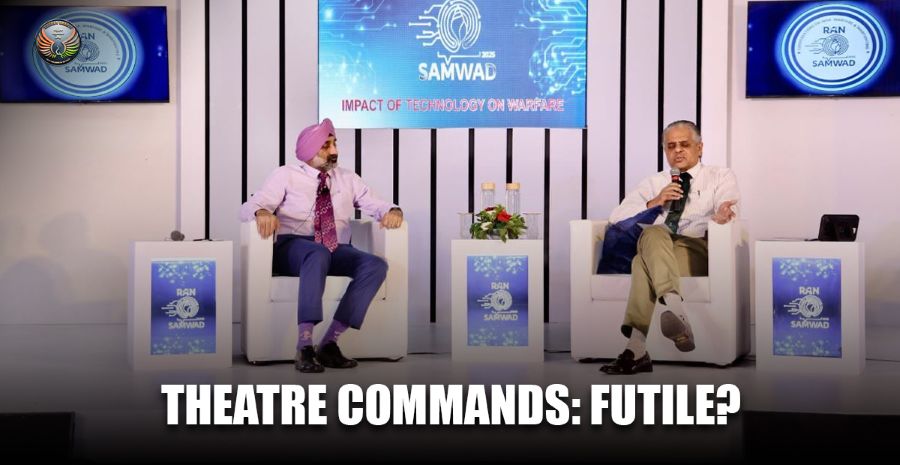
For over a month now, Indian military circles are busy in debating the necessity of creating joint commands or theatre commands as they are more popularly known, in the wake of Chief of Air Staff Air Chief Marshal AP Singh’s comments made at a tri-service conference about the futility in forming tri-service formation given a) lack of adequate resources with the IAF and b) the geographical expanse of India. You have read a series of opinion pieces on BharatShakti on this subject; here’s another, compiled by our team after speaking with veterans and serving officers. Read on:
The Indian Air Force Chief recently reignited the debate on theaterisation. His remarks were clearly made in the backdrop of Operation Sindoor, and the responses to these have trotted out old arguments in favour of or against the idea of theaterisation. Can stakeholders get back to square one on the drawing board?
While the Indian Air Force has had reservations on the idea of theaterisation, and these have been primarily on grounds of paucity of assets and the concept of indivisibility of this strategic resource, it is also understood that these have been suitably laid to rest when the three services endorsed the broad plan for theaterisation, which, as per open sources, will have three TCs. One each facing two principal adversaries aimed to address the security challenges posed by them and one facing outwards to encompass the maritime domain, reflecting the imperatives that the maritime domain will not only entail threats, from these continental worthies but also offer opportunities to address these threats through an indirect approach and that its expanding national interests will best be served by an outward looking posture.
Given the Air Chief’s assertions, do the agreed-upon Theatre Commands merit a fresh look? It seems unlikely, as significant deliberations would have gone into reaching that agreement initially. Unless there is some compelling new evidence to justify reversing course on this crucial issue, the best path forward is to continue as planned. However, taking cues from his remarks, the experience of Operation Sindoor may provide grounds for reconsideration.
Operation Sindoor raises several important questions regarding the higher direction of war. It appears that all major decisions were made in Delhi, effectively allowing the war to be conducted from that central location. It facilitated a close interface between the apex military and political leadership, which seems to have been crucial for the successful application of military force. If a theatre command had been in place, would Operation Sindoor have been executed in the same manner? What would have been the role of the Theatre Commander in that context? Furthermore, could a limited application of force, similar to that seen in Operation Sindoor, be managed more efficiently by a single lead service?
Many would argue that the answers to such questions are self-evident. However, is that truly the case? Both proponents and opponents of the theatre commands will present compelling arguments in response. Some individuals may even delve into the specifics of their preferred ‘model’ to influence the final decision, but this approach would essentially be putting the cart before the horse. At this juncture, it may be appropriate to limit the inquiry to how Operation Sindoor shapes the understanding of the necessity for theatre commands.
If current wars are better fought from Delhi and tight control is exercised from the apex headquarters, as was the case in Operation Sindoor, it is seen as a good template for how this approach will stand up to scrutiny in the case of a wider application of force, both in scope and duration.
In the context of this discussion, if one assumes that Chiefs are better equipped to wage war than a distant theatre commander, it raises the question of whether they would prefer to conduct the war through multiple regional single service Commanders-in-Chief. It may be feasible for an operation like Operation Sindoor, which involved a limited application of force, to be managed more efficiently by a single lead service or centrally from Delhi. However, the suitability of this approach for handling any escalation in military force remains in question. Command structures must be adequately prepared for such eventualities.
In the event of escalation, would the conflict still be managed from Delhi? If not, the initial dilemma would arise regarding when to transition command responsibilities to the appropriate operational or theatre-level Commander and how to carry out this transition smoothly. A single theatre commander is likely to facilitate this transition more effectively than multiple single-service commands.
Contemporary warfare, as evidenced by Operation Sindoor, necessitates a strong overlay of political direction, requiring a continual reassessment of the constraints and restraints imposed on the forces. It is reasonable to assume that unity of command would enhance the application of such higher direction, allowing for sustained momentum and minimising the risk of misdirection in the use of force.
At the operational/tactical level, the need for a combined arms force has been felt at every stage as we move up from the basic fighting unit, and militaries the world over have evolved in a manner best suited to address this requirement. In the military, the lowest level of the unit- a company in the army, a small ship in the Navy or a single aircraft in the air force is designed to operate and fulfil a very narrow range of tasks. The inherent equipment/ manpower assigned are such that they have the necessary training to operate the equipment effectively and bring it to bear to achieve the mission set out for it.
At this level, the unit invariably has a singular capability. Any other supporting capabilities required are brought to bear by the higher commanders to aid mission accomplishment. As the expectations of the unit increase, the need for combined arms capability starts manifesting. Thus, a Division in the Army or a Fleet in the Navy has inherent to it multiple capabilities that are placed under a single commander, and these are orchestrated coherently to achieve a mission larger than the sum of its parts. The military leadership feels it is appropriate for such multiple capabilities to be placed under a single commander in the interest of mission accomplishment. If this imperative is extrapolated upwards, multiple capabilities (from within the same service, for instance, Infantry, Armour, Artillery) will change into multiple capabilities from various domains.
The principle behind the need for such a combined arms force, however, does not change. It seems to melt away at the higher level when single service proclivities trump (pun intended) the argument. While prescriptions such as centralised planning, decentralised execution, and variations on this theme are offered regularly as the solution to this conundrum, these may not stand up to scrutiny, if for no other reason than a lack of consistency.
As one progresses along the spectrum of war, the effective application of multi-domain military capabilities becomes essential for mission accomplishment. Concurrently, there arises a necessity to leverage all elements of national power – often encapsulated in the military acronym DIME (Diplomatic, Informational, Military, and Economic) – to fulfil the political-military objectives of the conflict. This integration typically extends beyond the command span of the military leader directly engaged in the conflict. It is most effectively achieved through a strategic collaboration among military, political, and bureaucratic leadership, ideally at the highest levels of governance.
It raises an important question regarding the orchestration of these diverse elements of national power in pursuit of the war’s objectives: Will this critical function be managed by the military Chiefs while simultaneously conducting military operations?
Such questions can best be answered by the Principals themselves, drawing upon their first-hand experience of Op Sindoor, and there is every reason to believe that such assessments are indeed being made. While the process of creating theatre commands should avoid disruption, undue delay would be counterproductive. A significant amount of time has passed, and it is now essential to confront the issue directly. There are two viable paths: either accept the necessity for a suitable ‘combined arms’ structure and proceed decisively along this route, or set it aside for the time being, with the intention of revisiting it later when the need is deemed compelling.
TCs: Important Considerations
Need for Combined Arms Capability: In the military, the lowest level of the unit- a company in the army, a small ship in the Navy or a single aircraft in the air force is designed to operate and fulfil a very narrow range of tasks. The inherent equipment/manpower assigned are such that they have the necessary training to operate the equipment effectively and bring it to bear to achieve the mission set out for it. At this level, the unit invariably has a singular capability. Any other capabilities required are brought to bear by the higher commanders, such that the mission accomplishment is aided. As the expectations of the unit increase, the need for combined arms capability starts to manifest. Thus, a Division in the Army or a Fleet in the Navy has inherent to the force multiple capabilities, under a single commander, that are orchestrated to bring coherence to the application of force in achieving a larger mission. In this effort, the degree of support to single units will be determined by the campaign design, after weighing competing priorities. The military leadership feels it is appropriate for such multiple capabilities to be placed under a single commander in the interest of mission accomplishment. If this imperative is extrapolated upwards, multiple capabilities (from within the same service) will change into multiple capabilities from various domains. The principle behind such a need for a combined arms force, however, will not change.
Span of Command: In the military, a commander is supported by a staff that is tailor-made to meet the requirements of the span of command entailed and hence the expectations of the commander in terms of the types of mission(s) that are to be accomplished. The higher the level of command, the greater will be the experience and expertise embedded in the staff, which in turn is a direct consequence of seniority. Thus, the rank of the commander should be such that the staff under him can be of the appropriate seniority (and hence have the necessary experience/expertise) to be able to discharge the staff functions expected of them in order to meet the commander’s intent in pursuit of the mission.
Jointness/Integration vs Core Competencies: It is clear at the unit/sub-unit level, single service core competencies will need to be nurtured, but as you go up the ‘combined arms’ value chain, the ability to harness cross-domain capabilities will be increasingly felt. Thus, at the unit/sub-unit level, the extent of jointness/integration should be determined by the types of tasks/ missions envisaged. At higher levels of command, the jointness/integration required will depend on the capabilities (under command or additional) that are envisaged to be harnessed by the commander.
Extent of the Theatre: In the given context, the debate has oscillated between geography and adversary as the primary determinant for defining the extent of the theatre. The example of the United States during World War II and thereafter partially informs this discourse. For the U.S., which engaged in expeditionary warfare and held global responsibilities, using geography as a defining factor likely made sense. The vast geographical space facilitated the marshalling of diverse resources under a single senior commander.
In the context of India, it may be necessary to establish a balanced arrangement that aligns the imperatives of command span with the advantages of geographical continuity. The current structure, based on geographically oriented commands, is limited as it does not integrate the full range of capabilities required under a single commander. If Combined Arms (multi-domain) capabilities are considered a driving factor, then the theatres in India’s context will need to be larger than what geography alone can dictate.
Team BharatShakti