


India has taken a significant step to secure the long-term health of its newest naval helicopter fleet, signing two major sustainment agreements with the United States for the MH-60R Seahawks. The Ministry of Defence on Thursday confirmed that the Letters of Offer and Acceptance, together worth about Rs 7,995 crore, will guarantee five years of continuous support, spares, training and technical assistance for the multi-role helicopters.
The pacts, concluded under the U.S. Foreign Military Sales framework, were signed in New Delhi in the presence of Defence Secretary Rajesh Kumar Singh.
Why This Helicopter Matters for the Indian Navy
For the Navy, the MH-60R is not just another aircraft; it is the backbone of India’s modern anti-submarine warfare strategy. The Indian Ocean has witnessed a sharp rise in submarine deployments, especially from extra-regional navies, and the Navy’s older Sea King and Chetak fleets lacked the sensors and endurance to meet emerging demands.
The “Romeo” decisively fills this gap. Its suite of sensors, dipping sonar, multi-mode radar, electronic surveillance systems and sonobuoys, allows it to hunt submarines at far greater ranges and with much better accuracy than any helicopter India has ever operated.
But this superiority comes with a catch: the platform’s effectiveness depends heavily on uninterrupted maintenance, rapid access to spares, and specialised technical support. Any disruption quickly affects operational readiness aboard frontline warships.
It is precisely what the new MoU aims to prevent.
What the New Agreements Provide
The sustainment package is far more than a spare-parts contract. It creates an entire ecosystem in India to keep the helicopters fully mission-ready. Key elements include:
In-country repair and inspection capability
New facilities will be established in India to handle intermediate-level repairs, periodic inspections and component servicing. It reduces dependence on U.S. depots and dramatically cuts waiting time.
Five-year support pipeline
The agreements guarantee the steady availability of spares, test equipment, training modules, and technical specialists, which are essential for a fleet spread across ships and coastal bases.
Capability transfer to Indian firms
By placing maintenance activities in India, the MoD expects MSMEs and private manufacturers to gradually assume repair and component-supply roles, supporting the Aatmanirbhar Bharat objective.
Improved availability at sea
Navy planners say the package will allow Seahawks to operate continuously from dispersed locations and deployed warships, rather than being tied down at shore bases for maintenance cycles.
India’s MH-60R Programme: The Larger Picture
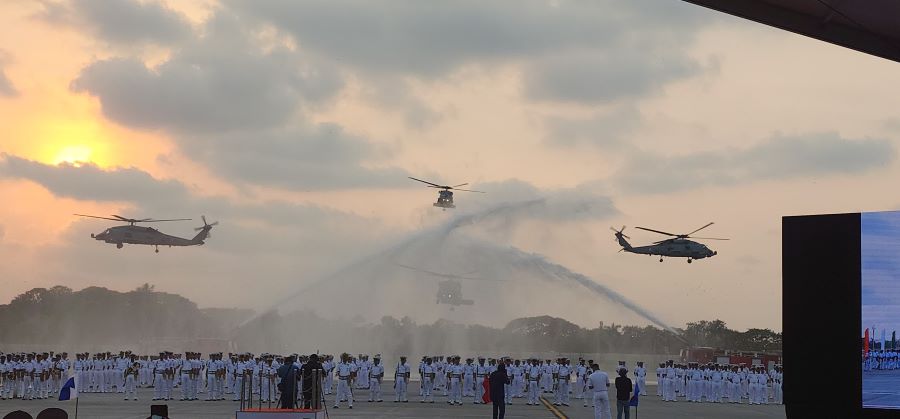
India ordered 24 Seahawks in 2020 for roughly $2.2 billion. Nine are currently in service, operating from Kochi, with the remaining aircraft slated to join the fleet by late 2025. The helicopters for India feature several India-specific systems, including mission-specific communication suites jointly developed with BEL and customised IFF transponders from HAL.
The U.S. had separately cleared a $1.17-billion package last year covering advanced radios, infrared sensors, external fuel tanks, software support and specialised ground equipment, an indication of the programme’s growing depth.
Strategic Significance: Beyond Maintenance
Although the new MoU is focused on sustainment, it carries strategic weight.
Enhances India’s underwater domain awareness
The Indian Ocean’s central shipping lanes are increasingly being shadowed by foreign submarines. The MH-60R, when properly sustained, provides India with reliable ASW coverage across wide stretches of sea.
Reinforces India–U.S. defence cooperation
Sustainment deals often reflect long-term trust. Unlike one-time purchases, they bind militaries together operationally and technologically.
Complements India’s shipbuilding plans
The Navy’s next-generation destroyers, frigates and aircraft carriers are being designed with the Romeo in mind, making its availability crucial to future fleet architecture.
Both sides are now preparing for implementation, which will require American specialists to help set up repair infrastructure and train Indian technicians. The Navy’s focus is on synchronising the new sustainment pipeline with the arrival of the remaining helicopters, ensuring the entire fleet reaches full operational capability by the end of the decade.
Team BharatShakti