


Global demand for weapons reached new highs in 2024, but China’s defence giants bucked the trend with sharp revenue declines, according to the latest annual assessment released on 1 December by the Stockholm International Peace Research Institute (SIPRI).
The SIPRI Top 100 ranking shows arms and military services revenues rose 5.9% worldwide to a record $679 billion in 2024. Yet Asia and Oceania were the only regions to record a fall, driven almost entirely by a 10% drop among China’s eight leading arms companies, whose combined revenues slid to roughly $88 billion.
The starkest fall came at NORINCO, China’s primary producer of land systems, whose arms revenues plunged 31%, the largest drop for any major company in the region. SIPRI directly linked the decline to turmoil inside China’s defence establishment.
“A host of corruption allegations in Chinese arms procurement led to major arms contracts being postponed or cancelled in 2024,” said Nan Tian, Director of SIPRI’s Military Expenditure and Arms Production Programme. “This deepens uncertainty around the status of China’s military modernisation efforts and when new capabilities will materialise.”
Purges, Delays and Budget Strains Hit Chinese Defence Industry
China has been grappling with three overlapping pressures: Xi Jinping’s sweeping anti-corruption purge that has reached deep into the PLA’s procurement bureaucracy; a slowing economy forcing tough budget choices; and sluggish export demand.
The purges have triggered contract reviews and cancellations across multiple state-owned giants, including NORINCO, AVIC and CASC. More than 100 suppliers have reportedly been blocked from bidding for PLA contracts since last year, while several top research institutes have faced sanctions over alleged bid rigging and collusion, disrupting critical R&D pipelines.
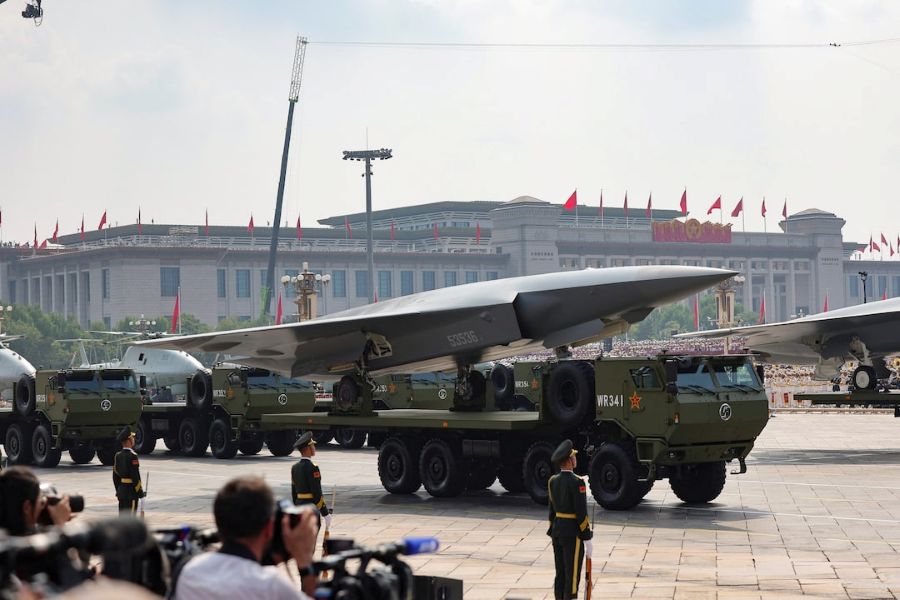
Even though Beijing’s military spending rose for the 30th consecutive year, estimated at $314 billion in 2024, analysts say fiscal pressures are forcing cuts in procurement, particularly for the ground forces. NORINCO’s slump suggests reduced orders for tanks, artillery and armoured vehicles, as resources shift to the Navy, Air Force and Rocket Force in line with a Taiwan-focused strategy.
Exports Weaken as Buyers Shift to South Korea
China remains the world’s fourth-largest arms exporter overall, but its market appeal is weakening. Many Chinese designs trace their lineage to Russian systems, whose battlefield performance in Ukraine has hurt confidence among foreign buyers. Several countries have also raised concerns about quality and after-sales support.
Meanwhile, South Korean and Japanese firms are booming. SIPRI data show:
- Japanese firms (five companies) grew arms revenues 40% to $13.3 billion.
- South Korean firms (four companies) rose 31% to $14.1 billion, powered by strong European demand.
- Hanwha Group, South Korea’s largest defence firm, posted a 42% surge in revenues, with more than half coming from exports, largely due to multibillion-dollar deals with European partners.
The rise of Korean suppliers, particularly in NATO markets, has eroded the competitive space traditionally occupied by Russian and Chinese firms.
China’s Slowdown Could Delay Xi’s Modernisation Timelines
Only two major Chinese companies, China State Shipbuilding Corporation (CSSC) and the Aero Engine Corporation of China (AECC, reported growth in 2024, both in high single digits.
The combined impact of corruption purges, contracting delays, fiscal strain and shrinking export demand is expected to slow Beijing’s military modernisation drive. Analysts warn that this may push milestone targets, such as achieving the capability to coerce or seize Taiwan, beyond earlier timelines associated with the 2027 horizon.
Despite China’s long-term ambitions, SIPRI notes that “uncertainty” has now become a defining feature of its defence industrial outlook.
Ravi Shankar

Dr Ravi Shankar has over two decades of experience in communications, print journalism, electronic media, documentary film making and new media.
He makes regular appearances on national television news channels as a commentator and analyst on current and political affairs. Apart from being an acknowledged Journalist, he has been a passionate newsroom manager bringing a wide range of journalistic experience from past associations with India’s leading media conglomerates (Times of India group and India Today group) and had led global news-gathering operations at world’s biggest multimedia news agency- ANI-Reuters. He has covered Parliament extensively over the past several years. Widely traveled, he has covered several summits as part of media delegation accompanying the Indian President, Vice President, Prime Minister, External Affairs Minister and Finance Minister across Asia, Africa and Europe.