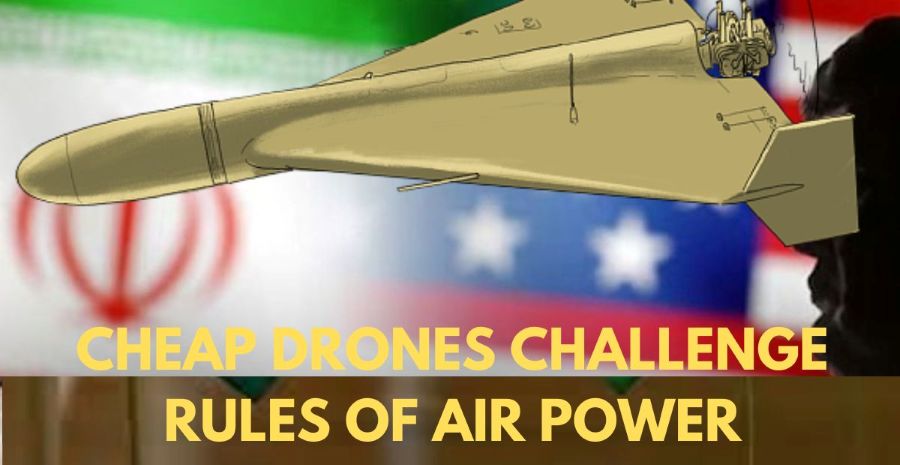
For decades, control of the skies largely belonged to wealthy militaries able to afford sophisticated fighter aircraft, complex air-defence systems, and the training needed to operate them. That advantage is now being challenged by a far cheaper weapon: the attack drone.
Across multiple conflicts, from Ukraine’s battlefield with Russia to Iran’s escalating confrontation with the United States and Israel, large numbers of inexpensive unmanned aircraft are reshaping the character of modern warfare.
The shift is not about technological superiority but scale. Cheap drones launched in large numbers are proving capable of overwhelming even the most sophisticated air-defence networks, forcing militaries to confront an uncomfortable reality: attacking the skies has become far cheaper than defending them.
Iran’s Drone Barrages
Iran has spent years developing and exporting unmanned aerial systems to regional allies. It is now deploying them on an unprecedented scale.
Since the United States and Israel carried out strikes on Iran on February 28, Tehran has launched hundreds of missiles and more than a thousand drones against Israel and several Gulf states aligned with Washington. The strategy relies less on precision strikes and more on saturation, large waves of drones and missiles designed to exhaust air defences.
According to the Institute for National Security Studies’ Data Analytics Centre in Israel, Iran launched 227 waves of attacks on Israel between February 28 and March 15, including over 290 ballistic missiles and about 500 drones.
Gulf states have also faced heavy barrages. No country has been hit harder than the United Arab Emirates, which by mid-March had been targeted with an estimated 309 missiles and roughly 1,600 drones.
The UAE says it has intercepted more than 90 per cent of incoming threats. Official figures from the country’s Ministry of Defence show that by the thirteenth day of fighting, its air defences had shot down 268 ballistic missiles, 15 cruise missiles and 1,514 drones. However, the attacks still caused casualties and infrastructure damage.
For Tehran, striking the Emirates serves multiple strategic goals: applying pressure on Washington, disrupting global energy flows, unsettling financial markets and targeting a country that has positioned itself as the Gulf’s main hub for finance, logistics and aviation.
The Economics of Drone Warfare
The drones themselves are remarkably cheap.
Iran’s widely used Shahed-series attack drones are estimated to cost between $20,000 and $50,000 each, according to the Centre for Strategic and International Studies. That is a tiny fraction of the cost of the missiles often used to intercept them.
The imbalance has become a growing concern for Western militaries.
“If we’re shooting down a $50,000 one-way drone with a $3 million missile, that’s not a good cost equation,” Bill LaPlante, the Pentagon’s chief weapons buyer, told a U.S. Senate subcommittee in 2024.
The scale of the challenge is equally striking. In the first week of the current conflict alone, Iran launched more than 1,000 drones, and analysts estimate the country could produce up to 10,000 drones a month.
Lessons from Ukraine
The transformation of warfare was first visible on the battlefields of Ukraine.
What began as a conventional war dominated by tanks and artillery has increasingly become a contest fought by drones. Outmatched in aircraft and armour, Ukrainian forces turned to inexpensive unmanned systems for reconnaissance, targeting and attack.
Military analysts estimate that drones now account for roughly 70 per cent of Russian battlefield casualties, allowing strikes to be conducted remotely while reducing risks to pilots and crews.
The conflict has highlighted a new military concept: “precise mass.” Instead of relying solely on a small number of highly sophisticated weapons, militaries are increasingly deploying large numbers of cheaper precision systems.
These drones are taking on roles traditionally performed by more expensive platforms. Some function like artillery shells or cruise missiles. Others perform surveillance missions once carried out by aircraft, while still others act as bombers or maritime strike systems.
Individually, such systems may be less capable than high-end platforms such as fighter jets or submarines. But when fielded in large numbers, they can deliver enormous striking power at a fraction of the cost.
A Strategic Cost Imbalance
The economic logic of warfare is shifting.
A modern fighter aircraft requires years of pilot training and costs tens of millions of dollars. If one is shot down, the loss includes not just the aircraft but potentially the trained crew.
By contrast, many attack drones are remotely piloted or autonomous. If one is destroyed, the operator survives, and the replacement cost may be only tens of thousands of dollars.
This asymmetry is creating what defence planners increasingly describe as a cost-imposition problem: the attacker spends little while the defender spends vastly more.
The imbalance is already visible at sea. Since late 2023, the U.S. Navy has spent around $1 billion in munitions defending ships in the Red Sea from drone and missile attacks launched by Houthi forces.
And the price of the interceptor missile is only part of the equation. Each interception also depends on warships, radar networks, intelligence systems, fuel, maintenance and trained crews.
The United States Plays Catch-Up
Recognising the shift, Washington is accelerating its own drone programmes.
The Pentagon has moved to fast-track development of small, low-cost systems such as the FLM-136 Low-Cost Uncrewed Combat Aerial System (LUCAS). The drone resembles Iran’s Shahed-136, a one-way attack system that Russia has widely used in Ukraine.
In July 2025, U.S. War Secretary Pete Hegseth issued a directive titled “Unleashing U.S. Military Drone Dominance,” ordering the Pentagon to streamline procurement and rapidly expand drone deployment across the armed forces.
The directive warned that adversaries were producing drones in the millions while U.S. programmes remained slowed by traditional acquisition processes.
The Search for Cheaper Defences
Militaries are now racing to find more affordable ways to stop the growing drone threat.
New counter-drone technologies include electronic jammers, interceptor drones, and high-energy lasers designed to destroy targets at the speed of light – many promise to reduce costs by relying on electricity or reusable platforms rather than expensive missiles.
But most of these systems are still emerging from testing and remain limited by range, power requirements or weather conditions.
Until they mature, armed forces will continue to rely largely on conventional air-defence missiles to stop incoming drones threatening cities, bases and ships.
The central question now confronting militaries is whether defensive technology can evolve quickly enough and cheaply enough to keep pace with the rapidly expanding world of attack drones.
Ravi Shankar

Dr Ravi Shankar has over two decades of experience in communications, print journalism, electronic media, documentary film making and new media.
He makes regular appearances on national television news channels as a commentator and analyst on current and political affairs. Apart from being an acknowledged Journalist, he has been a passionate newsroom manager bringing a wide range of journalistic experience from past associations with India’s leading media conglomerates (Times of India group and India Today group) and had led global news-gathering operations at world’s biggest multimedia news agency- ANI-Reuters. He has covered Parliament extensively over the past several years. Widely traveled, he has covered several summits as part of media delegation accompanying the Indian President, Vice President, Prime Minister, External Affairs Minister and Finance Minister across Asia, Africa and Europe.