






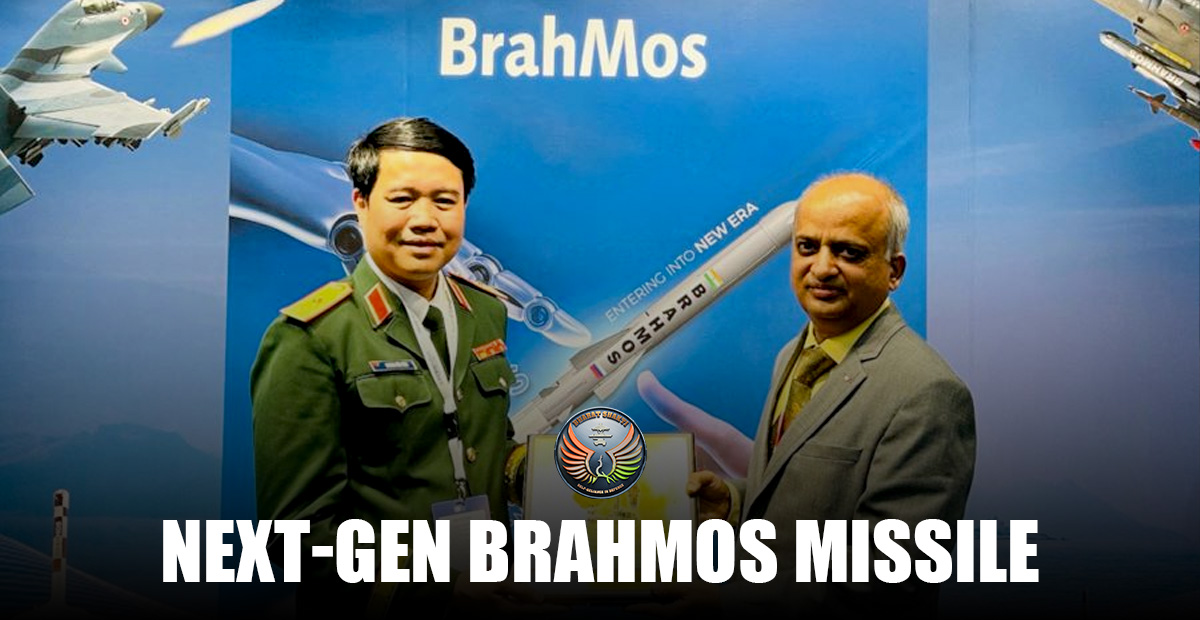
Vietnam has emerged as the latest country seeking to acquire India’s battle-tested BrahMos supersonic cruise missile, signalling a wider shift among Asian militaries towards diversifying away from traditional Western defence suppliers and investing in systems proven in real combat conditions.
Both countries are currently in advanced negotiations for a deal valued at nearly Rs 6000 crore. These discussions reaching logical conclusion following during Vietnamese President To Lam’s recent visit to India. During this trip, Lam met with Prime Minister Narendra Modi, Defence Minister Rajnath Singh, and other senior Indian officials.
If concluded, Vietnam would become the third foreign operator of the BrahMos system after the Philippines, which signed a US$375 million contract in 2022, and Indonesia, which agreed earlier this year to move ahead with a deal estimated at over US$340 million.
Indian officials have stopped short of formally announcing an agreement but have acknowledged ongoing discussions. “We do talk about the number of platforms, BrahMos platform is one of them … watch this space,” P. Kumaran, Secretary (East) in India’s Ministry of External Affairs, said while briefing reporters.
The growing interest in BrahMos marks a significant milestone for India’s defence exports. For many years, the missile was primarily seen as a major strategic asset intended solely for India’s military needs. However, this perception changed dramatically after “Operation Sindoor” in May 2025, when India deployed BrahMos missiles during retaliatory strikes against Pakistan in response to the Pahalgam terror attack that claimed the lives of at least 26 civilians.
Military analysts say the operation transformed the missile’s global standing by demonstrating its ability to penetrate active air defence systems in a live combat environment. Unlike weapons tested only during exercises, BrahMos had now been “bloodied” in operational conditions – a factor that carries enormous weight in defence procurement circles.
Its appeal lies in a combination of speed, survivability and versatility. While the US-made Tomahawk cruise missile travels at around Mach 0.8, the BrahMos supersonic cruise missile flies at speeds exceeding Mach 3. The missile’s high velocity, coupled with low-altitude flight profiles, drastically reduces enemy reaction time and complicates interception efforts, especially during coordinated salvo attacks.
Strategic experts say this capability is particularly attractive for Southeast Asian nations increasingly wary of China’s expanding military footprint in the South China Sea and wider Indo-Pacific region. Several ASEAN countries are now reassessing their deterrence capabilities amid rising regional tensions and uncertainty over long-term American security commitments.
For many of these countries, BrahMos offers a rare combination: a high-end precision strike system without the political baggage often associated with Western military sales. Developed jointly by India’s Defence Research and Development Organisation and Russia’s NPO Mashinostroyeniya, BrahMos sits outside the conventional NATO-linked defence supply chain.
That positioning has widened its appeal beyond Southeast Asia. Countries reportedly evaluating the missile include Thailand, Singapore, Brunei, Egypt, Saudi Arabia, the United Arab Emirates, Qatar, Oman, Brazil, Chile, Argentina and Venezuela.
For India, the missile’s export success represents more than a commercial breakthrough. It reflects New Delhi’s broader ambition to evolve from one of the world’s largest arms importers into a credible exporter of advanced military systems.
India’s defence exports touched a record US$4.6 billion in 2025-26, marking a sharp year-on-year increase, with BrahMos Aerospace emerging as one of the biggest contributors. Export contracts reportedly accounted for nearly US$480 million of the company’s revenues during the period.
The Vietnam negotiations also align closely with India’s long-running “Act East” policy, which seeks deeper strategic and security engagement with ASEAN nations. Alongside the BrahMos talks, India has also offered maintenance, repair and overhaul support for Vietnam’s Russian-origin Su-30 fighter aircraft and Kilo-class submarines, platforms already supported through Indian training programmes.
Ravi Shankar
Dr Ravi Shankar has over two decades of experience in communications, print journalism, electronic media, documentary film making and new media.
He makes regular appearances on national television news channels as a commentator and analyst on current and political affairs. Apart from being an acknowledged Journalist, he has been a passionate newsroom manager bringing a wide range of journalistic experience from past associations with India’s leading media conglomerates (Times of India group and India Today group) and had led global news-gathering operations at world’s biggest multimedia news agency- ANI-Reuters. He has covered Parliament extensively over the past several years. Widely traveled, he has covered several summits as part of media delegation accompanying the Indian President, Vice President, Prime Minister, External Affairs Minister and Finance Minister across Asia, Africa and Europe.