






At first glance, climate change and military preparedness appear to belong to two completely different conversations. One deals with rising temperatures and emissions targets; the other focuses on national security and combat readiness. But for India’s defence establishment, the overlap between the two is becoming impossible to ignore.
Military exercises consume enormous quantities of fuel, ammunition, and logistical resources. Tanks, artillery systems, transport vehicles, and live-fire drills all come with a significant environmental footprint. As fuel prices fluctuate globally and climate-related disruptions become more frequent, defence planners are beginning to reconsider how armies train for future conflicts.
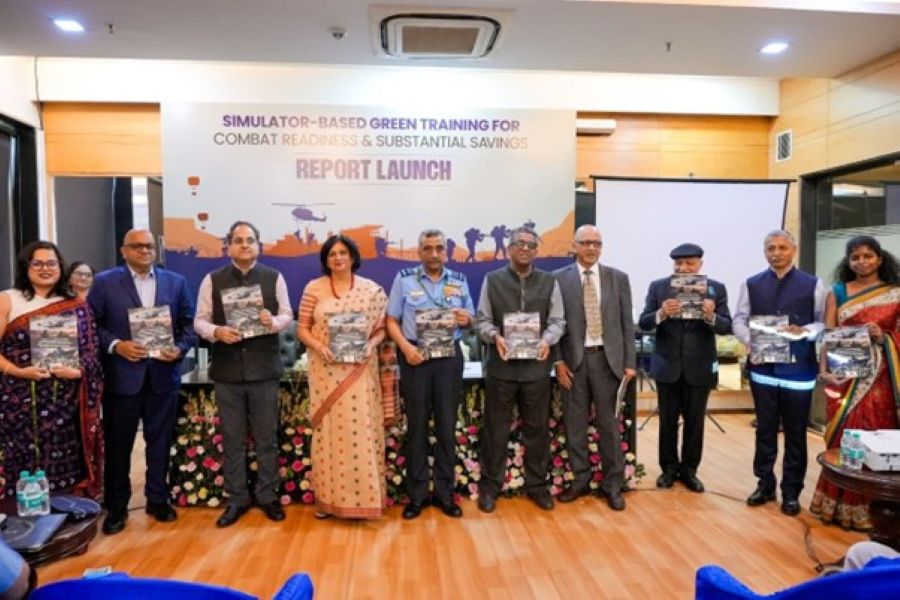
A new report released by The Energy and Resources Institute (TERI) earlier this week argues that simulation technology could become one of the most effective tools in addressing this challenge.
The study, released on Tuesday at the Constitution Club of India in New Delhi, examines the potential of simulator-based military training to reduce emissions and operational expenditure, and to improve training outcomes across the Indian Armed Forces. Rather than separating sustainability from defence modernisation, the report merges both objectives into a single strategic framework.
Training Without the Battlefield Costs Live exercises have been the foundation of military preparation for decades. Soldiers learnt by firing real ammunition, manoeuvring actual vehicles and operating under physically demanding field conditions. But modern warfare has changed. Tank crews can practice firing drills without deploying armoured vehicles. Air defence operators can engage simulated aerial threats repeatedly without consuming expensive resources.
The TERI assessment studies 13 such systems currently relevant to the Indian Armed Forces. These include simulators for infantry weapons, anti-tank guided missiles, artillery observation, air defence coordination, tank gunnery, and military driving operations.
According to the report, these systems are no longer just training accessories. They are becoming operational necessities.
Lt Gen V K Saxena, speaking during the report launch, captured this shift directly when he observed, “Simulator training is not a choice, it is the need of the hour for combat readiness.”
Why the Environmental Argument Matters
The environmental implications of military activity rarely enter mainstream public debate. Yet defence operations are heavily resource-intensive.
The report evaluates emissions generated during ammunition manufacturing, fuel combustion, troop movement, firing exercises, and transportation logistics. Using a life-cycle assessment framework, researchers calculated the greenhouse gas impact associated with conventional training methods.
The numbers are substantial.
Among the systems studied, the Infantry Weapon Training Simulator emerged as one of the largest contributors to the potential for emission reduction. At existing induction levels, the simulator is estimated to save nearly 13,000 tonnes of carbon dioxide equivalent annually.
Other systems, including tank crew simulators and missile-training platforms, also demonstrated considerable reductions in fuel consumption and emissions.
The larger argument, however, extends beyond environmental metrics.
Global geopolitical tensions over the past few years have repeatedly exposed the vulnerability of fuel supply chains. Rising oil prices directly affect military budgets. For armed forces dependent on continuous mobility and logistics support, reducing fuel-intensive activities has become strategically important.
Simulators as Strategic Assets
The discussion around simulator integration is no longer confined to technologists or defence manufacturers. Senior military officials increasingly view the transition as essential for long-term preparedness.
During the launch event, Air Marshal Ashutosh Dixit connected operational readiness with environmental responsibility, noting that the study examined not only battlefield effectiveness but also the “environmental and economic outcomes of simulator training.”
Dr Vibha Dhawan, Director General of TERI, highlighted the broader security dimension of the issue. “Energy security is as important as national security,” she said, while also highlighting how climate-related disasters increasingly place pressure on military resources.
Ashok Atluri, Chairman and Managing Director of Zen Technologies Limited, argued that modern systems can now digitally reproduce almost any combat environment. “India should set an example and lead the way in simulator integration in the training of armed forces,” he stated during the discussion.
Beyond Cost Cutting
Although the economic savings are significant, military experts argue that the biggest advantage of simulation lies elsewhere — repetition and precision.
Live ammunition exercises are expensive and often limited. In many cases, personnel may receive only occasional opportunities to train with certain weapon systems. Soldiers can go through drills in simulators over and over again, well before entering a live-fire environment. This repetition sharpens reflexes, muscle memory, coordination, and decision-making under pressure. Digital systems also improve safety in the learning environment. Mistakes made in a virtual environment don’t carry the same consequences as errors made in a live combat exercise. Instructors can pause a session, debrief mistakes on the spot, and provide consistent feedback across units.
It also shows the value of real-time performance monitoring and data-driven assessment tools, areas expected to grow further with the integration of artificial intelligence.
However, large-scale adoption is not without complications, as advanced systems require continuous software upgrades, significant infrastructure investment, technical maintenance, and cybersecurity safeguards.
There is also a learning curve for personnel accustomed to traditional training methods.
Simulation-based training offers a way to conserve resources without weakening operational capability. It reduces emissions without compromising combat readiness. And in a world shaped increasingly by climate pressures and geopolitical uncertainty, that balance may become critical for future defence planning.
Team BharatShakti