


The Saudi Arabia-Turkey-Pakistan defence pact has opened a new strategic front that India will have to watch closely.
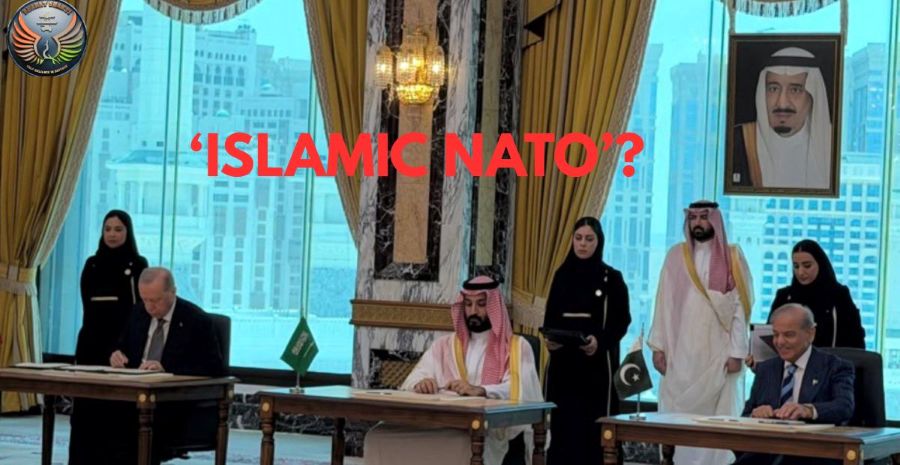
Signed in Mecca, the agreement says an armed attack on any one of the three countries will be treated as an attack on all. It also calls for enhanced defence cooperation. But the pact stops short of spelling out the military obligations that would follow such an attack.
That ambiguity could prove as important as the agreement itself.
India has responded cautiously. External Affairs Ministry Spokesperson Randhir Jaiswal said New Delhi was “closely following the development”. India had adopted a similar position when Saudi Arabia and Pakistan signed their mutual defence pact in September 2025.
For New Delhi, however, the bigger question is what the new trilateral framework could mean for Pakistan.
Former Foreign Secretary Kanwal Sibal, on an ‘X’ post, has described the pact as “a very negative development for Indian interests”. His concern centres on the collective-defence clause, which does not explicitly provide for consultations before one member responds to an attack on another.
That raises a difficult scenario for India. If Pakistan inflicts another major terrorist attack and India launches punitive strikes against terrorist or military targets, Islamabad could potentially attempt to invoke the pact and portray the Indian action as aggression against the three members.
“Does this mean that if, in response to a major terrorist attack by Pakistan, India responds. Will this be considered an attack against Saudi Arabia and Turkey?” Sibal asked.
The concern is compounded by the existing defence relationship between Turkey and Pakistan.
“Turkey is already arming Pakistan. Saudi Arabia can provide Pakistan financial resources,” Sibal said, urging Riyadh to clarify that the pact is not directed against India.
Former ambassador to the United Nations TS Tirumurti sees a broader regional shift.
“Türkiye, Saudi Arabia & Pakistan will benefit. Their ambitions and stock will rise to fill the regional space. This is not good news for India,” he said on ‘X’.
The timing makes the pact even more significant.
The agreement has emerged amid the wider regional confrontation involving Iran, Israel and the United States and growing fears over attacks on Gulf energy and maritime infrastructure. Saudi Arabia has a direct interest in strengthening its security architecture.
Turkey, meanwhile, brings a substantial defence-industrial base and Pakistan brings an established military relationship with Riyadh.
For India, the Turkey factor is particularly important.
During Operation Sindoor in May 2025, Turkey provided support to Pakistan, including assistance involving unmanned aerial vehicles (UAVs) and electronic warfare. That experience demonstrated that Ankara was prepared to back Islamabad during an India-Pakistan crisis.
The new pact could give such cooperation a broader institutional framework.
Strategic commentator Brahma Chellaney on social media ‘X’ has described the arrangement as a combination of “Saudi capital, Turkish defence technology and Pakistan’s strategic geography”. He also sees the potential for deeper intelligence sharing and joint defence research.
That does not mean Turkey or Saudi Arabia would automatically fight India alongside Pakistan.
The agreement’s military mechanism remains untested. Its practical response to an actual conflict is also unclear.
But deterrence is often shaped by uncertainty.
For India, the concern is that a future crisis with Pakistan could no longer remain confined to the traditional India-Pakistan military equation. Turkish military assistance and Saudi financial and strategic backing could introduce additional variables into escalation calculations.
The maritime dimension is equally important.
The three countries occupy positions along strategically important routes linking the Arabian Sea, Gulf and Mediterranean. Any deeper coordination among them could have implications for maritime security, intelligence and access to critical sea lanes.
India will therefore need to look beyond the “Islamic NATO” narrative.
The more immediate challenge is practical: preventing an emerging Turkey-Pakistan-Saudi defence relationship from becoming an additional military and diplomatic constraint during a future India-Pakistan crisis.
New Delhi’s response will require more than public statements. It will mean deeper engagement with Saudi Arabia, Turkey’s regional competitors and key maritime partners, alongside stronger naval surveillance, intelligence networks and defence preparedness.
The Mecca pact may not yet be a NATO-style military alliance.
But it has brought three strategically important countries closer together at a time when the regional security order is already being reshaped.
For India, that alone is reason enough to pay close attention.
Ravi Shankar

Dr Ravi Shankar has over two decades of experience in communications, print journalism, electronic media, documentary film making and new media.
He makes regular appearances on national television news channels as a commentator and analyst on current and political affairs. Apart from being an acknowledged Journalist, he has been a passionate newsroom manager bringing a wide range of journalistic experience from past associations with India’s leading media conglomerates (Times of India group and India Today group) and had led global news-gathering operations at world’s biggest multimedia news agency- ANI-Reuters. He has covered Parliament extensively over the past several years. Widely traveled, he has covered several summits as part of media delegation accompanying the Indian President, Vice President, Prime Minister, External Affairs Minister and Finance Minister across Asia, Africa and Europe.