



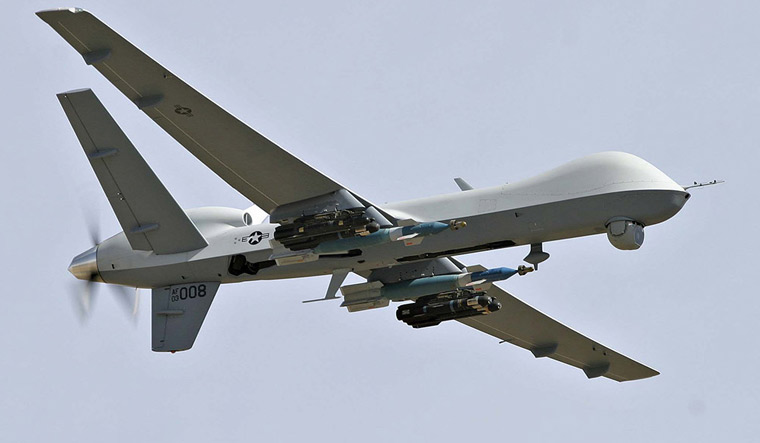
India has signed a Rs 1,943 crore ($203 million) contract with US defence major General Atomics Aeronautical Systems Inc. (GA-ASI) to lease two MQ-9B Sea Guardian high-altitude long-endurance (HALE) remotely piloted aircraft for the Indian Navy for 30 months.
The lease is aimed at strengthening the Navy’s maritime domain awareness and its ability to maintain persistent surveillance over large stretches of the Indian Ocean.
The Ministry of Defence said the MQ-9B Sea Guardians, equipped with advanced sensors and payloads, would provide persistent intelligence, surveillance and reconnaissance (ISR) coverage over vast maritime areas.
The systems will strengthen India’s ability to monitor and respond to developments across the Indian Ocean Region, it said.
The lease comes amid an intensifying strategic contest between India and China for influence and maritime presence across the Indian Ocean. The two MQ-9Bs will enhance the Navy’s long-range surveillance capabilities at a time when monitoring Chinese naval activity and shipping movements has become more important.
India had earlier leased two MQ-9A Sea Guardian drones from General Atomics in 2020 for one year. The lease was subsequently extended.
New Delhi has also been pursuing a larger acquisition of armed HALE drones from the United States. In 2024, India signed an agreement with the US to procure 31 MQ-9B drones, comprising Sea Guardian and Sky Guardian variants, for the three armed forces.
The MQ-9B is designed for long-endurance missions and can operate at high altitudes while carrying a range of surveillance and other mission payloads.
The latest lease will provide the Navy with additional unmanned surveillance capacity without waiting for the delivery of the larger MQ-9B acquisition programme.
For the Indian Navy, drones are particularly significant given the sheer expanse of the maritime area to be monitored. Persistent unmanned surveillance can help bridge gaps between satellite imagery, manned aircraft and warship-based sensors.
The move also reflects the Navy’s growing emphasis on unmanned systems for maritime ISR as India seeks to strengthen its ability to maintain round-the-clock awareness of activity across critical sea lanes and the wider Indian Ocean.
Team BharatShakti