



Editor’s Note
The debate over air power superiority is currently a hot topic, especially in light of the ongoing conflicts in Ukraine and Iran. The evolving battlespace increasingly favours the use of missiles and drones, as well as resilience, rather than relying solely on early air superiority. The author argues that military doctrine must adapt by shifting its focus from seeking dominance to ensuring survivability and sustained denial.
One might recall footage of air combat circulating on social media in the early months of the Ukraine war. While many were really video grabs from high-fidelity simulators, many were real footage of dogfights and strikes. Such footage is now rare, both from Ukraine and Iran, an absence not incidental but reflecting a deeper transformation: not the disappearance of airpower, but the erosion of its visible and decisive dominance.
Most twentieth-century air doctrine had evolved on the assumption that various grades of air superiority were achievable, and a linear progression from suppressing enemy air defences, through establishing adequate control of the skies, to exploiting that control for operational and strategic effect was widely accepted.
However, this orthodoxy has been questioned in recent conflicts, in what is best described as Mutual Air Denial (MAD), neither side can sustain air operations due to capable, resilient, and adaptive denial systems.
Doctrine Under Strain
The opening phases of the war against Iran appeared to validate the sequential model, just as the Israeli operations in 2025, which dismantled key elements of Iran’s air defence network, enabling rapid aerial dominance. Yet the superiority achieved was not translated into strategic finality, a doctrinal erosion first evident in Ukraine.
Ukraine: The Denial Equilibrium
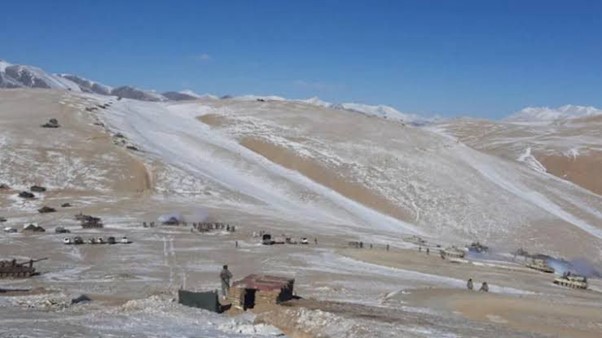
Russia failed to sustain air superiority over Ukraine despite significant advantages in aircraft systems, due to the proliferation of layered air defence that was ephemeral, given its mobility and rapid regeneration. Even the littoral air was difficult due to the proliferation of MANPADs and automatics. Russian aircraft could fly only at the edge of survivability, with only brief windows for close air support, while strikes from stand-off distances had a reduced impact. Not much empirical data is available on the reverse of the situation, but in the impasse, airpower is highly constrained, making cheaper options like drones attractive. Ukrainian drones have scored significant strikes on Russian targets, some so much in depth that the drones were smuggled in first.
The Israel–US War on Iran and the Fifth Generation Paradox
The ongoing US–Israel–Iran war complicates this pattern. Israeli and American forces achieved rapid air dominance in the beginning, as less integrated and previously degraded Iranian air defences proved unable to prevent penetration strikes. Yet, rather than an airpower-driven collapse, other countervailing dynamics emerged. Iran shifted from defending its airspace to sustaining retaliatory capacity with missiles and drones, which, given a highly dispersed launch network, were difficult to interdict. US–Israel defensive systems grew strained as leakages became significant, and anxiety spiked about depleting stockpiles and sustenance.
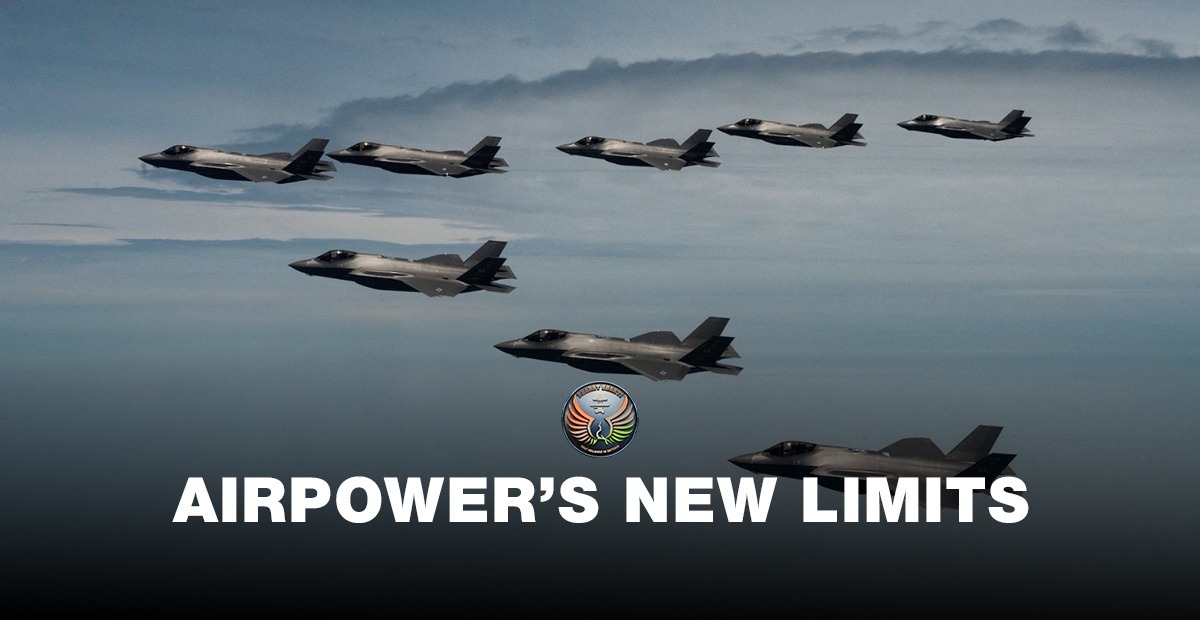
The most telling development has been the experience of fifth-generation aircraft, platforms designed to restore decisive air superiority through stealth, sensor fusion, and networked warfare. While these strengths were demonstrated in several air-to-air engagements, their limits have been exposed by credible indications of near-loss events, reflecting the reality that even fifth-generation platforms are neither invisible (to radar, as claimed) nor invulnerable in the dense, adaptive air defence environment. It reflects not simply the failure of technology but the limits of platform-centric approaches in a saturated air defence environment, the importance of which must be kept in mind during future development or procurement planning.
From Doctrine to Condition: Mutual Air Denial
A recent article by an air warfare practitioner correctly highlighted that, as a defensive strategy, air denial does not supplant air superiority as a paradigm—winning wars require offensive action. However, the passage only mentions air denial, leaving the operative word mutual—each side preventing the other from using the air. Also, the author’s saying that the paradigm is ‘best suited to an inferior side’ implies the use of comparatively inexpensive air defence weapons.
But superior sides and technology are equally able to deny air, extreme-range airborne radars and missile systems can lock on to enemy aircraft while still far beyond the battlespace, causing psychological pressure to break off. Such Mutual Air Denial (MAD) has manifested across Ukraine and the Iran war, preventing stronger sides from achieving sustained air superiority and questioning the continued relevance of airpower’s classical role as a decisive instrument.
Wargaming the present and the near future
Possibilities of a fundamental shift in air doctrine were examined via wargaming; several domain experts played multiple runs of a manual, board game based on the Israel–US–Iran war, which adapted the air and missile modules of a board wargame designed to explore the geopolitical and strategic–operational realms of Indo–Pakistan conflict. The game threw up several emergences that not only matched current conflicts but also were highly indicative of the future.
Emergent Outcome 1: Ubiquity of Denial
The selected modules were at the strategic–operational level, where primary concerns are the allocation of air effort across sectors and roles (counter air operations, counter-surface forces operations, strategic strikes). They calculate the air situation as a ratio of the air effort allotted to counter-air operations by each side, modified by the presence of air defence, which probabilistically affects other airborne operations.
It was consistently observed that the density of air defence, especially when layered, mobile, and supported by persistent ISR, led to impasses where both sides could barely operate, except in fragile, localised air windows. This situation differs from the concept of a favourable air situation, wherein localised and temporary air superiority is assumed to be achievable at any chosen time.
Emergent Outcome 2: Question of Efficacy of Fifth Generation Fighters
The feature of advanced aircraft, including fifth-generation systems, being able to lock on to fighters from great ranges denied air players the freedom to operate. Even advanced aircraft could only operate at the edges of survivability, with air capability progressively damaged though not immediately lost, making little overall difference to the course of the war. Such developments, as observed in Iran, must not immediately undermine the reputation of fifth-generation fighters, but air force planners must integrate them with robust ISR and electronic warfare systems to ensure their relevance.
Emergent Outcome 3: Increasing Reliance on Unmanned Vectors
In the game, aircraft losses were not just attrition but had wide-ranging, multivariate effects, including on public perception and international reputation. It made players more concerned with using missile arsenals and drones (including swarms) to attrit targets, supported by intense ISR to assess damages, and reluctant to commit manned aircraft. This likely situation aligns with India’s emphasis on indigenous drone and missile capabilities under initiatives such as Make in India.
Emergent outcome 4: Required Resilience of AD and Air
The game modelled the mobility and detection parameters of air defence systems to realistically portray the difficulty of suppressing them. In all runs, air defence was suppressed only after prolonged attrition and depletion of stockpiles. Participants felt that this might reflect realistic behaviour and that an opportunity for air operations might open later in the campaign, rather than the traditional expectation of early air use.
Also, with little to no close air support available to surface forces, they would have to rely on long-range support fire from missiles and drone swarms. It necessitates joint doctrines to ensure alternative fire-support mechanisms for land forces in air-denied environments.
Conclusion
In all runs of the games, despite the rules not being geared against air, it was drones and missiles that came to dominate, while manned sorties declined. It was an emergent behaviour, due in this case to the heavy negative impact of losses, with cost-exchange ratios favouring denial strategies. Such outcomes align with doctrinal expectations and empirical observations, suggesting that air superiority is no longer an immediate foundation for victory, and that air forces must plan for survival and persistent denial rather than rapid dominance.
For India, this necessitates greater emphasis on integrated air defence networks, scalable unmanned systems, and resilient industrial supply chains capable of sustaining prolonged, high-tempo conflict. Airpower shall endure, but in the new, harsher ecology, it must be far more resilient to guarantee survivability.
Colonel Saikat Bose (Retd) (The author is a wargame designer and military historian)

Colonel Saikat Bose (Retd) (The author is a wargame designer and military historian)