


Editor’s Note
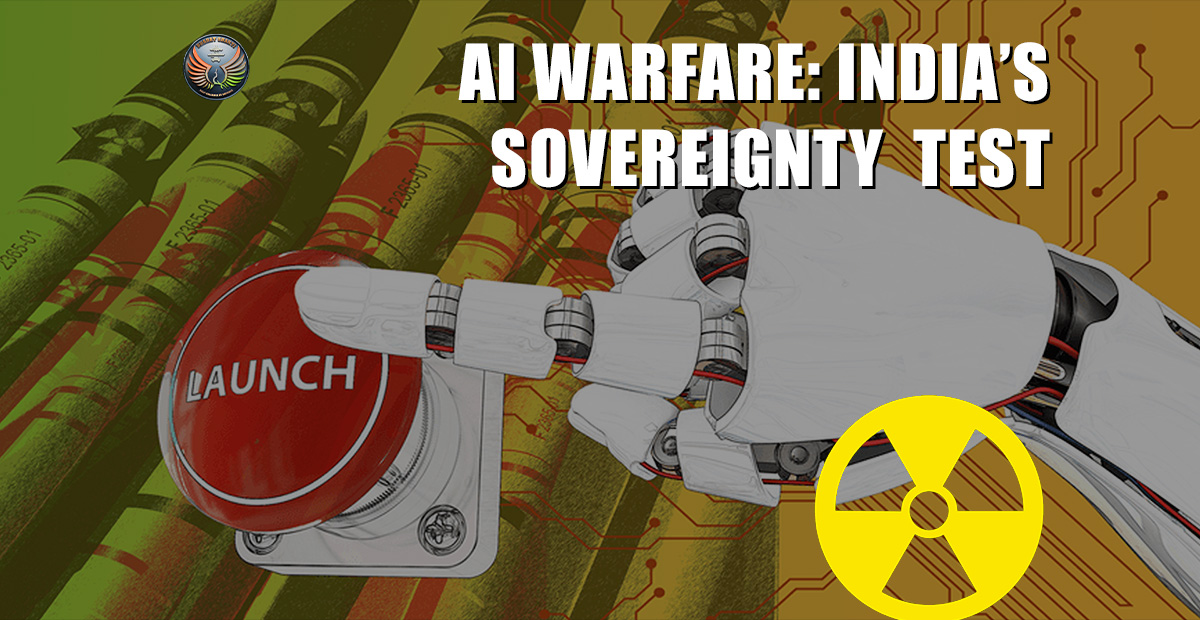
The piece argues that AI is reshaping warfare and sovereignty, placing India at a crucial juncture. Future conflicts will hinge as much on data and algorithms as on physical force. It warns that relying on civilian tech adaptation for defence could create vulnerabilities. The author calls for a shift to defence-led innovation and stronger control over AI capabilities. Without urgent reforms, India risks losing strategic autonomy in an AI-driven world.
AI in Defence
Security is the first principle of any system—be it a home, an organisation, or a Nation. In the age of artificial intelligence, this principle is being stress-tested at an unprecedented scale. AI is not a future disruptor – it is a present force reshaping warfare, economics, and sovereignty itself. The central question is no longer whether AI will impact national defence—it already has—but whether nations like India are structurally prepared for a world where defence is fundamentally AI-driven.
Modern conflict is no longer confined to battlefields. A war thousands of kilometres away can ripple into everyday life in Chennai. AI-enabled precision targeting, autonomous systems, and long-range strike capabilities mean that disruptions to oil infrastructure, shipping lanes, or supply chains can directly affect fuel prices, livelihoods, and economic stability. The Iran example is instructive: a sanctioned nation with a fraction of the defence budget of its adversaries has leveraged asymmetric technologies—drones, precision strikes, and operational ingenuity—to impose disproportionate costs. It is the new logic of warfare: cost asymmetry, precision, and persistence.
At the core of this shift is the expansion of the battlespace. Cyber warfare is no longer about firewalls and antivirus software. AI systems can identify vulnerabilities, exploit them, and adapt in real time—compressing what once took months into minutes. The response cannot be manual; it must be AI-driven defence. Similarly, perception warfare has become a primary domain. Social media, deepfakes, and algorithmic amplification are shaping narratives, influencing populations, and altering strategic outcomes without a single shot being fired. Sovereignty is no longer just territorial—it is cognitive.
Tech Diffusion versus Tech Infusion
This transformation aligns with a broader global pattern. In countries like the United States, DARPA has long ensured that defence sits at the frontier of technological innovation. China has institutionalised military-civil fusion, while Israel has built an ecosystem where battlefield requirements directly shape startup innovation. Even Russia continues to prioritise strategic technologies through state-driven defence R&D. In all these cases, defence is not a downstream user of technology—it is the primary driver. Technologies are born in military contexts and later scaled into civilian markets.
India’s trajectory has been the reverse. Our strengths, in whatever form, in AI and IT/Tech lie in the civil domain. Defence has remained relatively isolated, and we are now attempting to “infuse” civilian technologies into military systems, often through cost-driven procurement models like L1. This approach is inherently slow and misaligned with the demands of modern warfare, where resilience, security, and integration matter more than lowest cost.
The consequence is a structural lag. While Indian armed forces remain highly cost-effective and operationally experienced—having managed diverse conflicts and internal security challenges—the technological backbone required for AI-driven warfare is still evolving.
2 ½ Front is Land Front – We have Multi Front Challenges
The nature of conflict itself has changed: We do not have just a 2 ½ front – this is only in the Land Domain. Instead, we face a multi-front (multi-domain) environment—cyber, electromagnetic spectrum, space, and cognitive domains—where conflict is continuous rather than episodic. Peace and war have blurred into a state of constant competition.
AI sits at the centre of this transformation. It powers intelligence, surveillance, and reconnaissance (ISR) through massive data ingestion—from satellites, sensors, and open sources. It enables predictive modelling, decision support systems, and precision targeting. Autonomous swarms, electronic warfare, and non-kinetic operations are all increasingly AI-driven. Yet AI is not a standalone capability; it depends on an entire stack—semiconductors, operating systems, data infrastructure, and networks. Without control over this stack, sovereignty becomes fragile.
Tech Sovereignty
It raises a critical concern for India. If foundational AI technologies, platforms, and data pipelines are controlled externally, then decision-making autonomy is compromised. Whether it is surveillance data, agricultural intelligence, urban monitoring, or defence analytics, dependence on external systems introduces vulnerabilities. Sovereignty in the AI era is not just about borders—it is about owning the nation’s technological spine.
At the same time, AI presents an economic opportunity. Defence, historically, has been a driver of industrial growth in advanced economies. The United States and China have leveraged defence spending to build robust technology ecosystems. India can do the same—but only if defence is repositioned as a core pillar of technological and economic strategy, not a peripheral consumer.
It requires a shift from infusion to integration. Defence must shape technology development from the outset. Long-term procurement commitments, mission-driven R&D, and closer collaboration between the military, academia, and industry are essential. Platforms like Innovations for Defence Excellence are steps in the right direction, but they need scale, speed, and strategic clarity.
Governance and Policy
Equally important is talent and institutional capacity. India produces world-class engineers and researchers, many of whom power global AI ecosystems. The challenge is to harness this talent domestically to build sovereign capability. It includes creating “military technocrats”—professionals who understand both operational realities and advanced technologies.
There is also a governance dimension. AI models built for Western contexts may not address India’s unique socio-economic challenges. An “AI for India” approach must prioritise inclusivity, affordability, and local relevance. If AI becomes a tool that amplifies inequality or remains concentrated in a few global corporations, it could undermine both economic and strategic objectives.
The window for action is narrow. The pace of AI development suggests that the next three to five years will be decisive. Nations that establish control over AI infrastructure, data, and applications will define the rules of the emerging order—those who do not risk strategic dependency.
The reality is stark: the next generation of warfare is already underway. It is being fought in data centres, algorithms, and networks as much as on physical terrain. Deterrence is no longer just about nuclear capability or troop strength—it is about technological dominance and the ability to impose costs across domains.
For India, the choice is clear. Continue adapting civilian technologies for defence and risk falling behind, or build a defence-led technology ecosystem that drives both security and economic growth. In an AI-driven world, sovereignty will not be defended solely at borders; it will be secured through code, chips, and cognition.
Lt Gen Karanbir Singh Brar(Retd)