Editor’s Note
A year on, Operation Sindoor stands out as a rare instance where speed, precision and calibrated force delivered strategic effect without spiralling escalation. For the author, it reaffirmed that air power is not merely punitive – it can shape outcomes and compel restraint.
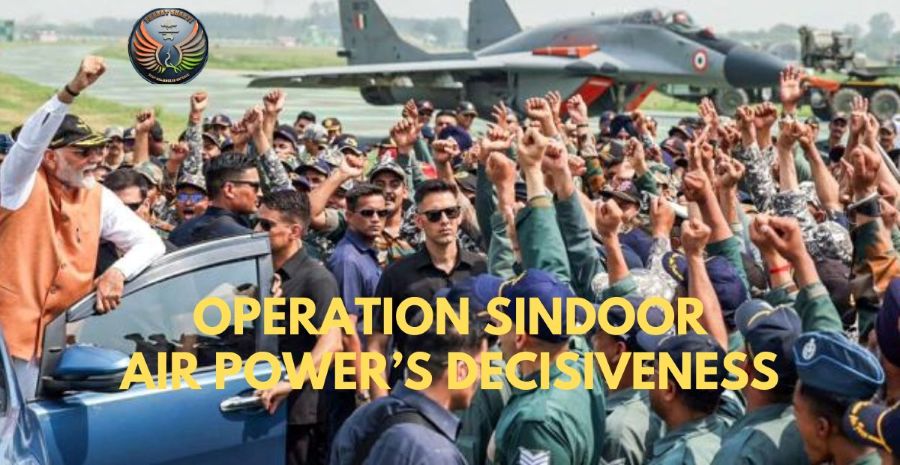
In retaliation for the gruesome killing of 25 Hindu males in Pahalgam on 22 April 2025, the Indian Air Force (IAF) decimated the terror hub centres operating from mainland Pakistan in just 22 minutes. Operation Sindoor, for which the entire nation stood together in unison, albeit for just a few days, chose the medium of air to be the best warfighting domain for defining a new normal.
The Union War Book of India mandates the responsibility for guarding India’s sovereign airspace to the IAF. The government’s strong political will, by giving the go-ahead for complete freedom to choose its own target in its own time and place of choosing, selected air power as the tool of statecraft to teach the perpetrators of heinous crimes.
10th May 2025 was a decisive day. It could have been either way. IAF, with its precision targeting of the western front on the intervening night of 9/10 May, created a strategic effect which brought down the Pakistani military and government to its knees to beg for a ceasefire within just 88 hours of IAF operations. Thanks to the military leadership’s impeccable display of Operational Art (Op Art). Had this not been the case, the day would have seen Pakistan annihilated with the lethality of air power, and the world would have seen further demonstration of the Op Art.
One may ask an air power practitioner what Bahawalpur and Muridke mean to them in this context. Striking Pakistan Air Force (PAF) airbases such as Sargodha, Nur Khan, Rafiqui, Muridke, Sukkur, etc, is a dream of every air warrior since the day one dons the blue uniform. The orchestration of air operations from the Command and Control Centre and witnessing a complete bird’s-eye view of PAF being made functionally paralysed with assets and psychologically from within, is an air warrior’s delight.
On Independence Day 2025, IAF air warriors were conferred with nine Vir Chakra, one Shaurya Chakra, four Sarvottam Yudh Seva Medal (SYSM), five Uttam Yudh Seva Medal (UYSM), 13 Yudh Seva Medal (YSM), 26 Vayu Sena Medal (VM) (Gallantry) and 162 ‘Mention-In-Despatches’ is the testament of such grit and glory.
These air operations in response to the religious killings were responded to by one religion of the defence forces, and that is the Indianness or Bhartiyata. One must not lose sight of the fact that the air warriors awarded with medals and ribbons are Hindus, Muslims, Sikhs and Christians. Thousands of unsung heroes who participated came from all religions and states. It, in itself, conveys a profound message of unity, which every citizen of this country should feel proud of.
To protect the sovereignty and territorial integrity, the Indian defence forces work on the instructions of the government of the day. The forces work on the single ideology of the ‘Nation First and Always.’ The IAF, despite its reduced inventory, has delivered much more than it could have and will continue to do so. Nevertheless, the IAF must be further strengthened, both qualitatively and quantitatively, on a war footing. Fighter aircraft depletion is the front end of shortages, but equal focus must also be on other enablers, orchestrators and pre-requisite essentials. No nation can be strong and prosperous without its robust hard power, as very rightly brought out ‘bhay binu hoyi na preet‘ (without fear, there is no love/respect).
Notwithstanding its resounding success, Operation Sindoor also brings the four Ns to the fore. It is about the Negativity, Nuisance, Narrative and Nuke Normal to the fore.
Negativity
Pakistan came into existence on 14 August 1947, founded based on religious identity. Within two months of its creation, the first military confrontation with India occurred in October 1947. Beyond the major declared conventional wars, the two countries have remained engaged in a persistent state of conflict through conventional wars, proxy wars and continued terrorism.
Militaries worldwide have their mottos to instil a sense of dedication and pride. The Indian Army, Navy and the Air Force’s respective mottos of “Service Before Self”, “Sham Nau Varunah” and “Nabhah Sparśam Deeptam”, embody secular, professional and constitutional values rooted in duty, restraint and honour. In contrast, Pakistan’s military adopts mottos such as “Iman, Taqwa, Jihad fi Sabilillah”, which inject religious ideology into military doctrine, promoting a worldview shaped by jihadist overtones and perpetual hostility. This ideological divide is not symbolic, but it has always translated into action.
General Munir’s overloaded religious and jihadi speech before and after the Pahalgam incident is a new overt tactic of spreading negativity for India under the guise of “Ghazwa-e-Hind“. Generally, militaries assess threats based on force vs force, but it is high time that India takes serious cognisance of such negativity as a new tool of threat perception.
Nuisance
A few years back, there was a significant shift in threat perception from the western to the northern adversary, although we maintained a two-front posture and preparedness. However, in the case of sovereignty, a threat remains a threat, no matter how minuscule it may be. Pakistan has a nuisance value and will retain it. The motive to ‘bleed India through a thousand cuts’ hasn’t diluted yet. Pakistan, instead of getting engaged in conventional conflict, has adopted nuisance warfare through effecting terrorism of various forms on Indian soil.
Operation Sindoor also showcased another form of nuisance warfare in the form of low-intensity drone waves targeted at the military and civil targets. Though every conflict brings a new form of warfare and surprises, drone nuisance is here to stay for at least a couple of conflicts. India will have to further strengthen its countermeasures by deploying long-range hard- and soft-kill options in a GPS-denied environment.
Narrative
Propaganda and Psy Ops have always been one of the essential tools of warfare, which often involves the spreading of misinformation, especially during the critical phases of war. Most of the time, it tends towards an unethical regime. Such unethical narrative building by Pakistan was revealed to the world as time passed, and it got badly exposed through their own information management.
Pakistan, from day one, tried to create a notion of victory through fake and AI-generated information warfare. The epitome was that Gen Munir not only elevated himself to the rank of Field Marshal, but he also decorated himself with the Hilal-e-Jurat, the country’s second-highest wartime gallantry award, within 10 days of the Operational pause on 10 May 2025.
However, the list of medal winners from Pakistan, announced on 14 August 2025, reveals around 138 ‘Shaheed‘ (martyr), which turned their own narrative on its head. The devastating effects caused by the IAF deep inside enemy territory were widely circulated on social media by the Pakistani diaspora itself, which were covered up by the Pakistani military media through cooked-up stories.
India, on the other hand, covered daily media bulletins through both symbolism and professionalism, culminating with the presser by the Director Generals of Operations of the three Services. However, were they adequate enough in the rapid tempo? India needs to be more proactive on this front and consider creating embedded journalism for such occasions.
Nuke Normal
Pakistan’s false bravado of talking about nuking India, launching their favourite Tactical Nuclear Weapons (TNW), annihilating the world’s half population, etc, has been put to an end with India laying down its conditions of the Operational pause of Operation Sindoor. The new normal defined by India has lowered the threshold for choosing conventional military options.
The precision bombing of Markaz Subhan Allah in Bahawalpur on 7th May 2025 produced an effect similar to the Governor’s House in Dhaka in 1971, which created a new country. Such symbolism should be a direct reflection of what it stores for the future. Apart from air-to-air and air-to-ground kills, the IAF’s standoff precision ground-to-air kill on a High Value Air Asset (HVAA) at a range of approximately 314 km is the longest successful kill range recorded in the world.
Any more misadventures like Pahalgam by Pakistan, which is most likely to have severe consequences through conventional means, and there will be no impact in the nuclear realm. The new normal will allow the diffusion of hostilities well below the nuclear threshold.
This 88-hour tri-services response is, of course, the new normal and has also become a classic case study not only for warfare practitioners but also for various constituents of comprehensive national power, especially the military and diplomacy. Right from the trigger point to taking political decisions, orchestrating warfare, pausing it with our own conflict termination criteria, and, on top of it, laying down the terms of reference for the next such conflict, is the key takeaway.
This case study should be included in the curriculum of military and diplomatic studies. Operation Sindoor will be remembered as the IAF’s ‘Shortest and Swiftest Precision War’, coercing the enemy into calling for a ceasefire. It has helped the proponents of air power and, once again, has broken the myth that air power is only escalatory. It reassures that Air power is not only escalatory but also controls and is decisive.
Gp Capt (Dr) Swaim Prakash Singh (Author is a Visiting Senior Fellow at the Centre for Aerospace Power and Strategic Studies)