


Editor’s Note
Amid the ongoing US-Israel-Iran war, this piece cuts through the noise around “machine wars” to make a harder point – technology may change how wars are fought, but not why they are fought. Drawing from Clausewitz theory and others, the author puts forward a strong argument that autonomy cannot erase politics from conflict. Avoiding boots on the ground in a conflict can lead to a loss of control and an increase in violence. In a crisis already defined by miscalculation and signalling, that is a dangerous proposition. The future may see fewer soldiers on the battlefield, but not necessarily less war.
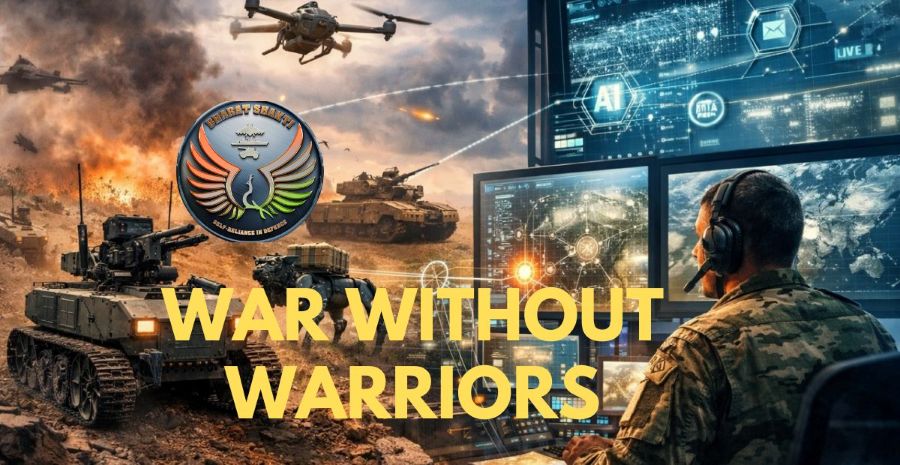
When the cost of war falls, the temptation to use it rises…The First Casualty of war is truth, the next will be human control….
The world is abuzz with claims that technology will fundamentally transform, if not transcend, war. From the good old machine gun to modern nuclear weapons and from the strategic bomber to the low-cost suicide drone, each innovation has been accompanied by predictions of either decisive dominance or the obsolescence of conflict. The current discourse around artificial intelligence (AI), machine learning (ML) and autonomous systems is no different, except in one crucial aspect. It contemplates the removal of humans from the battlefield.
It raises a foundational question. If humans are neither going to fight directly nor would there be human casualties because of direct contact, will war retain its original and essential nature? Or will it evolve into a form of managed competition, bereft of violence, as traditionally understood by theorists and the public alike?
Clausewitzian Nature and Character: Necessary Distinction
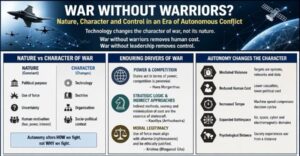
Military theorist Carl von Clausewitz, in ‘On War’, gives a classical discourse on the origins, conduct and logic of war. Clausewitz differentiates between two paradigms of the nature and character of war:-
- The nature of war is its enduring essence as a political instrument involving violence and uncertainty.
- The character of war is its changing form, shaped by technology, doctrine and context.
Clausewitz famously argues that war is ‘an act of force to compel the enemy to do our will’. This formulation is both instructive and normative. It does not specify the means of force, only its purpose and effect. Whether applied through swords, lances, muskets, missiles, tanks, aircraft, ships or machine learning algorithms, the logic remains intact. The key takeaway is that technology can transform how war is fought, but not why it is fought.
Morgenthau and Enduring Drivers of Conflict
Power, Fear, and Interest: Morgenthau’s Realist Theory holds that the roots of conflict lie in human nature and the eternal struggle for power. In ‘Politics Among Nations‘, he writes that states will act in terms of interest defined as power, and that this dynamic persists irrespective of technological change. When one posits this into a modern and futuristic world of autonomous systems, states will continue to:
- Compete for influence
- Guard against vulnerability
- Seek an advantage over rivals
What emerges is that technology may alter the balance of power, but not the existence of competition.
Kautilya’s Strategic Rationality and Indirect War
The Arthashastra offers a 2000-year-old perspective that echoes developments in contemporary warfare. Kautilya advocates indirect methods, covert operations, and minimising costs to improve warfare methodology.
In many ways, autonomous warfare represents the logical extension of this approach. It promises a reduced human risk, greater deniability and persistent engagement below the threshold of escalation. The Arthashastra echoes strains of modern hybrid warfare, creating asymmetric effects, and aligns closely with the emerging concept of autonomous warfare.
Krishna’s Moral Justification and Legitimacy
War is not only strategic but also moral. In the Bhagavad Gita, Krishna frames war as a duty aligned with dharma. His dialogue with Arjuna underscores that even when violence is necessary, it must be justified.
Autonomous warfare does not eliminate this requirement, and the absence of human involvement in direct physical contact may complicate the ethical calculus by obscuring emerging consequences. Something modern warfare calls collateral damage and the necessary evils of war.
Autonomous Warfare: Changing Character of War
The introduction of autonomous systems produces several interesting shifts in the conduct of modern warfare. In such a scenario, violence is normalised. It shifts from human bodies to systems and infrastructure, and becomes a tool of mass communication. Information becomes the tool and critical infrastructure, and data the new targets. The battlefield expands into the cyber and space domains, dissolving traditional frontlines and adding to the ubiquitous fog of war.
What naturally follows is that the cost of such a war appears reduced. The absence of casualties lowers domestic resistance, potentially making the use of force more politically acceptable.
This results in an unprecedented acceleration in the tempo of war. Algorithmic engagements compress decision cycles, placing pressure on command structures and increasing the risk of unintended escalation.
Finally, there is a growing psychological distance between society and conflict. The decoupling of violence and suffering represents a very significant transformation. Violence in traditional wars resulted in immediate suffering. However, in autonomous wars, violence will have indirect effects. People become less sensitive to consequences and thus may end up eroding restraint.
Despite these changes, war continues to remain political. Humans continue to determine objectives and end states, and, therefore, these changes remain within the realm of the character of war and not its nature.
Iran Imbroglio: Decapitation and the Question of Control
On the one hand, autonomy raises questions about execution, on the other hand, the removal of political leadership raises questions about control. Conventional wisdom has often treated leadership as a centre of gravity that, when eliminated, will result in systemic collapse. However, both theory and practice suggest otherwise.
Clausewitz’s framework cautions against such reductionism. War is sustained by a system of relationships, and never by a single entity. Remove leadership, and the system is most likely to adapt rather than disappear. It is exactly what is happening in Iran. From a realist perspective, as articulated by Morgenthau, interests endure beyond the level of individuals. Leadership may change, but the underlying drivers of conflict will forever persist.
Kautilya anticipated the need for resilient governance structures capable of surviving disruption. His teachings on delegation, redundancy, and covert continuity are evident in modern statecraft. When analysed empirically, leadership decapitation often results in the fragmentation of authority, escalation by subordinate actors and the ensuing prolongation of conflict. Therefore, rather than ending the war, it frequently removes mechanisms of restraint.
Autonomy and Decapitation: A Converging Risk
The convergence of autonomous warfare and decapitation of command authority produces a particularly unstable situation. Autonomous systems are designed to operate with limited human intervention. In the absence of leadership, strategic oversight significantly weakens, however, tactical systems continue to function (the mosaic strategy). The result is that escalation control becomes difficult.
It creates a new kind of conflict, one which is decentralised, persistent and extremely difficult to terminate. Clausewitz’s trinity offers a useful lens. With leadership degraded, the balance between its elements shifts, wherein,
- The people may become more emotionally charged
- The military (now autonomous) continues operating
- The government loses coherence
This imbalance increases volatility and reduces the possibility of controlled outcomes.
Modern Warfare: Implications for Strategy and Doctrine
The analysis yields several implications for strategic military leadership. Autonomy increases the likelihood of war. Lowering human cost may actually increase its frequency. Secondly, decapitation is not a reliable strategy for conflict termination. Thirdly, there is a critical need to maintain human control at the strategic level. Even as tactical execution becomes automated, political oversight must remain intact. Fourthly, military doctrine must adapt to the reality of persistent, low-visibility conflict, where war and peace are no longer clearly demarcated. And finally, ethical frameworks must evolve to address accountability in autonomous engagements.
The absence of direct human involvement does not absolve responsibility. Man-in-the-loop (MITL) and Man-on-the-loop (MOTL) are essential – complete autonomy is mayhem, with costs that could be catastrophic.
Conclusion
The main argument of this article is that autonomous warfare changes how wars are fought, but not why they are fought. The removal of human combatants reduces visible cost, but it does not eliminate the motivations that drive conflict. When combined with leadership decapitation, the risks multiply. War does not end – it becomes less controlled and more diffused.
To sum up, the enduring relevance of classical thought is both instructive and adaptive.
- Clausewitz reminds us that war is political
- Morgenthau highlights that it is driven by power
- Kautilya states that it is both strategic and adaptive
- Krishna stresses that it needs to be justified
Technology does not negate the value of these insights, rather, it amplifies their importance. The real danger, therefore, lies not in the disappearance of war, but in its normalisation because of reduced human cost and weakened control.
Gp Capt VP Naik (The author is currently serving as a Senior Fellow at the Centre for Aerospace Power and Strategic Studies)

Gp Capt VP Naik
Group Captain V.P. Naik is a fighter pilot of the Indian Air Force, commissioned in June 1999, with over 25 years of service across multiple operational and staff roles. An alumnus of the National Defence Academy, Defence Services Staff College, and College of Air Warfare, he has flown MiG-21 and MiG-29 fighters as well as transport aircraft. A recipient of the Vayu Sena Medal, he holds advanced degrees in defence and strategic studies, with research focused on information warfare and geopolitics. Currently, he is a Senior Fellow at the Centre for Aerospace Power and Strategic Studies, where he writes on air power, modern warfare, and international relations.