


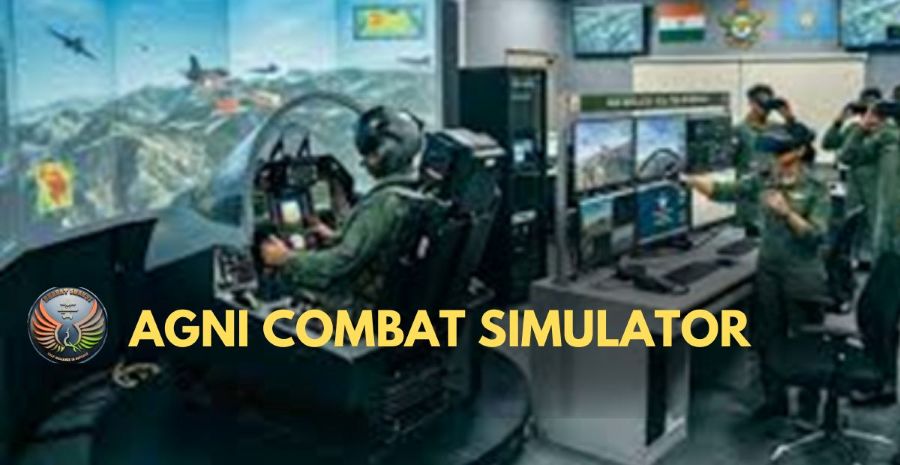
The Indian Air Force (IAF) is moving to acquire a next-generation combat simulation system designed to recreate the realities of modern multi-domain warfare, marking a shift away from conventional platform-specific pilot training. The Air Force has invited bids for the supply, installation, and operationalisation of the air combat, ground planning, and network-integrated AGNI systems, along with associated infrastructure.
The system, designated AGNI – Air Combat, Ground Planning and Network Integrated, will allow personnel from the Army, Navy and Air Force to train together on a common operational network, simulating real-time combat scenarios involving aircraft, missile systems, drones, radar networks and electronic warfare.
The procurement reflects the changing nature of aerial warfare, where battlefield outcomes are increasingly shaped not only by fighter aircraft but also by data links, satellite feeds, cyber operations, electronic jamming and integrated air defence systems.
Unlike traditional simulators focused largely on pilot handling skills, the AGNI framework is intended to replicate the complexity of joint operations in a contested battlespace.
Under the proposed setup, fighter pilots operating simulated cockpits, air defence controllers monitoring large-scale aerial threats, and ground commanders coordinating joint-force assets will function simultaneously within a shared networked environment.
Decisions taken by one operator will directly influence the operational picture seen by others in real time.
According to the project framework, the simulator architecture will comprise four major components.
The fighter controller segment will include panoramic display systems capable of tracking more than 1,000 airborne objects simultaneously, including fighter aircraft, helicopters, drones, missiles and transport aircraft. Controllers will train in threat assessment, interception planning, and engagement management under electronic warfare conditions, including jamming and spoofing.
The flying component will feature four high-fidelity simulator cockpits replicating aircraft currently in IAF service, including the Sukhoi-30MKI, Mirage 2000 and Rafale. The system will also simulate adversary platforms, including the F-16, F-22, and Chinese J-10 and J-11 fighters.
The simulators will incorporate motion feedback systems to recreate take-offs, high-G manoeuvres, and weapons-release profiles. Virtual and mixed-reality technologies layered over high-resolution satellite imagery will allow pilots to train in varied operational conditions, including night flying, poor visibility, rain, fog and cloud cover.
The ground warfare environment, described in the request for proposal as the most technically demanding segment, will integrate assets from all three services onto a single three-dimensional operational display.
The system will represent tanks, missile batteries, radar stations, warships, submarines, aircraft carriers, and ballistic missile defence systems, while also reproducing battlefield effects such as explosions, smoke, missile trails, and electronic interference.
A dedicated supervisor and control section will allow instructors to dynamically alter combat scenarios during exercises by introducing new threats, disrupting communications or changing weather conditions. The system will also record audio and video feeds for detailed post-mission analysis and debriefing.
The AGNI project signals the IAF’s push towards network-centric warfare training at a time when future conflicts are expected to be fought across air, land, sea, cyber and space domains simultaneously.
Team BharatShakti