



The Ministry of Defence (MoD) is preparing to impose financial penalties on Hindustan Aeronautics Limited (HAL) after the state-owned aerospace major failed to deliver a single Light Combat Aircraft (LCA) Tejas Mk1A to the Indian Air Force (IAF), more than two years after contractual deliveries were scheduled to begin.
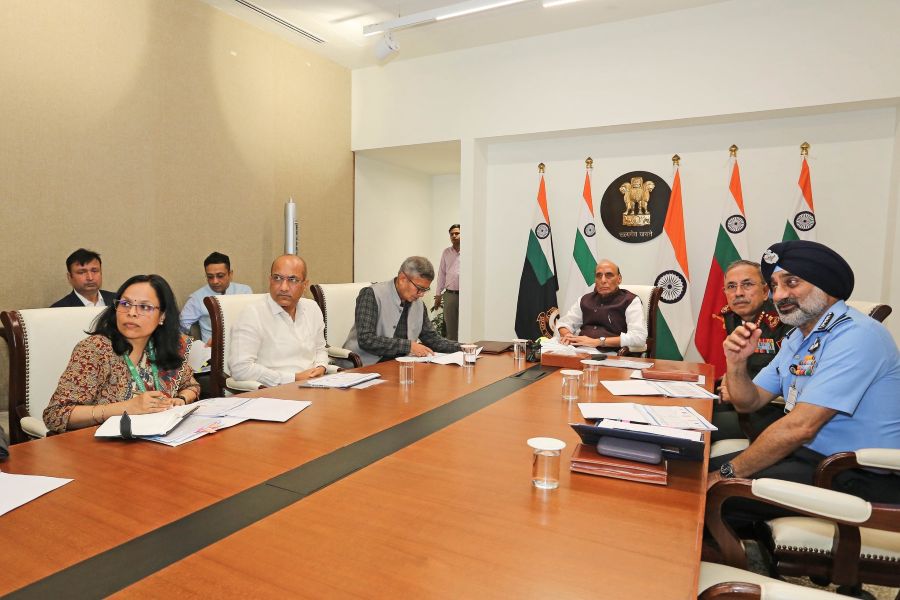
The issue came under scrutiny during a review meeting chaired by Defence Minister Rajnath Singh in New Delhi on Monday, where HAL’s continued inability to meet delivery commitments was discussed amid growing concern within the defence establishment over the impact on the Air Force’s combat fleet modernisation plans.
According to sources, the Ministry has sternly asked HAL to meet contractual deadlines and compensate for delays, while it considers penalties for the extended delays.
The setback has become one of the most significant challenges facing India’s flagship indigenous fighter programme. In February 2021, the MoD signed a Rs 45,696-crore contract with HAL for 83 Tejas Mk1A aircraft, comprising 73 fighter jets and 10 trainers. Deliveries were scheduled to commence in February 2024, with HAL expected to supply roughly eight aircraft annually thereafter.
However, despite more than two years having passed since the first delivery deadline, the Air Force has yet to receive a single operational Mk1A aircraft.
The delays have become particularly embarrassing for HAL because critical components and aircraft structures are already available. Sources said HAL has received at least six F404-IN20 engines from US manufacturer GE Aerospace and has completed the airframe structures for 18 aircraft. Yet, none of the six aircraft that the available engines could potentially power has been delivered to the IAF.
The company now faces increasing questions over production planning and programme execution, especially as the Air Force continues to grapple with a declining fighter squadron strength.
HAL has consistently attributed the delays to GE Aerospace’s failure to supply engines on schedule. Under a $716-million contract signed in 2021, GE was to supply 99 F404-IN20 engines for the Tejas Mk1A fleet. Engine deliveries were originally expected to begin in April 2023, but the schedule slipped significantly.
As of April 2026, GE had supplied only six engines, forcing Defence Minister Rajnath Singh to raise the issue with US counterparts repeatedly.
Yet officials point out that engine shortages alone do not fully explain the absence of deliveries. HAL has previously stated that five Tejas Mk1A aircraft are fully ready and incorporate all major contracted capabilities. The company has also disclosed that nine additional aircraft were built and flown using test engines and are awaiting replacement with production-standard F404-IN20 powerplants.
In total, nearly 20 Mk1A airframes have reportedly been assembled and are currently parked at HAL facilities awaiting engines.
The Ministry’s concerns also extend to unresolved shortfalls related to certain Air Staff Qualitative Requirements (ASQRs), which remain necessary before full operational acceptance by the Air Force.
Despite the current difficulties, officials remain cautiously optimistic that production could accelerate if engine supplies stabilise. Sources indicated that between 18 and 24 Tejas Mk1A aircraft could be ready by the end of this year, provided HAL overcomes the remaining technical and certification bottlenecks.
For the Indian Air Force, however, the delay has become increasingly costly. The Tejas Mk1A is expected to replace ageing MiG-21 fighters and form a critical pillar of the service’s future force structure. Every missed delivery pushes back squadron induction plans and adds pressure on an Air Force already operating well below its sanctioned strength.
The Ministry’s move to consider penalties reflects growing impatience with repeated schedule slippages in a programme regarded as central to India’s defence self-reliance ambitions. While GE’s engine supply disruptions triggered the crisis, the focus is now firmly on whether HAL can convert assembled aircraft into operational fighters and restore confidence in the Tejas production timeline.
Ravi Shankar

Dr Ravi Shankar has over two decades of experience in communications, print journalism, electronic media, documentary film making and new media.
He makes regular appearances on national television news channels as a commentator and analyst on current and political affairs. Apart from being an acknowledged Journalist, he has been a passionate newsroom manager bringing a wide range of journalistic experience from past associations with India’s leading media conglomerates (Times of India group and India Today group) and had led global news-gathering operations at world’s biggest multimedia news agency- ANI-Reuters. He has covered Parliament extensively over the past several years. Widely traveled, he has covered several summits as part of media delegation accompanying the Indian President, Vice President, Prime Minister, External Affairs Minister and Finance Minister across Asia, Africa and Europe.


