


As the Ministry of Defence is busy giving the finishing touches to the Defence Acquisition Procedure (DAP) 2026, the focus is no longer only on buying military hardware. The draft document signals a broader shift, from licensed production to technology ownership, from “Made in India” to “Owned by India”, and from fragmented procurement to capability creation.
The ambition is significant. But whether the proposed reforms will be able to deliver depends less on new procedures and more on fixing structural weaknesses that have plagued India’s acquisition system for decades.
In this context, if there is one country whose experience deserves closer attention, it is France.
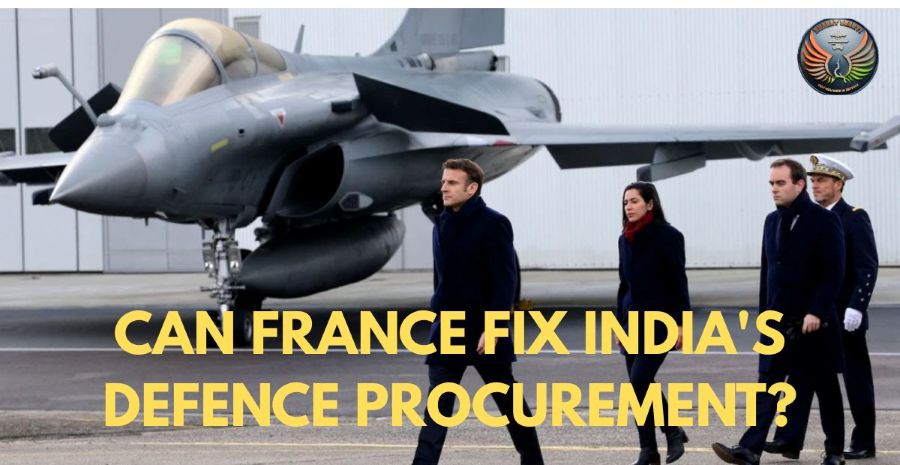
Of late, the India-France defence relationship is often viewed through the prism of Rafale fighters, Scorpene submarines and missile cooperation. Yet, the real lesson lies elsewhere.
France has built one of the world’s most integrated defence acquisition systems, in which procurement, industrial development, research, exports, and long-term military planning function as parts of a single national strategy. It is this institutional model, not merely French weapon systems, that offers valuable lessons as India prepares to roll out DAP 2026 soon.
The draft DAP, released for stakeholder consultations earlier this year, recognises that India’s acquisition challenge is no longer merely financial. It acknowledges that delays stem equally from procedural rigidity, fragmented decision-making, and inadequate integration among the armed forces, research organisations, and industry.
It proposes faster decision cycles, simplified procurement categories, long-term bulk procurement, greater emphasis on indigenous intellectual property, spiral development of platforms and stronger integration of start-ups and private industry into the acquisition process.
The philosophy represents an evolution. Instead of measuring success by indigenous content alone, the emphasis is gradually shifting towards Indian ownership of technology, design capability and intellectual property. That is a notable departure from decades of licence production.
Yet procurement manuals have changed before.
India has revised its acquisition framework repeatedly, from the Defence Procurement Procedure introduced in 2002 to subsequent revisions in 2005, 2006, 2008, 2011, 2013, 2016 and finally DAP 2020. Each promised faster acquisition and greater self-reliance. Many procedural bottlenecks were addressed. But delays, cost overruns and capability gaps persisted.
Former Financial Advisor (Acquisition) in the Ministry of Defence, Amit Cowshish, believes the problem lies deeper than procurement rules.
“The biggest structural weakness is the absence of comprehensive and financially viable defence plans, absence of an overarching 24×7 defence planning body, disjointed defence reforms, and tardy decision making,” he says.
His assessment goes to the heart of India’s procurement dilemma.
The acquisition process often begins before long-term capability planning, budgeting and industrial preparedness are fully aligned. Decisions pass through multiple organisations with overlapping responsibilities. Annual budgetary constraints frequently alter procurement priorities. The result is a cycle of delayed contracts, revised requirements and escalating costs.
According to Cowshish, “Time and cost overruns are a result of all the factors mentioned above, apart from needless complexity and rigidity of procurement procedures.”
France approached this challenge differently.
Its defence procurement revolves around the Directorate General of Armaments (Direction générale de l’armement or DGA), a single organisation responsible for managing the complete life cycle of defence equipment, from research and technology development to acquisition, industrial coordination, testing and induction into military service. The DGA functions within the framework of France’s long-term Military Programming Law, which provides predictable funding and clearly defined capability priorities over multiple years.
The result is an acquisition ecosystem in which military planning, industrial policy, and technological development reinforce one another rather than operate in separate silos.
Defence economist and national security scholar Laxman Kumar Behera, in his study on the French acquisition system, argues that this institutional integration is perhaps most crucial for India to learn from.
“The biggest lesson that India can borrow is France’s integrated and centralised procurement structure, which has the dual responsibility of arms acquisition and defence industrial development. The French understood the crucial linkage between these two functions and combined them by creating the DMA/DGA in 1961, which proved its mettle by establishing a robust procurement structure and an internationally competitive arms industry.”
That integration has helped France develop one of the world’s most sophisticated Defence Industrial and Technological Bases (BITD). Today, nearly 90 per cent of French defence requirements are met through domestic production, supported by globally competitive companies such as Dassault Aviation, Naval Group, Thales and MBDA. Procurement is not viewed merely as a purchasing exercise but as an instrument to sustain research, strengthen industry and generate exports.
India’s draft DAP 2026 appears to move in the same direction.
The document explicitly links acquisition with industrial development and exports. It encourages indigenous design, greater participation of start-ups, civil-military fusion and technology development through long-term procurement commitments. In many respects, these provisions echo the broader philosophy that France has refined over decades.
But Behera cautions that institutional fragmentation remains India’s principal handicap.
“The lack of jointness among the plans has resulted in ad hoc procurement and at times duplication of capability creation. This is undesirable not only from the point of view of defence preparedness but also from the perspective of managing scarce resources.”
The observation remains relevant nearly a decade after it was made.
The armed forces, the Department of Defence Production, the Defence Research and Development Organisation (DRDO), the acquisition wing, quality assurance agencies, and finance continue to operate through separate institutional channels. Coordination has improved, but decision-making remains dispersed.
To address this, Behera recommended structural reforms that extend beyond procedural amendments.
He argued for integrating procurement and industrial development under a single administrative authority, broadly along the lines of France’s DGA. Such a body, he suggested, could combine responsibilities currently divided among Service Headquarters, DRDO, the Department of Defence Production, quality assurance agencies and the acquisition wing. Equally important, he recommended creating a dedicated professional acquisition cadre capable of bridging the knowledge gap between government and industry.
Such reforms would undoubtedly face bureaucratic resistance. France itself encountered similar institutional challenges before establishing the DGA. Yet its experience demonstrates that enduring procurement reforms require organisational restructuring, not merely procedural simplification.
There is another French lesson that resonates with DAP 2026.
France increasingly relies on digital procurement systems, automated tender management and technology-enabled contract administration to compress acquisition timelines while improving transparency. The objective is not simply to award contracts faster but to reduce administrative friction throughout the procurement cycle.
DAP 2026 similarly seeks concurrent processing, simplified approvals and adaptive acquisition mechanisms for emerging technologies such as artificial intelligence, autonomous systems and cyber capabilities. These provisions recognise that future wars will evolve far faster than conventional procurement cycles.
Cowshish, however, offers a note of caution against relying on fashionable terminology alone.
“I do not really understand what’s meant by shifting the focus from a compliance-driven process to a capability-driven framework. These are theoretical niceties which, to my mind, are difficult to translate into actionable precepts. It’s all true of accountability. What does it mean, and how to enforce it? These ideas need greater clarity than has been the case so far.”
His remarks serve as a reminder that procurement reform is ultimately judged by outcomes rather than policy language.
India has no shortage of procurement manuals. What it has lacked is institutional coherence.
France’s experience suggests that acquisition reform succeeds only when planning, budgeting, industrial development, research and procurement operate within a unified strategic framework supported by predictable funding and professional management.
As Behera concluded in his study, “India has a lot to learn from France’s robust procurement process, which is characterised by a clear articulation of national security objectives, approved procurement and investment plans, and avoidance of wasteful and costly procurement.”
DAP 2026 has the potential to become India’s most consequential procurement reform in over two decades. Its promise lies not merely in introducing new acquisition categories or simplifying procedures, but in fundamentally reimagining how India creates military capability.
The real benchmark will not be how quickly the new manual is notified. It will be a test of whether it can break the cycle of fragmented planning, delayed acquisitions, and technological dependence that successive procurement reforms have struggled to overcome.
If DAP 2026 succeeds in bringing procurement, industrial policy, innovation and strategic planning under a more integrated framework, it would not replicate the French model. But it would embrace the central principle that has made France one of the world’s most self-reliant defence powers: procurement is not just about buying weapons, it is about building national capability.
Ravi Shankar

Dr Ravi Shankar has over two decades of experience in communications, print journalism, electronic media, documentary film making and new media.
He makes regular appearances on national television news channels as a commentator and analyst on current and political affairs. Apart from being an acknowledged Journalist, he has been a passionate newsroom manager bringing a wide range of journalistic experience from past associations with India’s leading media conglomerates (Times of India group and India Today group) and had led global news-gathering operations at world’s biggest multimedia news agency- ANI-Reuters. He has covered Parliament extensively over the past several years. Widely traveled, he has covered several summits as part of media delegation accompanying the Indian President, Vice President, Prime Minister, External Affairs Minister and Finance Minister across Asia, Africa and Europe.