






For nearly a decade, India has championed the idea of the Indo-Pacific.
Yet New Delhi has always added an important qualification. While the Indo-Pacific is the broader strategic canvas, India’s immediate maritime priority remains the Indian Ocean Region.
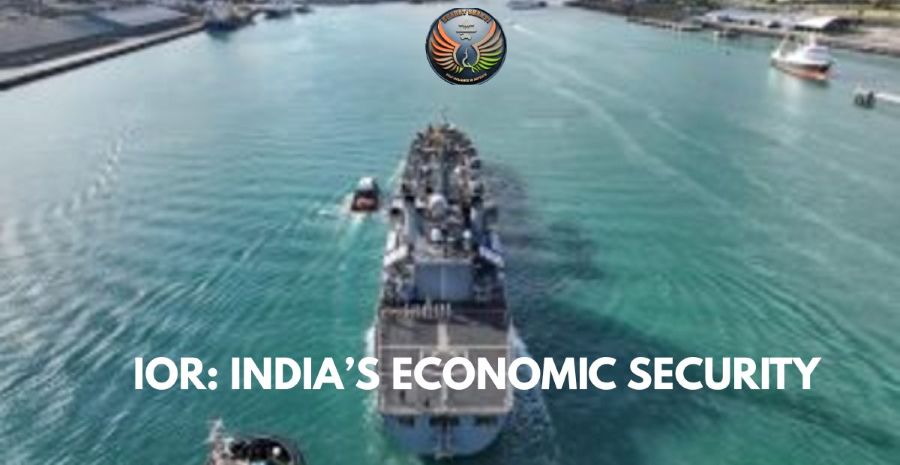
Stretching from the eastern coast of Africa to the Strait of Malacca, the Indian Ocean carries the lifeblood of the Indian economy. Energy imports from the Gulf, exports to Europe and East Asia, global shipping lanes and the undersea fibre-optic cables that carry almost all international internet traffic and financial transactions converge in these waters.
If the Himalayas define India’s territorial security, the Indian Ocean increasingly underpins its economic security.
That reality is beginning to shape Indian diplomacy.
Prime Minister Narendra Modi’s recent engagements with Indian Ocean island states, Indonesia and other regional partners have been described as a diplomatic blitz. Looked at more closely, however, they appear to be part of a longer effort to strengthen India’s position across what it considers its primary maritime neighbourhood.
Rear Admiral Sudarshan Shrikhande (Retd), a distinguished naval officer and scholar and an authority on sea-based deterrence, strategy and Indo-Pacific geopolitics. argues that India is not embracing a new strategic geography so much as rediscovering an older one.
“In some ways, the Indo-Pacific was always an important theatre, even in ancient times,” he told StratNewsGlobal. In the 13th century, “Rani Rudramadevi sent an embassy to Zanzibar asking it to cooperate in anti-piracy operations to protect trade. The Cholas sent ships into what we now call the South China Sea to trade and to protect trade. K.M. Panikkar used the term he borrowed from Haushofer—the Indo-Pacific.”
His historical references span nearly a millennium. The Chola Empire projected naval power across Southeast Asia not simply to expand its influence but to protect maritime commerce. K.M. Panikkar, diplomat, historian and one of the architects of India’s post-Independence maritime thinking, argued decades before the term entered diplomatic vocabulary that India’s security depended on the oceans surrounding it. Drawing on the geopolitical ideas of German scholar Karl Haushofer, Panikkar viewed the Indian and Pacific Oceans as an interconnected strategic space rather than separate theatres.
“I believe diplomacy with a maritime bias has been inevitable for India,” Shrikhande says.
That maritime bias reflects India’s unique strategic reality.
“Our major security concerns are continental from neighbours like China and Pakistan. However, our economic prosperity is primarily hinged on trade which includes imports and exports via seas, and of course—no longer to be ignored—the services trade that is supported digitally through underwater cables.”
It is a paradox that increasingly defines Indian strategy. The country’s principal military threats remain on land, but its prosperity depends overwhelmingly on the sea. Nearly all of India’s merchandise trade by volume travels by ship, while the global digital economy relies on seabed fibre-optic cables linking continents. Secure sea lanes are no longer only about oil tankers and container ships; they also protect the invisible digital infrastructure on which banking, communications and services exports depend.
The geography explains why India’s diplomacy has become more maritime.
Mauritius and Seychelles anchor the western Indian Ocean. Sri Lanka and the Maldives lie astride some of the world’s busiest sea lanes connecting the Gulf with East Asia. Over the past decade, all four have become arenas of strategic competition as China expanded its economic footprint through infrastructure projects, port investments and political engagement.
India has responded by stepping up development assistance, defence cooperation, coastal surveillance and maritime capacity-building, viewing the stability of these island states as essential to security in the Indian Ocean.
Further east, the Andaman and Nicobar Islands have assumed new importance. Located barely 150 kilometres from Indonesia’s Aceh province, the archipelago overlooks the western approaches to the Strait of Malacca, through which roughly a third of global maritime trade and much of China’s imported energy passes. New Delhi has accelerated investment in military infrastructure, surveillance systems, airfields and logistics facilities there, strengthening India’s only tri-service command into a forward maritime outpost capable of monitoring one of the world’s most critical chokepoints.
The strategic logic extends beyond India’s own territory.
Indonesia, particularly through cooperation around Sabang near the northern entrance to the Strait of Malacca, has emerged as an increasingly important maritime partner, complementing India’s presence in the Andaman and Nicobar Islands and reinforcing security across the eastern gateway to the Indian Ocean.
Ambassador Pankaj Saran, former Deputy National Security Adviser and Convenor of NatStrat, believes recent diplomacy should be viewed in that broader context.
“Recent summit-level engagements with these countries—Japan, Indonesia, Australia and Indian Ocean island states—had the appearance of a diplomatic blitz, but are part of a longer game in India’s maritime neighbourhood,” he says.
“The trend line of Indian policy in the Indo-Pacific is to inexorably build a network of partnerships with distinct security and strategic dimensions. Our relationships with the Indo-Pacific world are a necessary and desirable guarantor of regional stability and creating an environment conducive to India’s growth.”
The emphasis is on partnerships rather than alliances. Logistics agreements, maritime domain awareness, intelligence sharing, disaster relief, naval exercises, technology cooperation and resilient supply chains all strengthen India’s ability to work with like-minded countries without creating formal military blocs.
Watch our series 'The Arc Of Power' from the Andaman & Nicobar Command on our sister channel StratNews Global.
Does that amount to containing China?
Admiral Shrikhande believes the Cold War analogy is misplaced.
“Diplomatic efforts through the Quad, and India’s bilateral and multilateral ramping up with Japan, Indonesia and Australia are very important. However, this may not amount to containment of China.”
“Firstly, unlike containment of the USSR through a Western Cold War prism, it does not apply to China because most Indo-Pacific nations are major trading partners with Beijing, in which India is the lesser partner in terms of volumes. Rather, these steps are perhaps part of a continuum that should now look at security more closely. Such partnerships could contribute to a level of deterrence against China while economic interaction continues.”
Ambassador Saran draws a similar distinction.
“Containment lies in the eye of the beholder. If China feels contained, it is welcome to that view. We should reject this allegation with the same flourish as China rejects allegations of containing India in the sub-continent. But clearly, the countries of the region all feel more reassured when they are networked with each other minus China.”
Taken together, the two assessments point to a strategy that is less about excluding China than expanding India’s own strategic options while giving its partners greater room to manoeuvre.
For India, the Indian Ocean remains the first circle of security. From the eastern coast of Africa to the Strait of Malacca lies the maritime space through which its trade flows, its energy arrives, and its influence is most directly tested.
Beyond Malacca begins a wider Indo-Pacific—where partnerships with Indonesia, Japan, Australia and the Pacific island states extend India’s strategic reach beyond its own ocean.
That is the next chapter of India’s maritime story.
Next: India Beyond Malacca: Shaping the Indo-Pacific
Ramananda Sengupta

In a career spanning three decades and counting, I’ve been the foreign editor of The Telegraph, Outlook Magazine and the New Indian Express. I helped set up rediff.com’s editorial operations in San Jose and New York, helmed sify.com, and was the founder editor of India.com. My work has featured in national and international publications like the Al Jazeera Centre for Studies, Global Times and Ashahi Shimbun. My one constant over all these years, however, has been the attempt to understand rising India’s place in the world.
I can rustle up a mean salad, my oil-less pepper chicken is to die for, and it just takes some beer and rhythm and blues to rock my soul.