For nearly two decades, India’s military doctrine rested on a deceptively comforting assumption: that any future conflict would be short, sharp, and decisive.
This belief was not born of naivety, but of nuclear reality. The presence of nuclear weapons in South Asia was expected to impose a ceiling on escalation, forcing wars to conclude within days, before logistics, industry, and endurance could become decisive factors.
That assumption is now obsolete.
The war in Ukraine has shattered the illusion that modern conflict is inherently brief.
Instead, it has revived a much older truth: wars between near-peer adversaries tend to devolve into prolonged, high-intensity contests of attrition. Industrial capacity, supply chains, and logistical resilience matter as much, if not more, than battlefield brilliance.
For India, this is an immediate, structural, and deeply uncomfortable shift.
The country’s military posture, especially along the Himalayan frontier with China, is now being forced to reconcile decades of planning for limited conflict with the reality of a potential long-duration war.
The Galwan Reality: Tactical Loss, Strategic Consequence
Much of the public discourse around the 2020 Galwan Valley clashes has framed them as episodes of border friction: serious, but ultimately manageable within the broader framework of diplomatic engagement. That framing is misleading.
What has unfolded is not episodic tension but a deliberate strategy of “counter-containment” by China. Through calibrated military pressure, Beijing is signalling that India’s actions beyond the border, whether in the Quad, in Indo-Pacific partnerships, or on issues like Taiwan, will carry consequences on the ground.
More importantly, the territorial shifts are not temporary bargaining chips. They are structural.
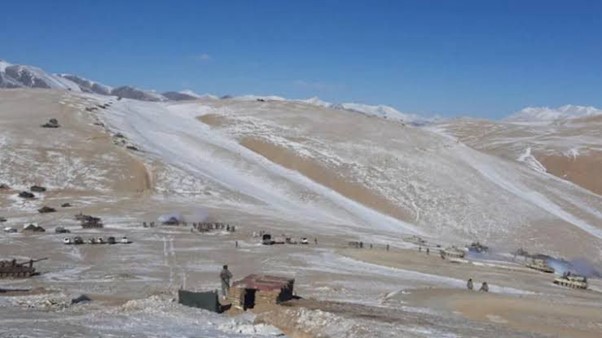
By occupying heights that overlook the Darbuk–Shyok–Daulat Beg Oldi (DSDBO) road, China has placed one of India’s most critical northern supply arteries within artillery range.
This is a logistical lever. In a conflict scenario, it gives the People’s Liberation Army (PLA) the ability to disrupt or sever India’s ability to sustain operations in Ladakh at the very outset. In other words, the battle for the heights has already reshaped the battlefield before a war has even begun.
The Ammunition Paradox: A 10-Day War Machine
India today faces a stark and deeply paradoxical reality. It is among the world’s top military spenders, yet its capacity to sustain high-intensity combat remains alarmingly limited.
The roots of this contradiction lie in doctrine. The belief in short wars led to a conscious reduction in War Wastage Reserves (WWR). Where India once planned for 40 days of intense combat, this was cut to 20 days, and eventually—by 2017—to just 10 days for a conflict with Pakistan and 30 days for China.
On paper, this may have appeared fiscally prudent. In practice, it has created a strategic vulnerability.
Reports suggest that actual reserves may barely sustain 10 days of high-intensity warfare. That is not a buffer, but a countdown clock.
This shortfall is compounded by systemic issues. Bureaucratic inefficiencies, inter-service rivalry, and procurement delays have slowed the acquisition of critical munitions. India’s heavy reliance on imports further complicates matters, making replenishment both slower and more expensive.
Meanwhile, defence R&D remains underfunded, receiving a fraction of government expenditure compared to other major powers. The result is a system that struggles not only to stockpile but also to rapidly produce and replenish in wartime.
In a long war, this is not just a weakness, it is a liability that could prove fatal.
The Altitude Advantage, And Its Expiry Date
Geography, however, is not entirely unforgiving to India. In fact, it offers a crucial, if temporary, advantage.
The Indian Air Force (IAF) operates from bases at lower altitudes, allowing its aircraft to take off with full fuel and weapon loads. In contrast, the Chinese airbases on the Tibetan plateau impose severe constraints on payload and operational tempo due to thin air.
This gives India a qualitative edge, particularly in the eastern sector where platforms like the Su-30MKI can outperform older Chinese aircraft such as the J-10 and J-11 under these conditions.
But this advantage too comes with a ticking clock.
China’s infrastructure superiority allows it to rapidly reinforce the theatre. Within weeks, it can deploy additional divisions, reposition advanced aircraft like the J-20, and bring its Strategic Rocket Force into play. Once that happens, the initial Indian advantage begins to erode.
The implication is clear: India’s air superiority is not a permanent condition. It is a window of opportunity, one that must be exploited early, before the balance shifts.
The Rise of Integrated Battle Groups
If the old doctrine was built around mass and momentum, the new thinking is moving toward agility and responsiveness.
The Indian Army’s transition from large, slow-moving Strike Corps to Integrated Battle Groups (IBGs) reflects this shift. These brigade-sized formations are designed around the “3Ts” principle: Threat, Terrain, and Task, and are tailored for the fragmented, unpredictable geography of the Himalayas.
Unlike traditional formations that can take weeks to mobilise, IBGs are meant to deploy within 12 to 48 hours. They are self-contained, combining infantry, armour, artillery, and support elements into cohesive, rapidly deployable units.
This is a major conceptual shift.
In a theatre where a single landslide can block a pass, or a targeted strike can isolate a formation, speed and decentralisation are more valuable than sheer mass. The IBG model reflects a recognition that future conflict in the Himalayas will be fought in dispersed, high-intensity pockets, not along continuous fronts.
The Western Pivot: Securing Supply Chains, Not Just Hardware
India’s recent defence acquisitions, like Rafale jets, MQ-9B drones, and advanced jet engines are often interpreted as efforts to modernise its arsenal. That is only part of the story.
The deeper shift is a strategic pivot toward securing supply chains.
India’s longstanding dependence on Russian defence equipment has become a vulnerability in the context of growing China–Russia alignment. The risk is not just technological obsolescence, but supply disruption: spares, maintenance, and upgrades could be affected in a crisis.
To mitigate this, India is embedding itself more deeply into Western defence ecosystems. Agreements like the Security of Supply Arrangement (SOSA) and ongoing negotiations for a Reciprocal Defence Procurement Arrangement (RDPA) are aimed at ensuring continuity of supply during conflict.
This is a critical evolution. Modern warfare is not just about platforms; it is about sustaining those platforms under stress. Without assured access to spares and maintenance, even the most advanced systems can quickly become ineffective.
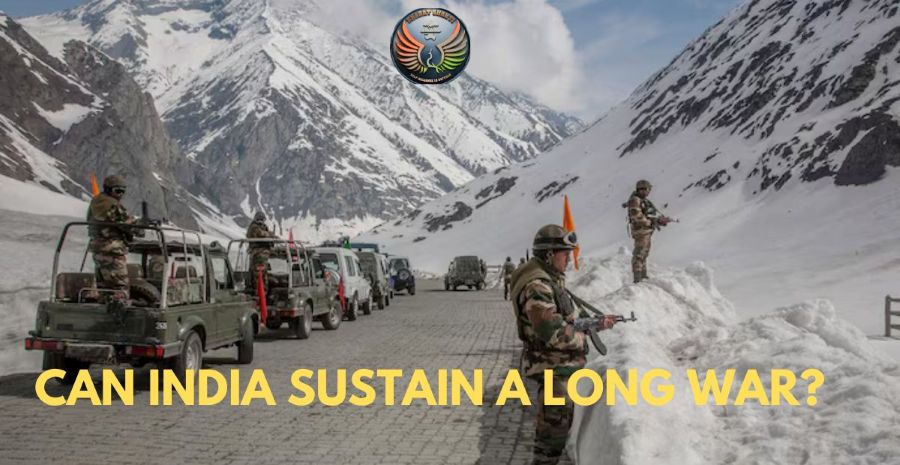
The Bigger Question: Can India Sustain a Long War?
All these threads converge on a single, uncomfortable question.
India today is assessed to be capable of fighting a “1.25 war”—a full-scale conflict with Pakistan alongside a limited engagement with China. But that assessment is rooted in assumptions of limited duration.
What happens when duration itself becomes the decisive variable?
The shift from short wars to long wars changes everything. It elevates logistics over manoeuvre, industry over tactics, and endurance over shock. It demands not just a capable military, but a resilient national ecosystem, one that can sustain production, maintain supply chains, and absorb prolonged strain.
India is attempting to move in that direction through its push for Aatmanirbharta in defence production. The ambition is to evolve from the world’s largest arms importer into a significant exporter, akin to models like Israel.
But ambition is not capacity, at least not yet.
The current reality remains stark: a military that may be able to fight intensely, but not indefinitely.
From Firepower to Staying Power
The era of the “short and sharp” war is over. In its place is a harsher paradigm, one where wars are decided not in days, but in weeks and months; not by singular breakthroughs, but by sustained pressure.
For India, this is a moment of strategic reckoning.
The question is no longer whether it can fight, but whether it can endure.
Because in the next Himalayan conflict, the decisive factor may not be who has the better jets, the higher ground, or even the faster mobilisation.
It will be who can keep fighting on day eleven.
Ramananda Sengupta

In a career spanning three decades and counting, I’ve been the foreign editor of The Telegraph, Outlook Magazine and the New Indian Express. I helped set up rediff.com’s editorial operations in San Jose and New York, helmed sify.com, and was the founder editor of India.com. My work has featured in national and international publications like the Al Jazeera Centre for Studies, Global Times and Ashahi Shimbun. My one constant over all these years, however, has been the attempt to understand rising India’s place in the world.
I can rustle up a mean salad, my oil-less pepper chicken is to die for, and it just takes some beer and rhythm and blues to rock my soul.