South Korea’s Navy has begun testing a humanoid robot capable of steering warships, marking a new phase in Seoul’s drive to integrate artificial intelligence into military operations as it confronts an intensifying manpower shortage, The Korea Times reported.
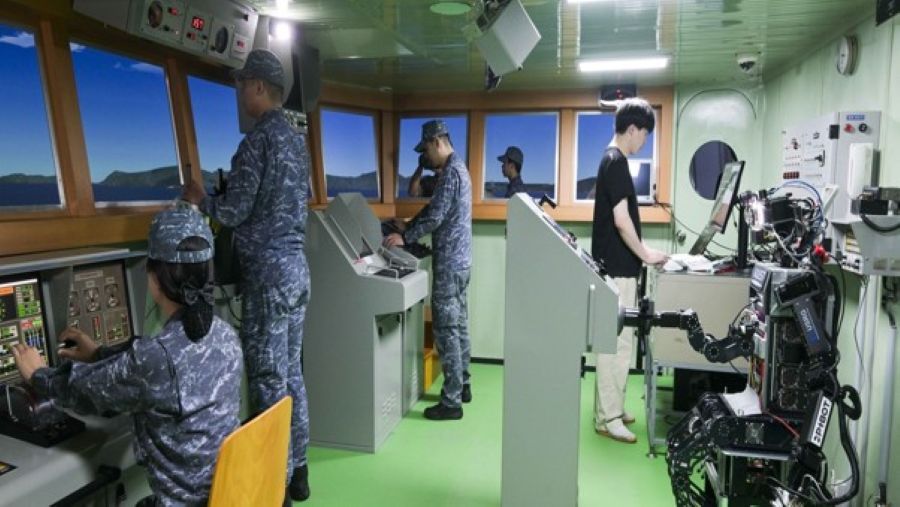
The robot, PIBOT, recently completed its first bridge simulation at a naval training centre in Changwon. During the exercise, it responded to spoken navigation commands, repeated instructions to minimise communication errors and physically operated the ship’s controls while navigating simulated conditions, including rough seas, narrow waterways, poor visibility and night operations.
Developed by the Korea Advanced Institute of Science and Technology (KAIST), PIBOT forms part of the Navy’s long-term effort to automate routine operational tasks aboard warships.
Demographic Decline Reshapes Defence Planning
The naval trial comes against the backdrop of South Korea’s deepening demographic crisis, which is forcing the country’s armed forces to rethink how they recruit and sustain military personnel.
With one of the world’s lowest fertility rates and a rapidly ageing population, the number of conscription-age men has been falling steadily. The challenge has already prompted policymakers to explore broader reforms, including expanding the role of women in the military..
The shrinking recruitment base is increasingly viewed not as a temporary staffing issue but as a long-term national security challenge. Military planners are therefore looking to artificial intelligence, autonomous systems and robotics to maintain operational readiness without relying solely on expanding troop numbers.
According to reports, the Navy sees AI-enabled crew members as a practical response to these demographic pressures, particularly for repetitive and labour-intensive tasks that currently require trained sailors.
Building A Future Fleet
The humanoid robot is being developed under the Navy’s broader Sea GHOST programme, which seeks to build hybrid fleets where human crews operate alongside autonomous systems.
According to reports, the current simulator exercise is the first in a four-stage testing programme. Future trials will move to docked vessels before eventually placing the robot aboard operational warships in live sailing conditions.
While PIBOT is unlikely to replace sailors entirely, defence officials see it as part of a broader transformation of South Korea’s military. As AI, robotics and autonomous technologies become increasingly central to modern warfare, Seoul is investing in capabilities that can compensate for a shrinking manpower pool while improving operational efficiency.
Team BharatShakti