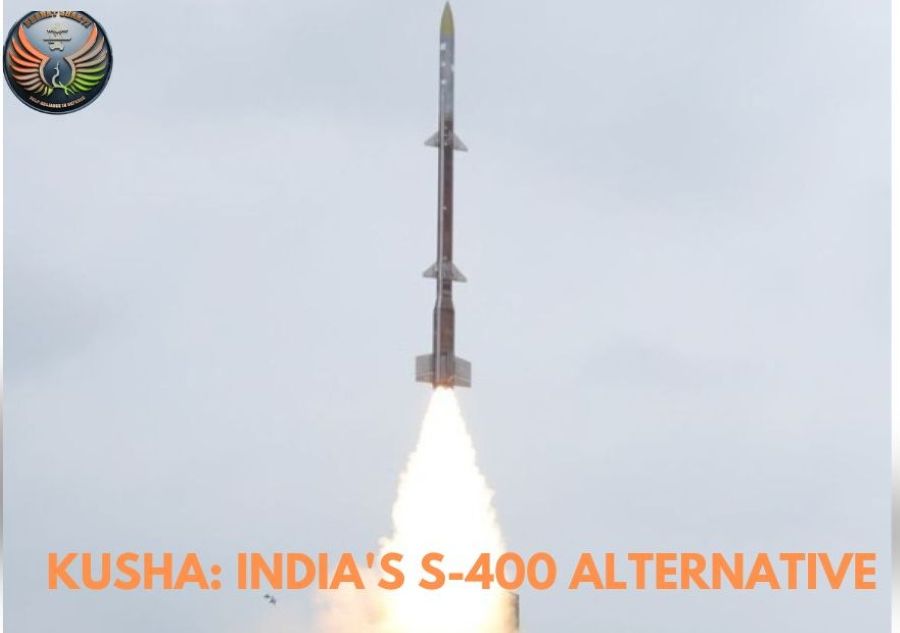
India’s successful maiden flight test of the indigenous Project Kusha has brought the country closer to fielding a homegrown long-range air defence system capable of reducing dependence on imported platforms such as the Russian S-400 and Israeli Barak systems.
Scientists associated with the classified programme say Kusha has been designed not merely to complement existing foreign-origin systems but eventually replace them as India’s primary long-range air defence architecture.
“Kusha features a three-tier interceptor architecture comprising M1, M2 and M3 missiles built around a common kill booster vehicle. The system is customised to meet the operational requirements of the Indian Air Force and the Indian Navy,” a senior scientist associated with the project told BharatShakti. His identity has been withheld for security reasons.
He said the programme marks a major technological shift because virtually every critical subsystem has now been developed within the country.
“Everything is indigenous, including seekers, actuators and computing systems that earlier had to be imported,” the scientist said.
The successful test comes as India seeks greater strategic autonomy in critical defence technologies amid geopolitical uncertainties and supply-chain disruptions affecting military imports.
The scientist said Kusha has been conceived as an indigenous alternative that will gradually reduce India’s dependence on overseas suppliers.
“It will not only complement but eventually substitute the Russian S-400 and Israeli Barak air defence systems in service. Once the indigenous technology matures, we will no longer remain dependent on foreign suppliers for this capability,” he said.
Project Kusha is India’s indigenous Long-Range Surface-to-Air Missile (LRSAM) programme designed to intercept fighter aircraft, cruise missiles, large drones, precision-guided weapons and certain classes of ballistic and hypersonic threats. The system forms the outer layer of India’s evolving multi-tier air defence architecture and will operate through the Indian Air Force’s Integrated Air Command and Control System (IACCS).
The system comprises three interceptor variants. The M1 missile is designed to engage targets between 120 and 150 km, the M2 has a range of around 250 km, while the M3 interceptor is expected to engage aerial threats at distances of up to 350-400 km. The missiles can reportedly achieve speeds of up to Mach 5.5.
During the maiden flight trial conducted on July 23 from Dr A.P.J. Abdul Kalam Island off the Odisha coast, the M1 interceptor successfully destroyed an electronic aerial target. Although the planned engagement distance was 120 km, the interceptor achieved a successful kill beyond 142 km, validating the system’s performance envelope.
Officials associated with the programme view Kusha as a key building block of Prime Minister Narendra Modi’s vision of a “Swadeshi Sudarshan Chakra” – an integrated, multi-layered national missile defence shield intended to protect India against a wide spectrum of aerial threats.
“Kusha is a critical component of the Prime Minister’s vision of the Swadeshi Sudarshan Chakra. Countries such as the United States, Russia, Israel and China possess advanced integrated air defence technologies. With Kusha, India is moving into that league with an indigenous capability,” the scientist said.
The project is expected to strengthen India’s ability to sustain its missile defence network without relying on external supply chains for upgrades, software modifications or missile replenishment.
Unlike imported systems, Kusha has been designed around indigenous seekers, command-and-control software and mission computers, allowing future upgrades to be carried out entirely within the country. Defence scientists also point to its modern Gallium Nitride (GaN)-based Active Electronically Scanned Array (AESA) radar architecture and dual active radio frequency and imaging infrared seekers on longer-range interceptors, which are expected to improve performance against stealth aircraft, electronic jamming and complex aerial threats.
The Indian Air Force is expected to induct the system in phases between 2028 and 2030, making Project Kusha one of the country’s most significant indigenous air defence programmes after the Ballistic Missile Defence initiative.
Ravi Shankar

Dr Ravi Shankar has over two decades of experience in communications, print journalism, electronic media, documentary film making and new media.
He makes regular appearances on national television news channels as a commentator and analyst on current and political affairs. Apart from being an acknowledged Journalist, he has been a passionate newsroom manager bringing a wide range of journalistic experience from past associations with India’s leading media conglomerates (Times of India group and India Today group) and had led global news-gathering operations at world’s biggest multimedia news agency- ANI-Reuters. He has covered Parliament extensively over the past several years. Widely traveled, he has covered several summits as part of media delegation accompanying the Indian President, Vice President, Prime Minister, External Affairs Minister and Finance Minister across Asia, Africa and Europe.