


Editor’s Note
Exactly a year ago, soon after the maiden edition of the tri-services seminar Ransamwad was held in Mhow (Madhya Pradesh), we at BharatShakti initiated an informed debate, examining the complex proposition of establishing joint Theatre Commands and the associated restructuring of India’s Higher Defence organisation, in a two-part series.
The first article “Theatre Commands: Back To The Drawing Board gave an assessment of the situation that then prevailed in the domestic scenario in the backdrop of historical examples, while the second piece “Theatre Commands: Towards A Unique Indian Model Inspired By Global Best Practices” put forth broad contours of a model that suggested a phased, bespoke approach to the formation of Theatre Commands in India. It helped introduce fresh thinking on the topic, as evidenced by the responses it elicited at the time.
This month, in the wake of reports of two high-level discussions in the Ministry of Defence (MoD) on this issue, and two successive opinion pieces we published last week, in which forceful arguments were made by Lt Gen AB Shivane (Retd) and Air Marshal Raghu Nambiar (Retd), the debate has been reignited.
Considering the renewed interest, it is perhaps time to pick up the thread and revisit the ideas BharatShakti discussed last year to provide fresh food for thought for policymakers. The following article suggests one possible way forward.
For those tracking the Theatre Command debate in the country after the 2020 reforms of India’s higher defence organisation, it is hard to miss that some core arguments keep going around in circles, indicative of entrenched positions. This also raises the question of whether the proposal to form three separate geographical Theatre Commands, headed by four-star officers, as reported earlier, enjoys bipartisan civil-military support?
Indeed, does it even enjoy a real tri-services consensus? Or is there a need to review the proposal and reimagine it as a phased approach that could better bring all stakeholders on board?
Seasoned readers may recollect that in the second article in the sequel of August last year, BharatShakti had brought out that as a first step, forming a National Theatre Command headed by the Chief of Defence Staff may create the ground for the Indian military to adopt a phased approach to evolve into multiple theatre commands gradually.
The first phase would involve assembling the structural building blocks to operate as a pan-India theatre. Given the differences in perception among stakeholders regarding the form and substance of the purported “theatres”, a viable environment for ushering in structural integration could be fostered by initially establishing a unified command structure at the national level. Such a set-up could be termed as the National Theatre Command (NTC).
At the apex level of NTC would be the CDS (as the Permanent Chairman of the Chiefs of Staff Committee or COSC), assisted by his Joint Staff at HQ NTC. This will help evolve a mechanism in which the combatant Commander-in-Chiefs of the three Services report to the Permanent Chairman, COSC (CDS), in addition to their Service Chiefs, in a dual-track paradigm.
The empowerment of the CDS to plan, direct, and control operations could be contingency-based, as mandated by the government. This would ensure that these powers of the CDS remain need-based and that there is clarity among the Chiefs of Staff Committee members about the scenarios in which the CDS can exercise operational command.
The lessons of Operation Sindoor have made such an imperative abundantly evident. In this reform process, Headquarters IDS would need to be redesignated as the Joint HQ NTC, with a suitably structured joint planning staff under the CDS. The Chief of the Integrated Defence Staff to the COSC (CISC), who heads the HQ IDS, could be “double-hatted” as the Chief of Joint Operations (CJOPS) to assist the CDS in implementing his operational mandate. This way, the CDS and CISC would be mainstreamed into a contingency-driven operational role, in addition to their other duties.
How can a National Theatre Command Work?
Even as regular day-to-day operations may continue to be directed and managed by the respective Service Chiefs, the government will need to issue a clear, contingency-based mandate to the CDS to exercise operational powers as the Permanent Chairman of the COSC. Presently, the mandate is indirect, by virtue of his being the Chairman of the COSC.
This diffused entitlement will have to be addressed by clearly laying down the circumstances and contingencies under which the CDS can assume an operational role, pre-approved by the government or authorised by the Cabinet Committee on Security (CCS) on a case-by-case basis.
The proposed model does not dilute the importance or the primacy of the Service Chiefs. Instead, such an arrangement assigns the CDS a formal role as Permanent Chairman of COSC, enabling him to coordinate and work with other key players in the government (PMO, NSCS, Line Ministries, intelligence agencies, etc.).
In the run-up to and during Operation Sindoor, in the absence of a clearly mandated operational role, the previous CDS, Gen Anil Chauhan, had to use all his persuasive powers and his personal connect with decision-makers to play a crucial role.
In the proposed arrangement, operational forces would not be permanently controlled by the CDS but would be allocated by concerned Service Chiefs when so called for by the CDS, based on a Joint Planning process. Assigned forces can be mobilised for specific campaigns/operations and reverted to the control of the parent Service upon termination of those specific tasks. The conditions and circumstances under which such allocation would be necessary need to be clearly specified in government orders (issued with the approval of the Cabinet Committee on Security).
The CDS, as Permanent Chairman of COSC, could also be empowered to assign a Sub-Theatre Commander from among the tri-service combatant C-in-Cs for a given situation that calls for a joint operation to be launched at the National Theatre level. Once the government gives the necessary operational mandate to the CDS, it will naturally follow that the Combatant C-in-Cs of all three Services will also be answerable and accountable to the CDS as Chairman COSC, in addition to their Service Chiefs. The CDS will exercise his operational mandate through the CJOPS (double-hatted by CISC).
The chain of command can be effective with the creation of a well-equipped Joint Ops Room and a standing Joint Operations Committee (JOCOM) to perform regular functions under the overall supervision of COSC. The issuance of operational directives to the Supporting Commanders (among the GOC, AOC, and Naval Commanders) would also fall within the prerogative of JHQ NTC, led by the CJOPS and reporting to the CDS. In a full-blown inter-state conflict, more than one Sub-Theatre Commanders may need to be nominated.
The likely contingencies in which CDS could be called upon to exercise operational powers could be large-scale conventional conflict (inter-state war), limited war (e.g., Kargil 1999, Op Meghdoot 1984), major cross border terror attack (e.g., akin to Pahalgam/Op Sindoor, Mumbai 26/11), Out of Area Contingencies (e.g., Sri Lanka – Op Pawan, or Maldives – Op Cactus), large-scale HADR/evacuation operations (e.g., severe tsumani (2004)/Floods (Uttarakhand 2015), Overseas evacuation operations like Op Rahat (2013), Op Kaveri (2023), Op Ganga (2022)).
While detailed planning would be undertaken by JHQ NTC, representatives of Service HQ would be co-opted in the joint appreciation and planning process by the Joint Operations Committee. In this model, retaining a strategic focus would be easier, and responses to Out-of-Area Contingencies (OOACs) and emergent threats, including major acts of cross-border terrorism, could be addressed more effectively.
For large-scale operations, specific planning for a given sub-theatre must be undertaken by the respective Sub-Theatre Commanders. The regular service-specific operations remain untouched and would continue under their respective Service Chiefs.
In such a framework, integration of the fighting elements across the Services can be undertaken more effectively.
This may also address the recent apprehension expressed by the Indian Air Force that India cannot risk upsetting the current structures while Operation Sindoor is on pause and the bigger threat on the northern borders is still alive.
Will forming an NTC sound a death knell for the idea of multiple Theatre Commands?
Perhaps not. Examples from across the world indicate that the process of evolving the right integration defence model suitable for the given national context can be long and tenuous. In India, it has been six years since the Government created the post of CDS and the Department of Military Affairs. Those reforms, widely hailed as pathbreaking, have been a success in mainstreaming the Defence Services in the functioning of the Ministry of Defence.
The process of evolving the right model for the Indian military has been iterative and ideational; therefore, there cannot be finality to the model under discussion. The government’s mandate to the Department of Military Affairs inter alia includes “Facilitation of restructuring of Military Commands for optimal utilisation of resources by bringing about jointness in operations, including through establishment of joint/theatre commands”.
There is a fair degree of latitude available to decide the number/form of the theatre commands. It could be one or more. Hypothetically, after the formation of a putative National Theatre Command, the nation could even pursue joint commands in the future, e.g., a Joint Aerospace Command or a Joint Cyber Command.
However, given the apparent lack of consensus across the aisle today, it would better serve the national interest if an NTC is created in the first phase and allowed to settle down for a period of three to five years before ushering in the next phase.
Forming the NTC would not mean a death warrant for the idea of multiple theatres. Much has been said by veterans about the merits and demerits of organising Theatre Commands on geographical or threat principles. There would be ample opportunity and scope, after the NTC is formed, to weigh the pros and cons of geographical or threat-based Theatre Commands against the progress of functional integration. Three to five years would offer an optimal time frame to absorb lessons from global conflicts and adapt them to Indian conditions to decide on the most appropriate model suited for the Indian context. Allowing the momentum of the process of integration to move forward is more important at this stage.
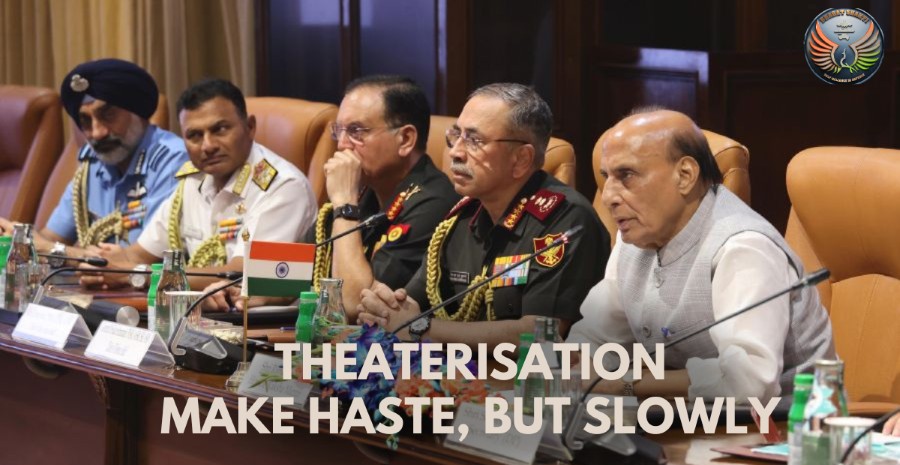
Make Haste, but Slowly
The process of reform is often described in government circles as a “work in progress”, and indeed it needs to be seen as such in a phased approach. The challenge is to remain flexible in thought and action while being committed to constructive change, without allowing preconceived notions to take hold of strategic thinking.
Generating inter-service harmony and civil-military consensus on military reforms has never been an easy proposition in democracies. The National Theatre Command concept offers a “least common denominator” option for moving forward with integrating the Indian military, with an operational and war-fighting focus. From what we know, a lot of progress has indeed taken place in inculcating jointness and integration over the past six years and more. However, in the absence of any consensus so far, the NTC model could be a step forward rather than stalling the movement altogether.
By tweaking the existing higher defence organisation, the model can strengthen jointness by bringing the CDS, CISC and HQIDS under an operational ambit which they currently lack. It would serve to provide greater purpose to the post of CDS as the Principal Adviser on military matters to the Raksha Mantri, across operational and administrative domains.
Once put in place, it would naturally evolve with experience and, within a reasonable time frame of three to five years, provide clearer direction for further reforms concerning Theatre Commands and the conceptual imperatives impinging upon them. It is perhaps time to make haste, slowly.
Nitin A. Gokhale

Author, thought leader and one of South Asia's leading strategic analysts, Nitin A. Gokhale has forty years of rich and varied experience behind him as a conflict reporter, Editor, author and now a media entrepreneur who owns and curates two important digital platforms, BharatShakti.in and StratNewsGlobal.com focusing on national security, strategic affairs and foreign policy matters.
At the beginning of his long and distinguished career, Gokhale has lived and reported from India’s North-east for 23 years, writing and analysing various insurgencies in the region, been on the ground at Kargil in the summer of 1999 during the India-Pakistan war, and also brought live reports from Sri Lanka’s Eelam War IV between 2006-2009.
Author of over a dozen books on wars, insurgencies and conflicts, Gokhale relocated to Delhi in 2006, was Security and Strategic Affairs Editor at NDTV, a leading Indian broadcaster for nine years, before launching in 2015 his own digital properties.
An alumni of the Asia-Pacific Centre for Security Studies in Hawaii, Gokhale now writes, lectures and analyses security and strategic matters in Indo-Pacific and travels regularly to US, Europe, South and South-East Asia to speak at various international seminars and conferences.
Gokhale also teaches at India’s Defence Services Staff College (DSSC), the three war colleges, India's National Defence College, College of Defence Management and the intelligence schools of both the R&AW and Intelligence Bureau.
He tweets at @nitingokhale