


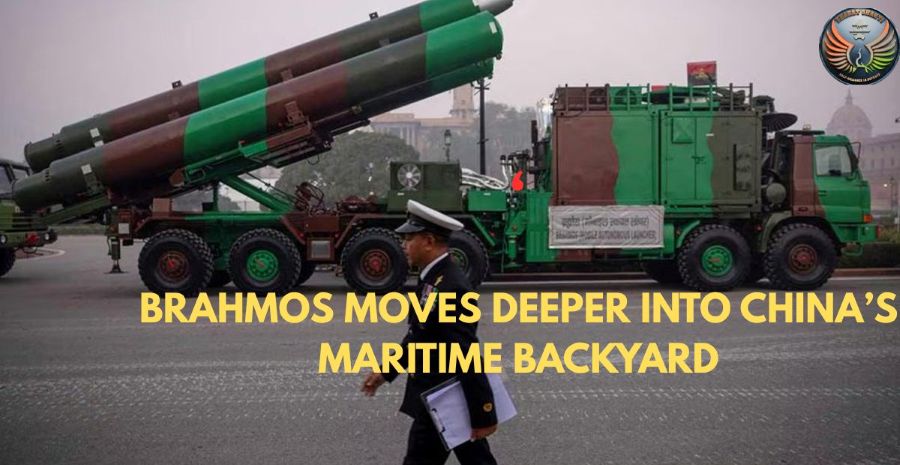
Thailand is emerging as the likely next Southeast Asian buyer of India’s BrahMos supersonic cruise missile, with negotiations between New Delhi and Bangkok understood to be at an advanced stage.
Bangkok is evaluating the BrahMos as part of a broader effort to strengthen its military capabilities and maritime deterrence. The discussions gained momentum after the 10th Thailand-India Defence Dialogue in Bangkok in June, where the two sides agreed to deepen defence cooperation, including in defence manufacturing.
If the deal is concluded, Thailand would become the fourth ASEAN member to acquire BrahMos after the Philippines, Vietnam and Indonesia, further strengthening India’s position in Southeast Asia’s rapidly expanding defence market.
Thailand’s interest comes amid growing security concerns along its maritime and land borders with Cambodia. Relations between Bangkok and Phnom Penh have deteriorated following deadly border clashes and unresolved disputes over land, maritime boundaries and overlapping resource claims.
The security environment has also been shaped by Cambodia’s growing defence relationship with China. Beijing has supplied Phnom Penh with Chinese-built naval vessels and helped upgrade infrastructure at the Ream Naval Base. In April, Cambodia received the first of two Type 056 Jiangdao-class guided-missile corvettes from China.
Against this backdrop, the BrahMos could give Thailand a significant boost to its maritime deterrence.
The missile can be launched from land, ships, submarines and aircraft. Its high speed and multi-platform capability make it particularly attractive to countries seeking to complicate an adversary’s naval operations close to their coastline and around strategically important waters.
A shore-based BrahMos deployment could be particularly relevant to Thailand, which operates across two geographically separated maritime theatres – the Gulf of Thailand and the Andaman Sea.
Maritime strategists believe mobile BrahMos batteries deployed along both coasts, linked to a common surveillance, targeting and command network, could allow the Thai Navy to treat the two theatres as a single operational space.
The capability could become more significant as Thailand expands its surface fleet. The Thai Navy plans to increase its active frigates from four to eight by 2037.
A BrahMos deployment could also provide Bangkok with an additional deterrent in the Gulf of Thailand, particularly as Cambodia expands its naval capabilities with Chinese-made vessels.
Thailand’s potential acquisition would also have a wider regional impact. The Philippines, Vietnam and Indonesia are already moving ahead with BrahMos procurement. Indonesia signed a landmark defence agreement with India on July 7 during Prime Minister Narendra Modi’s visit to Jakarta.
With BrahMos systems eventually deployed across these countries, the missile’s footprint would stretch from the northern South China Sea to the Strait of Malacca and potentially into the Gulf of Thailand and the northeastern approaches to the Andaman Sea.
This would not amount to an integrated ASEAN missile network. But strategically, it could begin to resemble an informal “ASEAN missile wall”, increasing the risks and costs for any major naval power operating close to Southeast Asian coastlines.
For Thailand, buying BrahMos from India also offers a diplomatic advantage. The system incorporates Russian-origin technology, while procurement from India avoids the political complications that could accompany a direct purchase of Russian weapon systems.
The growing BrahMos footprint is unlikely to be welcomed by Beijing. But China may avoid a strong public reaction as India deepens defence partnerships with four countries in its maritime neighbourhood.
For New Delhi, meanwhile, a Thai deal would be more than another export contract. It would strengthen India’s strategic presence in Southeast Asia while expanding the regional footprint of one of its most successful defence exports.
Ravi Shankar

Dr Ravi Shankar has over two decades of experience in communications, print journalism, electronic media, documentary film making and new media.
He makes regular appearances on national television news channels as a commentator and analyst on current and political affairs. Apart from being an acknowledged Journalist, he has been a passionate newsroom manager bringing a wide range of journalistic experience from past associations with India’s leading media conglomerates (Times of India group and India Today group) and had led global news-gathering operations at world’s biggest multimedia news agency- ANI-Reuters. He has covered Parliament extensively over the past several years. Widely traveled, he has covered several summits as part of media delegation accompanying the Indian President, Vice President, Prime Minister, External Affairs Minister and Finance Minister across Asia, Africa and Europe.