



India and Japan are moving to give their growing defence partnership a sharper operational and industrial edge.
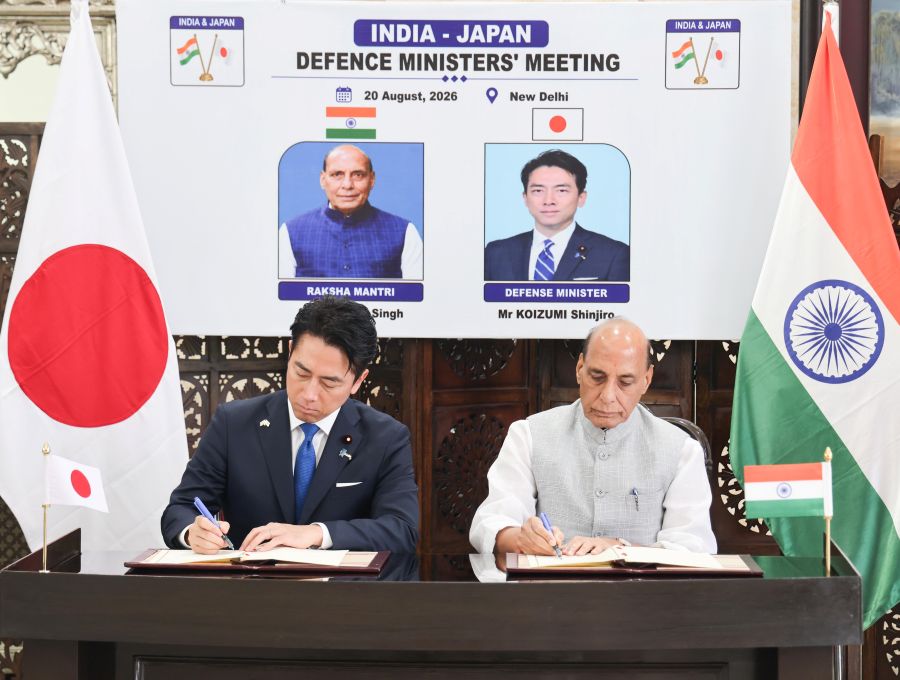
Defence Minister Rajnath Singh and his Japanese counterpart, Shinjiro Koizumi, on Thursday signed a new framework for maritime security cooperation and agreed to accelerate collaboration in naval shipbuilding, defence technology, logistics, and military exercises.
The outcome of the August 20 meeting in New Delhi is significant because it takes the relationship beyond broad strategic convergence. It sets out mechanisms aimed at turning that convergence into operational cooperation and industrial projects.
The two Ministers signed a Memorandum of Arrangement on Maritime Security Cooperation. It provides for greater information sharing on Maritime Domain Awareness, closer cooperation between the Indian Navy and the Japan Maritime Self-Defence Force, and expanded work in search and rescue and in humanitarian assistance and disaster relief.
The focus is also shifting towards the ability to sustain naval operations.
India and Japan agreed to strengthen cooperation to protect sea lines of communication through naval visits, joint exercises, personnel exchanges and logistical support. This includes access to ports as well as maintenance and repair facilities.
For India, however, the most consequential part of the statement could be the push for industrial cooperation.
The two sides agreed to explore joint development in naval shipbuilding and design by combining Japan’s technological expertise with India’s production capabilities. They also agreed to deepen discussions on Japan using Indian production capacity under the Make in India framework.
The two Ministers further agreed to work towards reciprocal access to ship-repair facilities and conclude a ship-repair arrangement in the near future.
Also Read: Defence Secretary Visits Japan, Reviews Strategic Ties as Mogami Frigate Proposal Gains Momentum
This dovetails with Japan’s growing interest in India as a defence manufacturing partner. Tokyo has been pushing the Mogami-class frigate proposal, including technology transfer and local production. The latest statement provides broader political and industrial context for that proposal without announcing a final decision on the frigate programme.
The shift is particularly important against the backdrop of Japan’s recent review of its framework for the transfer of defence equipment and technology.
Singh welcomed the change and expressed expectations for deeper defence and technology cooperation. The two Ministers described the shipborne UNICORN integrated communications antenna project as a symbol of the emerging partnership.
The UNICORN project is the first defence equipment transfer project between the two countries. Both sides committed themselves to its early realisation.
But New Delhi and Tokyo are also signalling that UNICORN should not remain an isolated project.
They agreed to advance discussions among the respective Services on operational requirements for other defence equipment and technology projects. Defence R&D cooperation between India’s DRDO and Japan’s ATLA will also be strengthened, particularly in advanced defence technologies.
A Defence Industry Forum will be convened as part of the effort.
This is where the partnership faces its real test.
As the earlier India-Japan defence dialogue has shown, political convergence does not automatically translate into projects. Differences over technology transfer, intellectual property, costs, production arrangements and export controls have historically slowed cooperation.
The latest statement attempts to address that gap by linking operational requirements with industry, technology and production.
It also establishes a Working Group headed at Director-General/Joint Secretary level. The group will coordinate cooperation across the operational, intelligence, equipment, technology, and industrial domains and accelerate the implementation of decisions taken by the two Ministers.
That could prove more important than another high-level declaration.
Also Read: SIDM Push Tests India-Japan Defence Technology Partnership
The military relationship is expanding on several fronts. India and Japan are deepening Dharma Guardian and JAIMEX. Japan’s fighter aircraft will participate in Veer Guardian 26 in India for the first time. Both sides also want greater integration of unmanned systems and the ability to conduct exercises at short notice.
They have also agreed to promote exchanges between Special Operations Forces and explore cooperation with India’s integrated theatre commands after their establishment.
Meanwhile, the partnership is widening beyond bilateral cooperation. India, Japan and Indonesia held their first trilateral naval PASSEX in February. The two countries now want greater engagement with third countries through exercises and high-level exchanges.
The Indo-Pacific Logistics Network is another emerging pillar. India and Japan plan to use it to support partner countries during natural disasters by moving personnel and supplies.
The two Ministers also agreed to accelerate preparations for the fourth India-Japan 2+2 Foreign and Defence Ministerial Meeting to be held in Tokyo this year.
The direction is clear. India and Japan are trying to build a defence relationship that connects strategy, military operations, technology and industrial capacity.
The challenge now is delivery.
The new Working Group, the Defence Industry Forum, the UNICORN project and the proposed shipbuilding and repair cooperation will provide early indicators of whether the partnership can overcome the structural hurdles that have held it back.
For India, the opportunity is to tap into Japan’s strengths in precision engineering, advanced technology, and naval systems while leveraging its own manufacturing scale.
For Japan, India offers something equally valuable: production capacity, a large defence market and a strategic partner in the Indo-Pacific.
The latest meeting suggests that both sides increasingly see the value of combining those strengths.
The next test will be whether the agreements signed in New Delhi produce platforms, technologies and industrial capacity on the ground rather than remaining another chapter in an otherwise promising strategic partnership.
Ravi Shankar

Dr Ravi Shankar has over two decades of experience in communications, print journalism, electronic media, documentary film making and new media.
He makes regular appearances on national television news channels as a commentator and analyst on current and political affairs. Apart from being an acknowledged Journalist, he has been a passionate newsroom manager bringing a wide range of journalistic experience from past associations with India’s leading media conglomerates (Times of India group and India Today group) and had led global news-gathering operations at world’s biggest multimedia news agency- ANI-Reuters. He has covered Parliament extensively over the past several years. Widely traveled, he has covered several summits as part of media delegation accompanying the Indian President, Vice President, Prime Minister, External Affairs Minister and Finance Minister across Asia, Africa and Europe.