






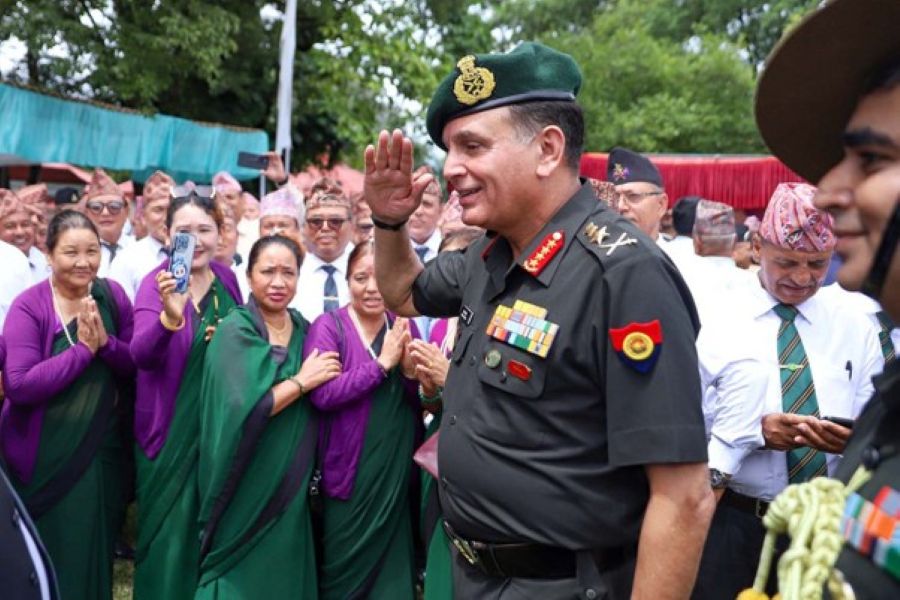
Indian Army Chief General Dhiraj Seth concluded his first foreign visit since taking charge with a four-day trip to Nepal this week, aimed at strengthening the longstanding defence and military ties between the two countries.
But the visit was also dominated by a contentious issue that remained outside the formal agenda – the stalled recruitment of Nepali Gorkhas into the Indian Army.
Gen Seth, who visited Nepal at the invitation of Nepali Army Chief General Ashok Raj Sigdel, held talks with Nepal’s top political and military leadership. President Ram Chandra Paudel conferred on him the honorary rank of General of the Nepali Army, continuing a military tradition dating back to 1950.
Gen Seth also held separate meetings with President Paudel, Prime Minister Balendra Shah and the Nepalese Army Chief. Prime Minister Shah, who also holds the defence portfolio, received the Indian Army Chief at the Office of the Prime Minister.
The official discussions focused on strengthening bilateral military relations, joint training and strategic cooperation. Nepali Army spokesman Brigadier General Rajaram Basnet said the talks centred on bilateral defence cooperation and military-to-military engagement.
According to Nepali officials, the Agnipath scheme was not part of the agenda prepared by the Bilateral Group on Security Issues, which includes officials from the defence and foreign ministries and senior military officers of both countries.
Indian Army sources did not comment on whether the subject was raised during COAS’ meetings.
The issue nevertheless remained prominent throughout the visit.
Days before Gen Seth’s arrival, hundreds of former Indian Army personnel, their families and Gorkha aspirants marched in Pokhara demanding that Kathmandu allow the recruitment of Nepali youths under the Agnipath scheme. The protesters submitted memorandums to Prime Minister Shah and Home Minister Sudan Gurung.
Former Gorkha soldiers also raised the issue directly with Gen Seth during his visit to Pokhara. Gaj Bahadur Thapa, central vice-president and Gandaki Province coordinator of the Nepal Bharatiya Gorkha Sainik Board, urged him to help revive recruitment.
“We have been raising our voice for Gorkha recruitment, and you must also address it,” Thapa told Gen Seth, according to The Kathmandu Post.
The Indian Army Chief did not commit to resuming recruitment.
The recruitment of Nepali citizens into the Indian Army has been suspended since 2020, initially due to the COVID-19 pandemic. The issue became more complicated after India introduced the Agnipath scheme in June 2022.
Under the scheme, recruits, known as Agniveers, serve for four years. Only up to 25 per cent of a batch can be retained for longer service. The remaining personnel leave without a lifelong pension or medical benefits, but receive a one-time financial package and a promise of absorption in other government organisations, including state and central police forces. The first batch of Agniveers will be completing their tour of duty later this year.
The new system triggered protests in Nepal, particularly over the implications of sending short-service personnel back without traditional pension benefits.
Before the suspension, the Indian Army recruited around 1,200-1,500 Gorkhas from Nepal every year. The force currently has seven Gorkha regiments, with around 34,000 Nepali citizens serving in them.
The recruitment relationship has deep historical roots. Gorkhas have served in the Indian Army for more than two centuries. The 1947 tripartite arrangement between India, Nepal and Britain allowed the recruitment of Gorkhas to continue after Indian independence. Six Gorkha regiments were transferred to the Indian Army, while four remained with the British Army.
For India, the Gorkha connection remains an important pillar of military ties with Nepal. For Nepal, however, the Agnipath model has raised questions about the future of a recruitment arrangement that has survived for generations.
Gen Seth’s visit therefore highlighted both the resilience and the emerging strains in India-Nepal military ties. The honorary rank ceremony and high-level meetings reaffirmed the traditional relationship. The continuing silence over Gorkha recruitment, meanwhile, showed that the issue remains unresolved.
The strong mobilisation by veterans and prospective recruits also suggests that pressure on Kathmandu to reopen the recruitment channel is unlikely to disappear soon.
Ravi Shankar

Dr Ravi Shankar has over two decades of experience in communications, print journalism, electronic media, documentary film making and new media.
He makes regular appearances on national television news channels as a commentator and analyst on current and political affairs. Apart from being an acknowledged Journalist, he has been a passionate newsroom manager bringing a wide range of journalistic experience from past associations with India’s leading media conglomerates (Times of India group and India Today group) and had led global news-gathering operations at world’s biggest multimedia news agency- ANI-Reuters. He has covered Parliament extensively over the past several years. Widely traveled, he has covered several summits as part of media delegation accompanying the Indian President, Vice President, Prime Minister, External Affairs Minister and Finance Minister across Asia, Africa and Europe.