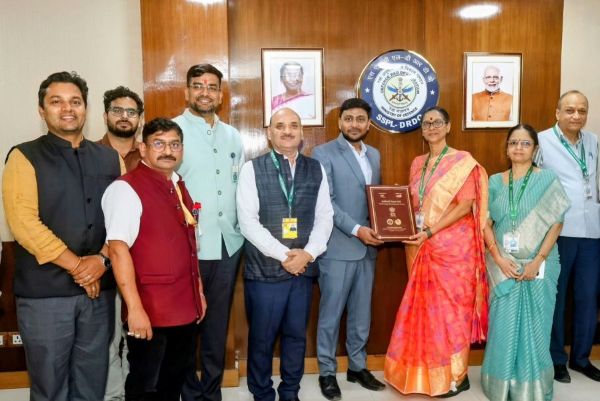
India has taken a step towards building a critical piece of infrastructure for quantum applications, with the Defence Research and Development Organisation (DRDO) signing its first high-value deep-tech agreement under the Technology Development Fund (TDF) for the indigenous development of a 20 millikelvin (mK) dilution refrigerator.
The agreement with Rajasthan-based start-up Zero mK India Private Limited is the first high-value deep-tech project to be taken up under the Rs 500-crore corpus approved by Defence Minister Rajnath Singh for cutting-edge technology development.
While a dilution refrigerator is not itself a quantum computer, it is a critical enabling system for several quantum-computing architectures. These systems require operating temperatures only a fraction of a degree above absolute zero to maintain the extremely fragile quantum states on which quantum processors depend.
The ability to cool quantum hardware to around 20 mK is therefore an important part of the technology stack needed to build, test and scale certain quantum processors. At these temperatures, thermal disturbances are drastically reduced, allowing quantum devices to operate in the highly controlled environment required for experiments and computation.
For India, developing this capability domestically has implications beyond quantum computing. Advanced cryogenic systems are specialised technologies involving precision engineering, refrigeration, electronics and control systems. Dependence on imported equipment can create vulnerabilities in the development and testing of sensitive strategic technologies.
The DRDO project is consequently aimed at building more than a specialised refrigeration system. It seeks to establish an indigenous capability in an enabling technology that could become increasingly important as India’s quantum ecosystem expands.
The project is aligned with the National Quantum Mission and is intended to strengthen India’s capabilities in quantum technology, advanced cryogenics and other strategic technology areas. Indigenous production could reduce dependence on imported cryogenic infrastructure while giving Indian researchers, start-ups and technology developers greater access to critical equipment.
The agreement also signals a widening role for the TDF in supporting deep-tech start-ups in areas that may have applications beyond traditional defence systems.
The Rs 500-crore corpus was specifically approved to support high-end and emerging technologies, with greater participation by industry and start-ups. The 20 mK dilution refrigerator project is the first high-value agreement under this initiative, giving it significance as an early test of the DRDO-industry model for developing difficult-to-build technologies domestically.
Rajnath Singh congratulated DRDO, Zero mK India and other stakeholders involved in the project, expressing confidence that the partnership would establish a precedent for future DRDO-industry collaborations in emerging technology domains.
Defence Secretary, Secretary, Department of Defence R&D and DRDO Chairman Rajesh Kumar Singh also congratulated the teams and wished them success in achieving the project objectives.
The project is being monitored and mentored by the Solid State Physics Laboratory (SSPL), with its Director and team providing technical support. Senior officials from DRDO’s Micro Electronic Devices & Computational System and Cyber Security, Technology Management and SSPL were present at the signing.
The project comes as India seeks to develop an indigenous quantum technology ecosystem spanning quantum computing, communications, sensing and associated enabling technologies. Building domestic capability in the less visible but essential infrastructure, such as ultra-low-temperature cryogenics, could prove as important to that effort as developing the quantum processors themselves.
Team BharatShakti