






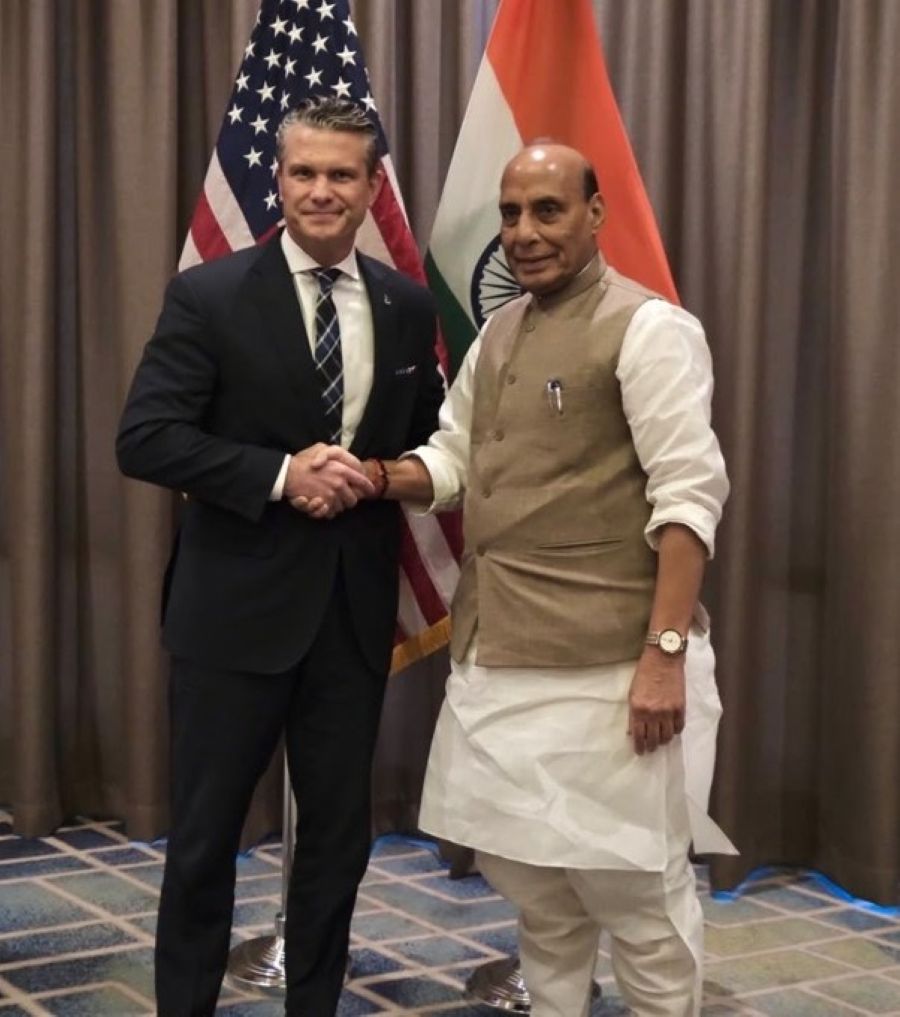
India has stepped up defence engagement with the United States and Japan, with Defence Minister Rajnath Singh holding separate bilateral meetings with his US counterpart Pete Hegseth and Japan’s Defence Minister Shinjiro Koizumi on the sidelines of the ASEAN Defence Ministers’ Meeting-Plus (ADMM-Plus) in Cebu on Wednesday.
The discussions focused on strengthening military cooperation, expanding defence industrial collaboration and advancing maritime security in the Indo-Pacific. While the India-US meeting reviewed progress under the 10-year Defence Framework and addressed counterterrorism, the talks with Japan sought to translate the two countries’ strategic partnership into deeper operational and industrial cooperation.
In his meeting with Hegseth, Singh reviewed the progress of the India-US Major Defence Partnership, with both sides exploring ways to improve operational readiness, expand technology sharing and integrate defence industrial supply chains. The discussions also covered military-to-military exchanges and maritime security cooperation.
The two ministers reiterated their commitment to combating terrorism. Singh called for a zero-tolerance approach towards countries that support, train or finance terrorist organisations, while Hegseth reaffirmed Washington’s support for India in its fight against cross-border terrorism. Singh expressed appreciation for US support.
The meeting comes as New Delhi and Washington seek to build on their established defence cooperation and strengthen the industrial and technological foundations of their strategic partnership. Both sides reaffirmed their commitment to taking the relationship towards greater strategic convergence.
In a post on X following the meeting, Singh described the India-US partnership as a cornerstone of a free, open and secure Indo-Pacific.
Japan talks target maritime and aerospace cooperation
Singh’s meeting with Koizumi focused on implementing the directions agreed upon at their previous meeting in August and expanding practical defence cooperation between the two countries.
Maritime security emerged as a key area, with the two sides reviewing discussions on mine countermeasure capabilities and exploring the possibility of joint development in naval shipbuilding and design. The proposed cooperation would draw on Japan’s technological expertise and India’s manufacturing and production capabilities. The visit of the Indian Navy’s Vice Chief to Japan was cited as an opportunity to advance these discussions.
The two ministers also welcomed progress in air force cooperation following the first-ever visit of Japanese Air Self-Defence Force fighter aircraft to India for the ‘Veer Guardian 26’ exercise. The visit of Japan’s Air Self-Defence Force Chief of Staff, held in conjunction with the exercise, provided another avenue to strengthen service-to-service engagement.
Defence industry cooperation was another focus, following the successful India-Japan Defence Industry Forum in Tokyo, which brought together around 40 companies from the two countries.
The ministers agreed to accelerate preparations for the fourth India-Japan Foreign and Defence Ministerial Dialogue, known as the 2+2, and a bilateral defence ministers’ meeting scheduled to take place in Tokyo later this year.
Singh said the discussions had explored new avenues to strengthen the India-Japan Special Strategic and Global Partnership, adding that the two countries’ shared commitment remained vital to a free, open and peaceful Indo-Pacific.
A wider regional security agenda
Taken together, the two meetings underline India’s effort to deepen defence partnerships across the Indo-Pacific through a combination of operational cooperation, technology access and stronger industrial links. With the US, the emphasis remains on consolidating the existing strategic framework and addressing shared security concerns. With Japan, the agenda increasingly includes practical collaboration in naval capabilities, aerospace cooperation and defence manufacturing.
The challenge for both partnerships will be to convert political commitments and ongoing discussions into deliverable projects, stronger military interoperability and resilient defence supply chains as regional security demands continue to evolve.
Team BharatShakti