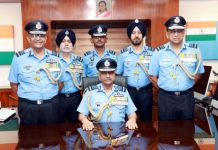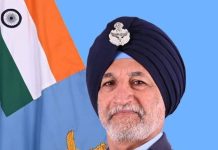






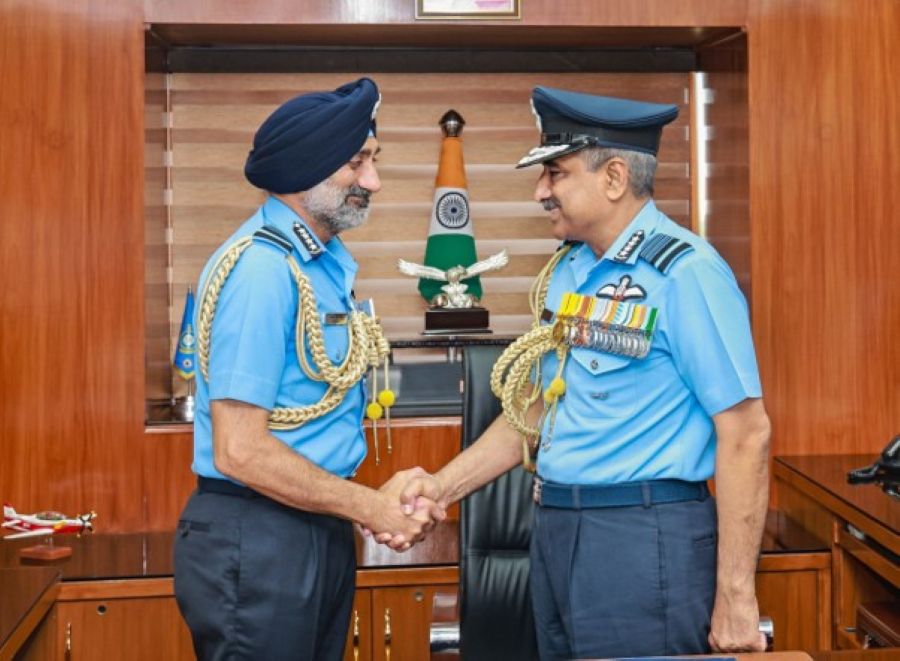
Air Chief Marshal AP Singh retired on Saturday after 42 years of service, leaving behind a tenure that combined operational leadership with unusually forthright interventions on India’s defence preparedness, indigenous manufacturing and the changing demands of air warfare. While Operation Sindoor became a defining episode of his tenure, his public remarks on defence production bottlenecks and the IAF’s shrinking fighter strength also brought institutional shortcomings into sharper focus.
His most consequential operational moment came during Operation Sindoor in May 2025. In August that year, ACM Singh publicly disclosed that the IAF had confirmed the destruction of at least five Pakistani fighter aircraft and a larger aircraft, possibly an airborne early warning or electronic intelligence platform, at a distance of around 300 km. His account brought greater clarity to India’s assessment of the operation but also fuelled competing claims and counter-claims over aerial losses. The military operation demonstrated the IAF’s ability to execute precision strikes and employ integrated air defence capabilities, although the full details of the aerial engagements and losses on both sides remained contested.
ACM Singh was equally outspoken about the shortcomings in India’s defence manufacturing ecosystem. His public criticism of Hindustan Aeronautics Limited (HAL), particularly over delays in delivering the Light Combat Aircraft Tejas Mk1A, was among the most striking interventions by a serving Air Chief in recent years. At Aero India 2025, he questioned HAL’s ability to meet delivery commitments, criticised the absence of a coordinated, mission-oriented approach and expressed frustration over repeated assurances without tangible results. While his remarks were welcomed by those demanding accountability from defence public-sector undertakings, they also raised questions about the growing disconnect between the armed forces’ operational requirements and the delivery capabilities of domestic manufacturers.
The fighter squadron deficit remained another recurring concern. ACM Singh repeatedly warned that the IAF needed to induct 36–40 fighter aircraft annually to arrest the decline in combat strength and move towards its authorised establishment of 42 squadrons. By October 2026, the operational strength had fallen to around 29 squadrons. His remarks underscored the urgency of accelerating Tejas Mk1A deliveries, progressing the proposed multi-role fighter aircraft acquisition and strengthening indigenous development programmes. He also cautioned that delays in India’s fifth-generation Advanced Medium Combat Aircraft (AMCA) programme could force the IAF to consider alternative platforms.
His October 2026 remarks on the American F-35 stealth fighter added another dimension to the debate over access to advanced foreign military technology. During Exercise Tarang Shakti, he jokingly told a senior US Air Force commander that American personnel did not even allow Indian officers close access to the aircraft, while Washington was talking about selling it to India. He subsequently clarified that the US had made no formal offer to sell the F-35. The exchange highlighted the limitations of technology access and the complexities of evaluating foreign platforms even as India seeks to bridge its fifth-generation fighter capability gap.
His retirement was also accompanied by an unusual episode surrounding the traditional farewell golf outing. The planned ‘golfing-out’ at the Air Force Sports Complex on Lok Kalyan Marg was cancelled after the facility was abruptly closed on October 28 amid the government’s wider exercise to reclaim prime government land in the area. The timing prompted speculation and allegations of a possible institutional slight in some political and public circles. However, officials maintained that the closure was part of the broader land-reclamation exercise, while the IAF clarified that the relocation of the ceremonial farewell arrangements was unrelated to the development. ACM Singh had, in fact, received a formal farewell hosted by Defence Minister Rajnath Singh on October 26, attended by senior military and defence establishment officials, followed by a ceremonial guard of honour.
An Outspoken Air Chief Who Challenged Theatre Command Blueprint
Perhaps his most consequential institutional intervention concerned the proposed Integrated Theatre Commands, where his position brought him into a clear disagreement with the Army’s approach to restructuring the armed forces. As the government works towards establishing geographically defined Northern, Western and Maritime Theatre Commands, Singh repeatedly cautioned against permanently allocating fighter squadrons to individual theatres.
He was careful to clarify that the IAF was not opposed to jointness or theatreisation as such. His objection was to a rigid arrangement that would divide its combat assets into fixed geographical formations, restricting the flexibility to deploy air power wherever operational circumstances demanded. The Army’s emphasis on integrated, theatre-based command structures has to be reconciled with the IAF’s argument that air power derives its strength from mobility, reach and the ability to concentrate combat resources rapidly across different fronts.
ACM Singh advocated the principle of centralised control and decentralised execution, arguing that fighter aircraft, supported by aerial refuelling, long-range weapons and networked surveillance systems, could be shifted between operational sectors depending on the evolving threat. In his assessment, permanently locking fighter squadrons into individual theatres risked undermining this inherent flexibility and could dilute the overall combat effectiveness of the IAF.
He also invoked the operational experience of Operation Sindoor to underline the importance of retaining the ability to allocate and reallocate critical air assets according to operational requirements. The experience, he suggested, should inform the final architecture of theatre commands rather than allowing organisational restructuring to dictate how air power is employed.
ACM Singh further cautioned against importing foreign military models, whether American or Chinese, without first examining India’s distinct geographical, strategic and operational requirements. He favoured a phased approach to theatreisation, ensuring that structural changes did not disrupt operational readiness or compromise the ability of the armed forces to respond to an emerging conflict.
The disagreement exposed a fundamental doctrinal question confronting India’s military integration exercise – whether geographical command structures should determine the deployment of air assets, or whether the unique characteristics of air power require a more flexible arrangement under centralised operational control. ACM Singh’s successor will inherit this unresolved debate, which is likely to shape the future command architecture of the Indian armed forces.
Beyond these controversies, Singh’s tenure was marked by a strong emphasis on operational readiness, indigenisation, innovation and the integration of emerging technologies. His direct engagement with air warriors across the organisation reflected his belief that the effectiveness of the force ultimately rests on the professionalism and commitment of its personnel.
His legacy, therefore, is likely to be assessed on two parallel fronts – the IAF’s demonstrated operational capabilities under his leadership and his willingness to publicly confront the structural deficiencies that continue to constrain India’s air power ambitions. His successor inherits many of the same challenges that Singh repeatedly flagged – an ageing fighter fleet, delayed indigenous programmes, a widening technological gap and the need to reconcile self-reliance with the urgency of military modernisation.
Ravi Shankar
Dr Ravi Shankar has over two decades of experience in communications, print journalism, electronic media, documentary film making and new media.
He makes regular appearances on national television news channels as a commentator and analyst on current and political affairs. Apart from being an acknowledged Journalist, he has been a passionate newsroom manager bringing a wide range of journalistic experience from past associations with India’s leading media conglomerates (Times of India group and India Today group) and had led global news-gathering operations at world’s biggest multimedia news agency- ANI-Reuters. He has covered Parliament extensively over the past several years. Widely traveled, he has covered several summits as part of media delegation accompanying the Indian President, Vice President, Prime Minister, External Affairs Minister and Finance Minister across Asia, Africa and Europe.