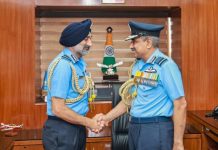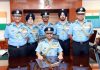






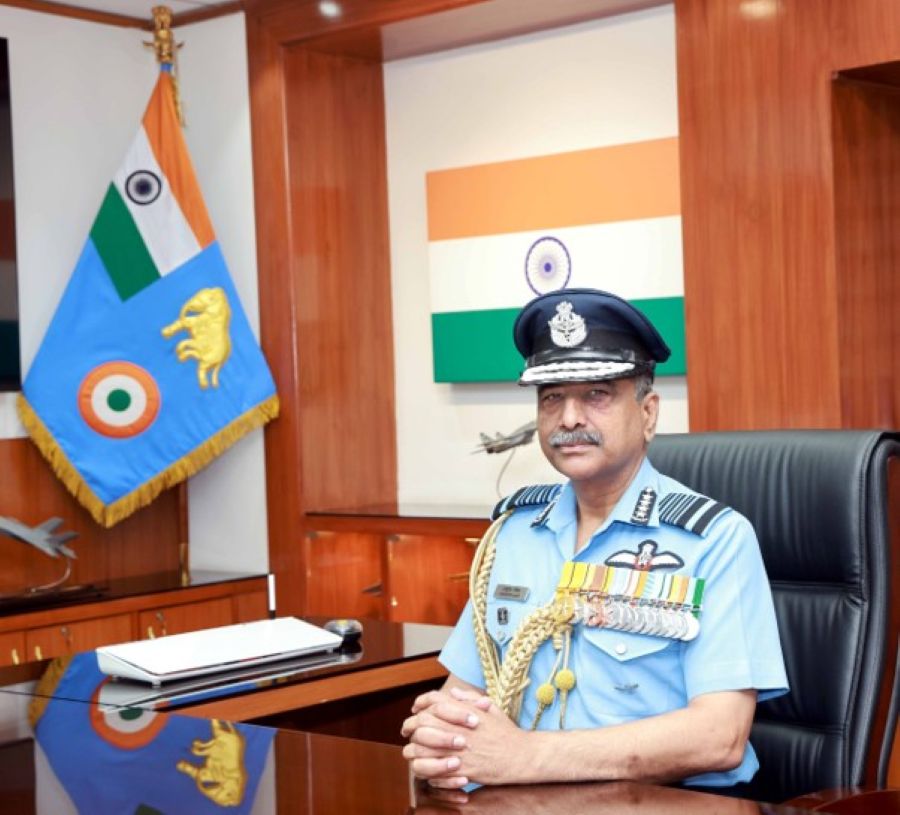
Restoring the Indian Air Force’s depleted fighter squadron strength, accelerating indigenous capability development and preparing for technology-driven warfare will be among the foremost priorities of the new Chief of Air Staff, Air Chief Marshal Ashutosh Dixit.
A day after taking over as the 29th Chief of Air Staff on October 31, Dixit outlined his vision for the force, bringing together four key priorities under the acronym ‘VAYU’ – Vigilance and Readiness, Aatmanirbharta, Yukti (ingenuity) and Unity of Effort.
The framework signals an emphasis on rebuilding the IAF’s combat capability while preparing it for an evolving security environment in which drones, long-range precision weapons, artificial intelligence, space and cyber capabilities are increasingly shaping the character of warfare.
” Our security environment remains demanding. In addition, the character of war is being reshaped by new technologies and systems like drones, long-range precision weapons, space, cyber, AI and the electromagnetic spectrum,” ACM Dixit said.
He added that while the IAF transforms into the force India would need in the next decade, it must remain prepared to fight and win.
Restoring combat strength
The first priority, represented by ‘V’ for Vigilance and Readiness, places operational preparedness and the restoration of the IAF’s sanctioned combat strength at the top of his agenda.
“Every squadron, every radar, every air defence unit along with each and every Air Warrior must be ready to respond at a moment’s notice. Restoring our combat strength towards the sanctioned level will also be my foremost task,” he said.
The IAF has a sanctioned strength of 42 fighter squadrons, but its actual numbers have remained significantly below that level. The retirement of ageing fighter aircraft, including the MiG-21, has further widened the gap, while delays in the delivery of the indigenous Light Combat Aircraft (LCA) Tejas Mk1A have complicated the force’s modernisation plans. More fighter squadrons are also due for retirement over the coming years.
Indigenisation as a combat imperative
The second pillar, ‘A’ for Aatmanirbharta, places indigenous platforms, weapons and sensors at the centre of the IAF’s future capability development.
“The Tejas Mk1A and II, the AMCA, Indian sensors and Indian weapons are our highest priority,” ACM Dixit said, referring to the Light Combat Aircraft variants and the Advanced Medium Combat Aircraft programme.
Significantly, the new Air Chief linked self-reliance directly to operational effectiveness, arguing that indigenous systems must be available in sufficient numbers to sustain military operations.
“We will fight with Indian solutions, and we will hold them in numbers and meet sustained operations demands,” he said.
“Our responsibility is to fight and win, but most importantly, it is to deter conflict through credible Air Power.”
The emphasis reflects the IAF’s growing dependence on domestic industry for combat aircraft, weapons, sensors and supporting technologies, even as it continues to address critical capability gaps.
AI, counter-drone warfare and near-space
The third pillar, ‘Y’ for Yukti or ingenuity, underlines the importance of innovation in doctrine, operational procedures and technology.
ACM Dixit identified networked, AI-enabled command and control systems, layered counter-drone defences, responsive maintenance, force protection and operational resilience as areas requiring sustained attention.
He also highlighted the use of near-space as an emerging operational domain for the Air Force.
The priorities reflect the changing demands of modern air warfare, where the ability to integrate information, detect threats, respond rapidly and maintain operational continuity can be as important as conventional air combat capabilities.
Jointness at the heart of operations
The fourth pillar, ‘U’ for Unity of Effort, puts inter-service integration at the centre of the IAF’s operational planning.
“In step with the vision of JAI – Jointness, Aatmanirbharta and Innovation – we will plan and fight as one along with our Army, our Navy and our National Agencies,” he said.
“Air power delivers most when it is integrated from the very first plan.”
The emphasis on jointness comes amid continuing efforts to improve coordination among the three services and develop a more integrated approach to national security. ACM Dixit’s previous assignment as Chief of Integrated Defence Staff to the Chairman, Chiefs of Staff Committee had also placed him at the centre of tri-service integration initiatives.
Focus on personnel
Beyond operational and technological priorities, the new Air Chief underscored the importance of the IAF’s personnel, including serving air warriors, Agniveervayu personnel, civilian employees, veterans, Veer Naris and their families.
Their training, professional excellence, morale, safety, welfare and dignity would receive his personal attention, he said.
ACM Dixit also acknowledged the contribution of his predecessor, Air Chief Marshal AP Singh, under whose leadership the IAF conducted Operation Sindoor.
“Under his leadership in Operation Sindoor, the Air Force displayed what precise and decisive air power can achieve. I thank him for handing over a force in a high state of readiness,” he said.
Ravi Shankar
Dr Ravi Shankar has over two decades of experience in communications, print journalism, electronic media, documentary film making and new media.
He makes regular appearances on national television news channels as a commentator and analyst on current and political affairs. Apart from being an acknowledged Journalist, he has been a passionate newsroom manager bringing a wide range of journalistic experience from past associations with India’s leading media conglomerates (Times of India group and India Today group) and had led global news-gathering operations at world’s biggest multimedia news agency- ANI-Reuters. He has covered Parliament extensively over the past several years. Widely traveled, he has covered several summits as part of media delegation accompanying the Indian President, Vice President, Prime Minister, External Affairs Minister and Finance Minister across Asia, Africa and Europe.