






Editor’s Note
The three-part series examines why India’s Army needs a more responsive and institutional approach to evaluating and procuring rapidly evolving drone and counter-drone technologies. It moves from the challenges confronting users, industry and procurement authorities, to a proposed common battlefield testing framework, and finally to the critical question of translating operational evidence into procurement decisions. At its core, the series argues that testing has little value unless it influences what the Army buys and how it buys it.
Part I: Why Drone Procurement Keeps Falling Behind
The challenge is not simply to acquire better drones, but to build a system that can identify, evaluate and induct the right capabilities before technology overtakes the procurement cycle. The author examines the widening gap between the rapid evolution of drone warfare and the Army’s ability to assess emerging systems in time. The article sets out the difficulties faced by soldiers, manufacturers and procurement agencies, making the case for a recurring, transparent and operationally relevant evaluation mechanism. It introduces Ran Kasauti as a way to bridge this gap and ensure that battlefield performance, rather than procurement timelines alone, drives the choice of technology.
The Army does not need a better drone so much as a faster, fairer way of finding out which drone works this season – and buying it before the answer goes stale.
In drone warfare, the side that wins is rarely the side that had the best equipment on the day the contract was signed. It is the side that adapts faster than the adversary can change the problem. A jammer is fielded; frequency-hopping links answer it. Fibre-optic tethers answer the jammer. Interceptor drones answer the tether. In Ukraine, each turn of that wheel takes weeks. In our conventional procurement cycle, a single turn – from problem statement through trials to contract – still takes years. Urgent routes are faster, but rarely as fast as the threat changes.
The ingredients for speed largely exist. India has hundreds of drone makers. In June this year, the financial powers of field commanders for revenue procurement were doubled, and the ceiling for urgent operational requirements rose by 100 per cent. The Army has conducted electronic-warfare-integrated trials, and the services have run drone competitions. What is missing is the connection: testing, evaluation, procurement and battlefield feedback do not yet form one recurring, procurement-linked learning system.
This three-part series proposes one. I call it Ran Kasauti – the battlefield touchstone. A kasauti is the stone against which gold is rubbed to judge its purity. Rub every drone, counter-drone system and application against the battlefield, openly and at regular intervals, and buy what passes.
Scope matters. Ran Kasauti is not meant for tanks, guns or aircraft kept for decades. It is meant for rapidly evolving and possibly attritable systems – small drones, loitering munitions, FPVs, interceptors and the counter-drone systems that hunt them – where designs change every few months and losses are expected. Nor is it only about hardware. Flight control, mission planning, target recognition and sensor fusion software change faster than airframes and often decide the outcome.
The challenges, seen from three sides
Users
• Industry partners approach formations directly for demonstrations and trials, pulling troops, equipment, ranges and staff time away from operational tasks.
• With no institutional testing mechanism, an evaluation is only as good as the few individuals running it, and the expertise leaves when they are posted out.
• There is no consistently accessible, Army-wide base of trial results: a formation often cannot see how the same equipment performed for another, and past performance is effectively invisible.
• Units have no reliable way to check that what is delivered matches what was tested, or that quality holds from batch to batch.
• Requirements are written for threats that move on before trials end.
• Incompatible links and ground stations leave units sustaining a zoo of systems; a detection that cannot reach a shooter in seconds is merely an observation.
• Software updates arrive with no clear way to validate what changed, and field experience rarely flows back into the next purchase.
Industry
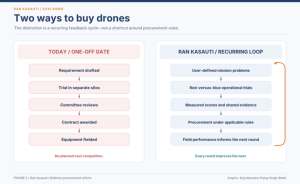
• Trials are one-off events: a winner has little reason to keep improving, and a loser who fixes the product has no way back in.
• Firms face repeated no-cost-no-commitment trials and endless proofs of concept, each with no assurance of an order.
• Capabilities are evaluated in fragments – GNSS-denied navigation in one trial, ISR in another, EW resilience in a third – so the same product is tested again and again at the firm’s cost, and no trial earns credit in the next.
• Results are rarely explained, so firms do not know why they lost.
• Price-led selection can reward the cheapest compliant product over the most effective one.
• Without visibility of future demand, firms hesitate to invest in production, and software-only firms have no obvious route in.
Procurement
• Financial powers decide who may approve spending, not how an industry partner is selected; an operational ranking does not automatically become a contract.
• Each route – urgent buys, development, upgrades of in-service equipment – runs its own demonstration or trial, and past performance is rarely available to inform the next decision.
• Trials are repeated at each level, and months disappear in the duplication.
• Drones and counter-drone systems are evaluated in separate silos.
• Rules built for platforms that last thirty years sit awkwardly with systems that may be obsolete in eighteen months, and audit caution makes officers reluctant to try anything novel.
A case in point: one Command, 79 problems
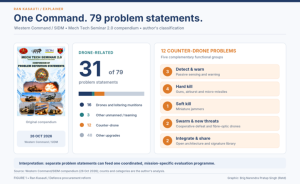
Western Command’s Mech Tech Seminar 2.0, held with the Society of Indian Defence Manufacturers, shows both the promise and the problem. Its Compendium of Problem Definition Statements, released publicly on 26 October 2026, sets out 79 problem definition statements for upgrading existing platforms – exactly the bottom-up, user-driven approach the Army needs. By my count, 31 concern drones or counter-drone systems: 16 on drones and loitering munitions, three on other unmanned systems and manned-unmanned teaming, and 12 on countering drones. Several more are driven by the drone threat.
Read together, the 12 counter-drone statements describe a single layered system: passive detection on moving vehicles, threat warning, airburst and close-protection guns, micro-missiles against swarms, jammers, defeat of fibre-optic drones, and common integration. The drone statements – from AI target recognition on FPVs to decoy and chaff-dispensing drones – are the very threats that the system must defeat.
• Handled one by one, each statement leads to its own demonstration: up to 31 separate events and 31 sets of results that never meet.
• Tested together, as one coordinated Ran Kasauti round – mission-specific test events sharing one range, one data standard and one evidence base, with drones and counter-drones pitted against each other – the results add up.
Tellingly, one statement itself asks for an Army-owned open architecture and a common drone signature library, so that any sensor or effector can be added and all systems recognise the same drones.
What other are doing
The United States has chosen an instructive answer. Its Drone Dominance Program runs recurring “Gauntlets” – competitive field evaluations scored on mission performance, ratings by the soldiers who operated the systems, and industrial capacity. The first, at Fort Benning early this year, ended in a public leaderboard and orders for about 30,000 one-way attack drones from the top eleven performers. The second, at Fort Carson in August, introduced different and more demanding mission categories, reshuffling the field and showing the value of repeated, mission-specific assessment. Ukraine, out of necessity, ties procurement to combat data: manufacturers can see performance rankings and mission statistics, and units buy directly through a defence marketplace.
We need not copy either model, and they differ: the US publishes rankings openly, while Ukraine feeds battlefield performance back to manufacturers. But both treat evaluation as continuous rather than a gate passed once, and both connect it to money. That is the shift we need.
Part 2 describes how Ran Kasauti would be built and run. Part 3 shows how its results can feed every procurement route, and why selection should rest on performance, not price alone.
The drone war is a contest of learning rates. Ran Kasauti is a proposal to make the Army’s learning rate visible – and to put a purchase order at the end of every lesson.
Brig Narendra Pratap Singh (Retd)
(The author is CEO of Mindsprintz Consulting. He led the Indian Army’s MIS and writes about defence procurement, AI, unmanned systems, and digital transformation.)
(To be continued)

Brigadier Narendra Pratap Singh (Retd) is a Defence Technology Strategist, AI and Digital Transformation Leader, and former Director of Artificial Intelligence in the Indian Army. He is currently the CEO of Mindsprintz Consulting, advising defence organisations, startups, and industry on artificial intelligence, autonomous systems, digital transformation, and the future of warfare.