



Editor’s Note
The author in this piece contends that sovereignty in the digital age is no longer defined solely by ownership, but by the ability to sustain critical capabilities amid disruption and attack. Drawing lessons from Ukraine, he argues that dependence on foreign-controlled communications such as Starlink, electronic warfare, cloud infrastructure and AI systems creates strategic vulnerabilities. For India, the imperative is to build resilient, trusted indigenous capacities that can endure coercion, denial, and conflict.
A Question Bigger Than Artificial Intelligence
These days, sovereignty has become a fashionable term. Governments speak about it. Technology companies speak about it. Think tanks write about it. Yet the events of the last few years suggest that we may not fully understand what sovereignty means in an age in which critical capabilities increasingly depend on technologies owned, operated, and controlled by others.
The debate gathered momentum when reports emerged of restrictions on access to some advanced AI systems and models. Questions were raised about the availability of Anthropic’s Fable and Mythos models, the relationship between frontier AI companies and government programmes such as Maven, and the growing role of private firms in capabilities that were once considered the exclusive domain of states. Around the same time, reports emerged of disagreements between the Pentagon and SpaceX over Starlink services during military operations. Elsewhere, Ukraine and Russia continued their relentless struggle over satellite communications, electronic warfare and access to critical digital infrastructure.
At first glance, these appear to be unrelated stories. One concerns artificial intelligence. Another concerns satellites. A third concerns military operations. Yet all point towards the same conclusion. Sovereignty is no longer exercised solely by governments. Increasingly, private technology companies, cloud providers, satellite operators and AI developers possess the ability to influence who can access critical capabilities, under what conditions and for what purposes.
This article is not really about artificial intelligence. Nor is it primarily about Starlink. It is about the larger lesson that these developments reveal. The future of national power will increasingly depend upon an interconnected stack of capabilities that includes energy, communications, compute, data and artificial intelligence. More importantly, it will depend upon the ability to protect those capabilities against disruption.
The Starlink War
Few technologies have influenced modern warfare as dramatically as Starlink. What began as a commercial satellite broadband service rapidly evolved into a critical military enabler during the Ukraine conflict. Starlink terminals allowed dispersed units to communicate, coordinate drone operations, exchange intelligence and maintain command and control even when conventional infrastructure was damaged or destroyed.
Yet the real significance of Starlink lies not in what it enabled but in what happened next.
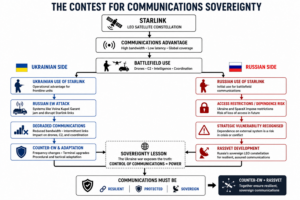
Reports suggested that Russian forces also began using Starlink terminals, recognising the operational advantages that the system provided. Ukraine and SpaceX subsequently moved to restrict unauthorised access through whitelisting mechanisms. Russia, in turn, intensified efforts to disrupt Ukrainian use of Starlink through electronic warfare. The contest quickly evolved into a struggle not for territory but for access to communications.
It should not surprise military professionals. Every Signals officer learns early in his career that communications plans rarely survive first contact with the enemy. Radios fail. Frequencies are jammed. Relays are destroyed. Terrain interferes. Weather intervenes. Something always goes wrong. The difference today is that modern military systems increasingly depend upon those communications links. A disconnected drone is often an ineffective drone. A disconnected sensor becomes far less valuable. A disconnected command network loses much of its utility.
The Starlink story, therefore, tells us something important. Modern warfare increasingly depends upon invisible infrastructure. Once that infrastructure becomes operationally decisive, it inevitably becomes a target.
The Return of Electronic Warfare
For many years, electronic warfare occupied a relatively specialised place within military planning. Precision weapons, stealth aircraft and network-centric warfare often attracted greater attention. Ukraine has changed that perception dramatically.
Recent reports have highlighted Russia’s use of electronic warfare systems, such as Volna Kupol Garant, against Starlink-enabled communications. Whether the objective is complete denial or merely degradation, the logic is straightforward. Destroying every satellite in orbit is difficult, expensive and escalatory. Interfering with communications at the user end is often cheaper, simpler and more sustainable.
It is not a new principle. Military history is full of examples of adversaries seeking the cheapest way to neutralise an expensive capability. Radar produced jammers. Precision-guided munitions produced spoofing systems. Communications networks produced an electronic attack.
The emergence of systems such as Volna Kupol Garant reflects this enduring logic. The battle is not being fought in space. It is being fought in the electromagnetic spectrum.
This distinction matters because it highlights a reality often overlooked in discussions about technology. Possessing an advanced capability is only the beginning. Preserving its effectiveness in the face of enemy action is the real challenge.
The modern battlefield increasingly rewards those who can disrupt information flows rather than merely destroy platforms. The objective is no longer simply to destroy tanks, artillery and aircraft. It is to blind, confuse and isolate them.
Disrupt communications.
Degrade navigation.
Corrupt data.
Jam control links.
Delay information.
Attack networks.
The side that achieves these effects first often gains a disproportionate operational advantage.
The Real Meaning of Sovereignty
The Ukraine conflict also exposes a common misunderstanding about sovereignty.
Many people assume sovereignty means ownership. If a country owns a satellite, a network or an AI model, then it is sovereign.
Reality is more complicated.
A sovereign capability is not merely one that exists. It continues to function even when an adversary actively attempts to disable it.
A satellite constellation vulnerable to jamming is not fully sovereign.
A drone fleet dependent upon uninterrupted GPS is not fully sovereign.
An AI-enabled command system that collapses when disconnected from the cloud is not fully sovereign.
True sovereignty is therefore measured by resilience rather than ownership.
It is perhaps the most important lesson emerging from the Starlink war. The contest is not about access alone. It is about preserving capability despite deliberate efforts to deny it.
In many ways, this represents a return to classical military thinking. The objective has always been to maintain combat effectiveness despite friction, uncertainty and enemy action. The technologies have changed. The principle has not.
Russia’s Strategic Response: Rassvet
If Volna Kupol Garant represents a tactical response to dependence, Rassvet represents a strategic response.
Recent reports suggest that Russia is developing Rassvet, a low-earth orbit satellite constellation intended to provide communications services across the country while reducing reliance on external systems. On the surface, Rassvet appears to be a telecommunications project. In reality, it is something far more significant.
It is a sovereignty project.
The sequence is revealing.
Starlink demonstrated the military value of resilient communications.
Electronic warfare exposed vulnerabilities.
The response was not simply better jamming.
The response was an attempt to build sovereign infrastructure.
This pattern is likely to be repeated across multiple domains.
Countries that discover dependence on foreign communications systems will seek domestic alternatives.
Countries dependent on external cloud providers will seek sovereign cloud infrastructure.
Countries dependent on foreign AI models will seek indigenous AI ecosystems.
Countries dependent on imported semiconductors will seek local manufacturing capabilities.
What appears to be industrial policy is increasingly becoming national security policy.
The Sovereignty Stack
This is why debates about artificial intelligence often miss the larger picture.
Many discussions focus on a single question: Does India need its own frontier AI model?
Important as that question may be, it addresses only one layer of a much larger challenge.
AI depends upon computing.
Compute depends upon data centres.
Data centres depend upon energy.
Digital systems depend upon communications.
Communications increasingly depend upon satellites, fibre networks and spectrum.
The failure of any one layer affects all the others.
Sovereignty in the twenty-first century, therefore, resembles a stack rather than a single capability.
At the foundation lies energy.
Above it sit communications networks.
Then come data centres and compute infrastructure.
Above them reside data ecosystems.
Artificial intelligence occupies the next layer.
Applications and military capabilities sit above that.
Weakness at any layer creates vulnerability throughout the stack.
The lesson from Ukraine is not that nations require their own version of Starlink. The lesson is that nations require resilience across the entire stack.
India’s Challenge
For India, this debate extends well beyond military communications.
The country is investing heavily in data centres, semiconductor manufacturing, digital public infrastructure, artificial intelligence and space systems. These initiatives are often discussed separately. In reality, they should be viewed as interconnected components of national power.
A data centre is not merely a real-estate investment.
A semiconductor fab is not merely a manufacturing project.
A satellite constellation is not merely a communications project.
An AI model is not merely a software product.
Each contributes to a larger architecture of sovereignty.
The challenge is not to eliminate all external dependencies. That objective is neither practical nor desirable. The challenge is to ensure that critical national functions continue to operate during disruption, coercion, or conflict.
Military planners often describe this as resilience.
Strategists have traditionally described it as sovereignty.
Increasingly, they mean the same thing.
Sovereignty Under Fire
The most important lesson from Ukraine may not be the rise of drones or artificial intelligence. It may be the rediscovery of a principle that military professionals have understood for generations: dependence creates vulnerability.
Starlink demonstrated the power of communications.
Volna Kupol Garant demonstrated the power of electronic warfare.
Rassvet demonstrates the response of a state that has concluded that critical capability cannot permanently rest on infrastructure it does not control.
Together, these developments reveal the emerging architecture of national power in the digital age.
Future wars will certainly involve drones, missiles, autonomous systems and artificial intelligence. But beneath all of them lies a deeper contest. It is a contest over communications networks, satellite constellations, data centres, compute infrastructure, cloud platforms and the electromagnetic spectrum.
The battlefield of the future will not merely be fought with technology.
It will be fought for control of the systems that make technology possible.
Brigadier Narendra Pratap Singh (Retd)

Brigadier Narendra Pratap Singh (Retd) is a Defence Technology Strategist, AI and Digital Transformation Leader, and former Director of Artificial Intelligence in the Indian Army. He is currently the CEO of Mindsprintz Consulting, advising defence organisations, startups, and industry on artificial intelligence, autonomous systems, digital transformation, and the future of warfare.