





Editor’s Note
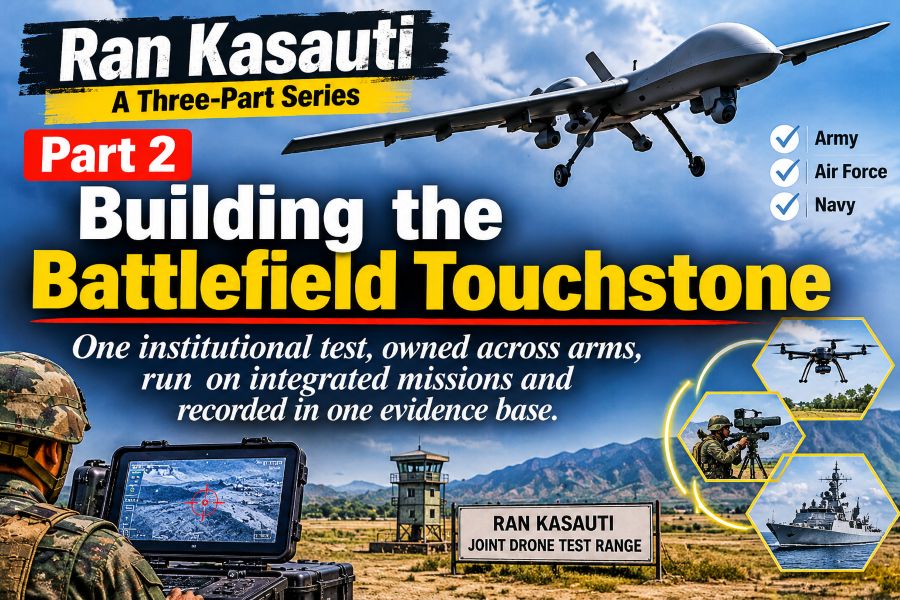
Part I of this series examined why drone procurement continues to lag behind battlefield realities, highlighting the challenges confronting users, industry and procurement authorities as technology evolves faster than acquisition cycles. It argued that the Army needs a recurring, institutional mechanism to identify what works and what does not, while systems are still relevant. Part II takes this proposition forward, explaining how Ran Kasauti could deliver that capability through a common test framework, jointly owned across arms, built around integrated missions and anchored in a shared evidence base. The objective is to replace fragmented trials with credible, operationally relevant performance assessment.
From fragmented trials to a common operational standard
Part 1 set out the challenges facing users, industry and procurement authorities. This part describes how Ran Kasauti would work.
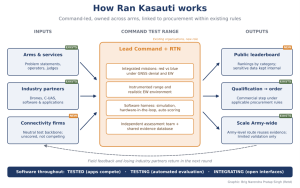
Ran Kasauti in outline
- Recurring. Rounds at regular intervals, so no result goes stale and every industry partner gets another chance.
- Command-led. Run by a field Command – Western, South Western or Southern – close enough to the threat to write honest problem statements, and owning ranges, troops and financial powers.
- Two-sided. Drones and counter-drone systems tested against each other, red against blue, in a contested electromagnetic environment.
- User-scored and transparent. Operators’ ratings count alongside measured performance; criteria are declared in advance and results published.
- Built on what exists. Existing ranges, EW units, the Regional Technology Node (RTN) and delegated powers, working within existing procurement rules.
Why a Command
A field Command is close enough to the threat to write honest problem statements, and it owns the ranges, troops, and financial power. It can test what its formations faced on the border weeks earlier. Army Headquarters sets the frame, approves the categories, and ensures Commands don’t duplicate each other; the Command does the learning. Over time, more than one Command can run rounds in different terrain, adding to the same evidence base.
Ownership across arms
Infantry, Armoured Corps, Artillery, Army Air Defence, Signals and EW, and Army Aviation each have a stake, as does the Air Force in the airspace. Each should sponsor problem statements – for example, defeat a fibre-optic FPV approaching a company post – and nominate operators and judges, so that the verdict carries the user’s voice and is not seen as imposed from the top. The Command hosts; the arms own.
Evidence that stands scrutiny
Ran Kasauti needs a modest Command-level test setup on the lines of the US Test Resource Management Centre: an instrumented range, a realistic EW environment, common telemetry and repeatable scenarios.
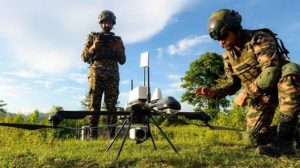
Trials should be built around complete missions, not isolated capabilities. An ISR task flown under GNSS denial and active jamming tests navigation, sensors, links and EW resilience together, as the battlefield will. One integrated evaluation replaces several separate no-cost trials and proofs of concept. Western Command’s 12 counter-drone statements, for instance, could be evaluated in one round against its own drone statements.
Instrumentation alone does not guarantee objectivity. The method matters:
• Missions repeated enough times to separate real differences from luck.
• Operators prepared to the same standard, and failure defined in advance.
• Results reported by mission category with a consistency measure, not as one headline number.
• Cost per effect defined for each mission, including attrition, consumables, training and support equipment.
• A small independent assessment team, appointed by the Command with declared conflicts of interest, that preserves raw data and hears appeals from industry partners within a fixed window.
One evidence base
Every result goes into a single, access-controlled database: each system’s reference configuration, scores by mission, operator ratings, delivery and field reliability.
• Any formation, Command or procurement agency evaluating the same equipment draws on it instead of starting from zero, and past performance finally counts.
• Industry partners carry credit forward, re-proving only what has changed.
• Results are published in three tiers: a public leaderboard by category, confidential feedback to each industry partner, and a classified Army assessment of vulnerabilities.
Software: tested, testing and integrating
• Tested. Applications compete in their own right – mission planning, AI-based detection, swarm control, counter-drone sensor fusion – so a good software firm can win without building airframes.
• Testing. Ran Kasauti itself runs on software: simulation and hardware-in-the-loop before live flights, scripted EW scenarios and automated scoring.
• Integrating. Competing systems must exchange tracks and commands through open interfaces, and integration is measured, not assumed: handover time, track accuracy, coordinate consistency and authentication.
Secure updates, configuration control, audit logs and component origin are qualifying conditions. Specialist connectivity firms provide the common backbone that lets competing systems talk during trials; they are not scored and do not compete in the same round, so the referee is not also a player.
Quality control after the trial
A trial proves a sample, not a supply.
• Each qualified system is recorded as a reference configuration – hardware, firmware and software versions, with measured performance.
• Delivered lots are accepted against it through sample testing at the Command’s test cell, using the same instrumentation.
• A change of components or software triggers re-verification.
• A drop in field reliability below the qualified baseline costs the industry partner standing in the next round.
What changes for users and industry
For users
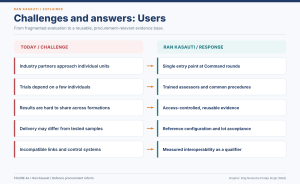
• Ran Kasauti becomes the single front door: industry partners come to the Command’s rounds instead of approaching individual units, freeing formations for operational tasks.
• Testing becomes an institutional process with written procedures, trained assessors and recorded data, so it no longer rises or falls with a few individuals.
• Systems that pass have already proved they can talk to each other, and a software update is accepted only after the Army can see what changed.
• Field experience feeds the next round instead of disappearing into reports.
For industry
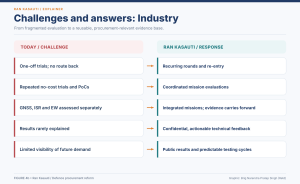
- The rules are known in advance, and one integrated evaluation replaces repeated no-cost trials.
- A losing firm learns exactly why and can return in the next round.
- A published leaderboard gives investors and banks a credible signal of demand, so firms can invest in production with some confidence.
- Software firms get a route of their own, and component-origin and security requirements are stated at the start rather than discovered at the end.
(Note: Part 3 takes up the last and hardest link: turning this evidence into orders.)
Brig Narendra Pratap Singh (Retd)
(To be continued)

Brigadier Narendra Pratap Singh (Retd) is a Defence Technology Strategist, AI and Digital Transformation Leader, and former Director of Artificial Intelligence in the Indian Army. He is currently the CEO of Mindsprintz Consulting, advising defence organisations, startups, and industry on artificial intelligence, autonomous systems, digital transformation, and the future of warfare.