





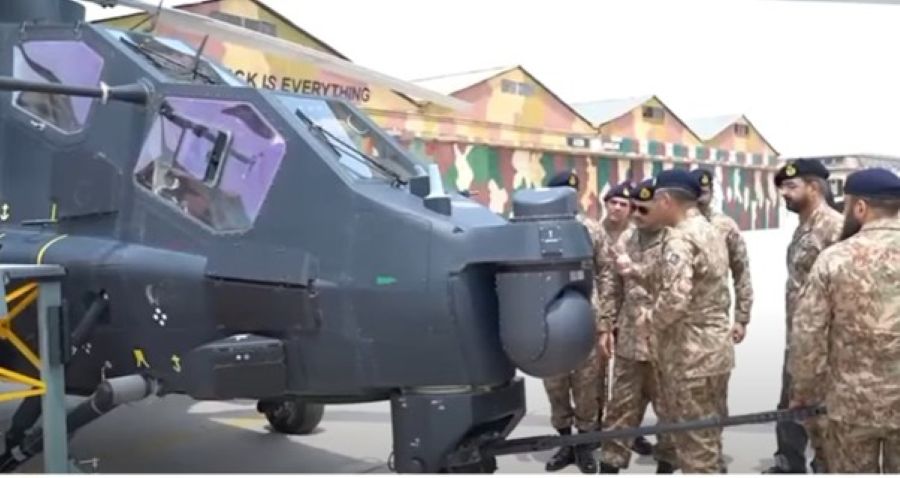
Pakistan’s dependence on Chinese military hardware is set to deepen with a reported contract for 30 Z-10ME attack helicopters, marking a significant expansion of its Army Aviation fleet and further consolidating Beijing’s position as Islamabad’s principal defence supplier.
The contract details surfaced in an image circulating on Chinese social media, shared on Sunday by military blogger Sashoujian. According to the post, China National Aero-Technology Import and Export Corporation (CATIC) signed an export agreement with Pakistan’s Ministry of Defence Production on July 11 for 30 Z-10ME helicopters, along with associated equipment and services.
The year in which the agreement was signed was not specified. Neither Beijing nor Islamabad has officially confirmed the reported order size, contract value or delivery schedule. If accurate, however, the figure provides the clearest indication yet of the scale of Pakistan’s acquisition since the Army formally inducted the helicopters in August last year.
The blogger described the agreement as a breakthrough in Chinese military exports, claiming it was the first time a domestically developed main battle attack helicopter had been exported as a complete system.
Pakistan had reportedly considered acquiring as many as 40 Z-10-series helicopters as early as 2022. Their induction has been described by the Pakistani military as a major step towards modernising Army Aviation.
China fills the gap left by Western suppliers
The Z-10ME acquisition also highlights the difficulties Pakistan has faced in diversifying its military procurement. Islamabad’s efforts to acquire the American AH-1Z Viper and Turkish T129 ATAK attack helicopters failed amid export restrictions and licensing complications, leaving China as the principal alternative.
The Z-10ME will join an Army Aviation fleet built largely around ageing American AH-1F Cobra helicopters, which have served Pakistan for nearly four decades, alongside a limited number of Russian Mi-35 Hind assault helicopters. The Chinese platform offers Pakistan an opportunity to replace older aircraft while avoiding the political and regulatory uncertainties associated with Western arms supplies.
The purchase is another illustration of how China has become central to Pakistan’s military modernisation, supplying combat aircraft, air defence systems, drones and other platforms. The J-10CE fighter, acquired alongside the JF-17 programme, has already strengthened the Chinese footprint in Pakistan’s combat aviation. The Z-10ME adds an attack-helicopter capability to that expanding portfolio.
A helicopter designed for demanding terrain
The Z-10ME is an export-oriented, upgraded variant of the Z-10 attack helicopter operated by China’s People’s Liberation Army. The aircraft has featured in Chinese military exercises near the Indian border and in the Taiwan Strait, reflecting its role in Beijing’s evolving operational doctrine.
Chinese state media have previously highlighted the helicopter’s operations in the high-altitude Tibetan region, including at elevations approaching 6,000 metres. Such performance could be relevant to Pakistan’s military requirements along its mountainous borders.
The export variant reportedly incorporates improved WZ-9C turboshaft engines, enhanced electronic warfare systems and other upgrades intended to improve its operational performance and survivability.
First unveiled at the Zhuhai Airshow in 2018, the Z-10ME made its international airshow debut at Singapore in 2024. It was subsequently showcased at the Marrakech Air Show in Morocco in early October alongside China’s J-10CE fighter, Y-20 strategic transport aircraft, Z-20 utility helicopter and Wing Loong drone family, according to an AVIC social media post dated October 10.
Strategic implications
For Pakistan, the reported acquisition offers a route to modernising Army Aviation without dependence on Western export approvals. For China, it reinforces the strategic value of a defence partnership in which equipment procurement, operational interoperability and long-term military support increasingly converge.
The implications extend beyond the helicopter fleet. As Pakistan increasingly relies on Chinese platforms across its armed forces, Beijing’s influence over Islamabad’s military modernisation is becoming more pronounced. The Z-10ME deal, if confirmed at the reported scale, would be another step in that direction.
Team BharatShakti