





Editor’s Note
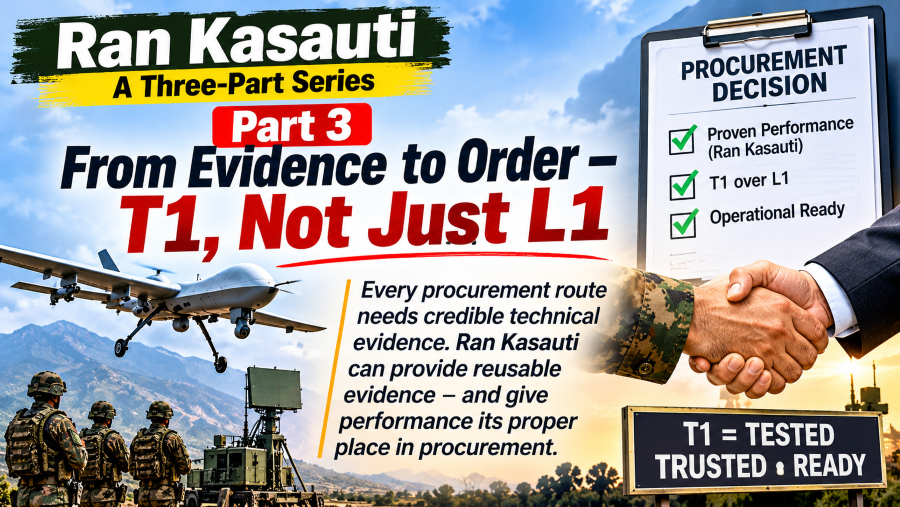
The first two parts of this series examined why drone procurement struggles to keep pace with battlefield realities and proposed Ran Kasauti as an institutional framework for rigorous, integrated operational testing. The final instalment addresses the critical missing link – translating test evidence into procurement decisions. The author argues that credible, reusable technical evidence must inform every acquisition route, ensuring that operational performance is not overshadowed by the lowest-cost bid. The case is for a procurement system that values T1, not just L1 – making battlefield effectiveness count in the journey from evaluation to order.
From Evidence to Order: Giving Performance Its Due
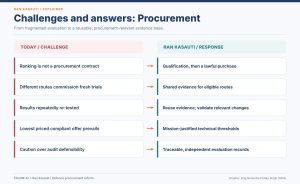
Parts 1 and 2 argued that the Army needs a recurring, institutional way of testing fast-changing drones and counter-drone systems, and described how Ran Kasauti would generate that evidence. Evidence that does not move money, however, changes nothing. This part deals with the link to procurement.
Every route needs credible technical evidence
Three routes matter most for these systems. The Army Commander’s Special Financial Powers (ACSFP) allow urgent purchases close to the user. The indigenisation and R&D powers (IR&D) support equipment that is promising but needs further development, with users involved. The Other Capital Procurement Plan (OCPP) supports improvement of equipment already in service. Each, in its own way, relies on credible technical evidence – usually a demonstration, trial or evaluation – before money is committed. Today each runs its own, with its own board and report, invisible to the others.
Ran Kasauti can become that common demonstration and trial for all three. One integrated, instrumented evaluation produces evidence that every route can use, and the results are available transparently to all. What is needed is a common trial report format that all three routes accept, so a board convened for an ACSFP purchase, an IR&D project or an OCPP upgrade reads the same evidence rather than commissioning its own.
Three outcomes, three routes
- Systems that cross the declared thresholds are qualified and become eligible for initial procurement under ACSFP, subject to the applicable tendering, commercial evaluation and approval procedures. Army-level procurement can scale them on the same evidence, with only limited validation of configuration, safety and integration.
- Systems that show real potential but fall short on measured parameters move to IR&D. The gaps measured in the trial become the development milestones, users take part in each iteration, and the product re-enters the next round to prove the fix. Users do not merely receive the result; they shape it, flying each iteration and recording what works. Prototypes developed under iDEX or other schemes can enter the same rounds, so every development path is judged by one yardstick.
- Improving what we have. Upgrades to in-service equipment – new software, anti-jam links, sensors or interceptors – are tested against the fleet’s recorded baseline. OCPP funds the improvement on measured gain, not on an industry partner’s claim. This matters because much of the Army’s drone and counter-drone capability is already in service, and the fastest gains often lie in making it work better under jamming rather than buying anew. Most of Western Command’s 79 statements are of exactly this kind – upgrades to tanks, infantry combat vehicles and guns already in service.
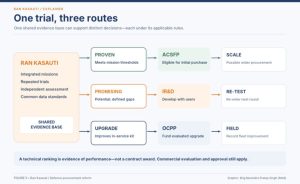
Figure 5: One trial, three routes – how Ran Kasauti evidence feeds ACSFP, IR&D and OCPP T1, not just L1
Our procurement culture is built around L1: among technically compliant offers, the lowest price wins. For a rifle or a truck, that is defensible. For an attritable drone, it often is not. A compliant drone that loses its link under jamming is not cheaper; it is a write-off. The real measure is cost per effect. Suppose one drone costs a third less but completes half as many missions under jamming. Under L1, it wins; on cost per completed mission, it loses badly. Without recorded performance, the procurement officer has no defensible way to choose the better drone. With it, the choice is easy to justify.
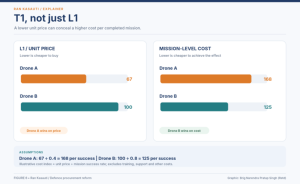
Figure 6: An illustrative comparison – the lowest price is not the lowest cost per completed mission - Ran Kasauti makes another approach defensible: T1, the technically best performer, identified by instrumented, repeated and independently assessed results. Several ways of using that evidence are worth considering:• Set demanding, mission-justified qualification thresholds, declared before evaluation, so that L1 is chosen only among genuinely strong performers.• Use cost per effect, not unit price, to shape requirements and, where a procedural basis exists, evaluation.• Where the rules permit weighted technical and commercial evaluation, let recorded scores supply the technical weight.• Where the applicable procurement procedure permits multiple awards, divide orders among the top performers, keeping competition alive for the next round.
A caution is in order. Cost per effect is an operational and economic measure; it does not by itself become an authorised method of evaluating bids. The immediate, fully compliant use of Ran Kasauti evidence is to set demanding, realistic qualification criteria. Weighted technical selection needs its own procedural basis, and where present rules confine such approaches, Ran Kasauti’s transparent evidence is exactly what a case for wider use would need. Procurement can then be justified on performance and not on financial bids alone. The signal to industry changes too: firms stop engineering to the cheapest compliant specification and start investing in what wins on the range – EW resilience, reliability, software that can be updated quickly.
From ranking to lawful order
A first-place ranking is not a contract. Financial powers determine who approves; procurement rules determine how. Ran Kasauti produces technical qualification and a scored record; the commercial step follows the applicable rules for the route chosen. The Army Design Bureau and RTNs, today interfaces without procurement roles, would gain one: generating the evidence on which spending decisions rest.
For procurement authorities, the gain is evidence. A file built on instrumented, independently assessed results and recorded past performance is easier to approve and to defend before audit than one built on a single trial report. The safeguards remain; the uncertainty they guard against shrinks.
A pilot in five phases
• Authority and scope. Nominate the Command, select a few mission categories, appoint assessors, and agree with finance authorities how ACSFP, IR&D and OCPP cases will use the results.
• Preparation. Publish criteria, configure instrumentation, validate scoring, and screen for safety and security.
• Trials. Run integrated missions, collect operator ratings, and record evidence.
• Results and routing. Publish sanitised rankings, give confidential feedback, and route each system as proven, promising or upgrade.
• Acceptance and field evidence. Accept delivered lots against the qualified reference, track reliability, and feed findings into the next round.
The pilot must prove two things: that the Army can generate credible comparative evidence, and that the evidence actually shortens a compliant procurement. Risks – scenario gaming, data security, barriers for startups – are design problems, not reasons to wait.
A kasauti does not make gold. It tells you, honestly and quickly, which piece is gold. That is what the Army needs from drone procurement today.
Brig Narendra Pratap Singh (Retd)
(Concluded)

Brigadier Narendra Pratap Singh (Retd) is a Defence Technology Strategist, AI and Digital Transformation Leader, and former Director of Artificial Intelligence in the Indian Army. He is currently the CEO of Mindsprintz Consulting, advising defence organisations, startups, and industry on artificial intelligence, autonomous systems, digital transformation, and the future of warfare.