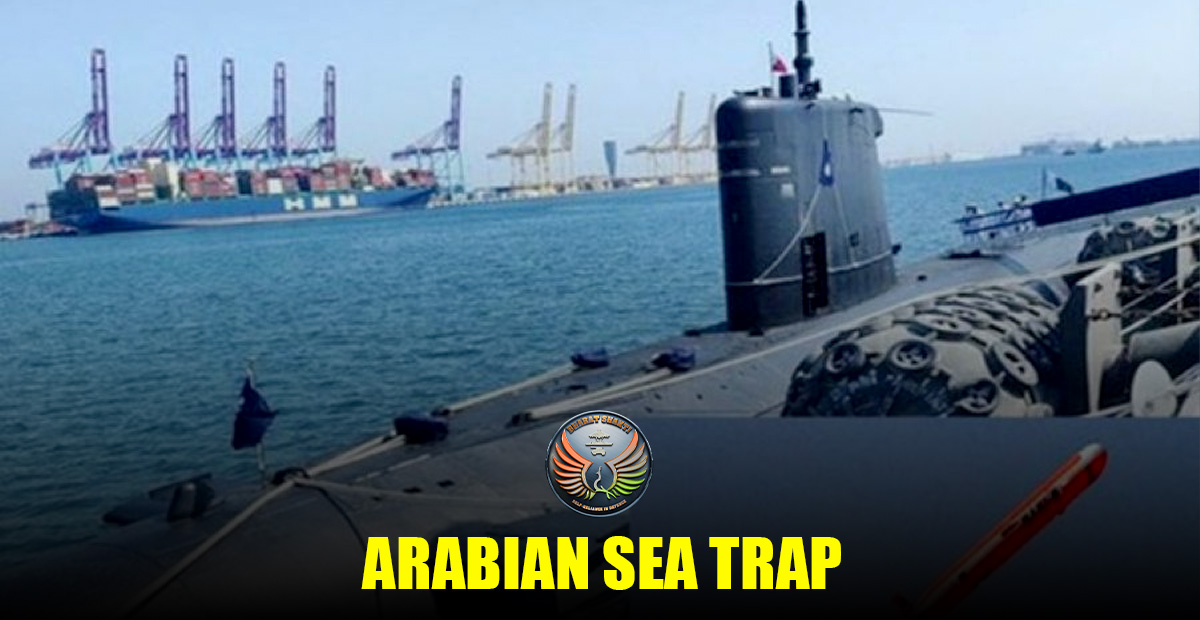
As Pakistan celebrates its 79th Independence Day – a day before India marks its own – the northern Arabian Sea is quietly bracing for a contest beneath the waves. Islamabad’s eight-boat Hangor-class submarine programme, an export variant of China’s Yuan-class, has been sold as a strategic game-changer. Two boats have already been launched – the first in April 2024 and the second in March 2025 at Wuhan – with more in the pipeline.
But the reality is harsher. These submarines will have to operate in one of the world’s most heavily monitored anti-submarine warfare (ASW) environments – a battlespace India has spent more than a decade fortifying. From the seabed to the skies, a multi-layered ASW grid now stands ready, reducing the Hangor’s chances of slipping undetected into operational waters.
India’s ASW Wall: A Decade in the Making
The Indian Navy’s ASW network is already fully deployed:
- Persistent patrol: Twelve Boeing P-8I Poseidon aircraft provide wide-area surveillance across the Arabian Sea, using advanced sonobuoys and magnetic anomaly detectors.
- Surface hunters: Project 28 Kamorta-class corvettes and frontline destroyers/frigates field HUMSA-family sonars, Maareech anti-torpedo decoys, and Varunastra heavyweight torpedoes.
- Rapid airborne strike: The new MH-60R Seahawk helicopters combine dipping sonar with torpedo delivery, offering fast reaction to sub-surface contacts.
- Littoral choke point control: INS Arnala, commissioned in June 2025, is the first of 16 planned Anti-Submarine Warfare Shallow Water Craft – designed to dominate the exact coastal approaches Pakistani subs must transit from Karachi and Ormara.
“This layered kill chain ensures P-8I detections can be acted upon almost instantly,” says a former Indian Navy officer. “In the constrained northern Arabian Sea, early detection often seals the submarine’s fate.”
Propulsion: Hangor’s Potential Weak Link
The Hangor-class was initially meant to use Germany’s MTU-396 diesel engines. Germany’s export ban forced Pakistan to adopt China’s CHD-620 engines – a system with no proven export track record.
Thailand’s S26T programme, also forced to take the CHD-620, suffered over a three-year delay just to integrate and validate the system. For a diesel-electric submarine, propulsion noise is a matter of life and death; any acoustic disadvantage directly feeds India’s sonar advantage.
Sustainment and Readiness Hurdles
Regional experience with Chinese-built subs offers a cautionary tale. Bangladesh’s refurbished Ming-class pair and Myanmar’s single Ming have spent more time alongside than at sea, hampered by upkeep demands and crew availability.
The Hangor’s AIP system may give it better submerged endurance than older designs, but its sustainment pipeline, spare parts flow, and crew proficiency remain untested in Pakistan Navy service. If propulsion or AIP teething problems emerge, readiness will be further compromised.
Operational Reality: The ASW Gauntlet, Trapped Before Open Water
India’s ASW dominance is not just about technology – it’s about integration. Regular exercises have honed coordination between P-8Is, MH-60Rs, surface combatants, and now shallow-water ASW craft – the Arnala-class patrols the littorals, while Kamortas sweeps deeper waters.
For the Hangor fleet, this means early detection is not just possible – it’s probable. Pakistani submarines could be tracked within hours of leaving harbour, forcing them into slow-speed, low-risk transits that limit operational reach and deterrent value. Each of these factors blunts the strategic impact of Pakistan’s submarine arm, even if all eight Hangors arrive on schedule.
Strategic Outlook
The Hangor class will replace ageing Agosta-90Bs and undoubtedly modernise Pakistan’s submarine arm. But in a theatre as compressed and surveilled as the northern Arabian Sea, modernisation does not guarantee advantage.
India’s ASW grid is already in place. The Hangor’s propulsion remains untested. And the geography leaves little room for stealth. In this environment, the Arabian Sea is less a hunting ground for Pakistan’s new subs and more a fortress where India controls the gates.
For the Hangors, the real challenge may be surviving the journey from Karachi’s jetties to the open ocean – because in these waters, they are hunted before they sail.
Huma Siddiqui