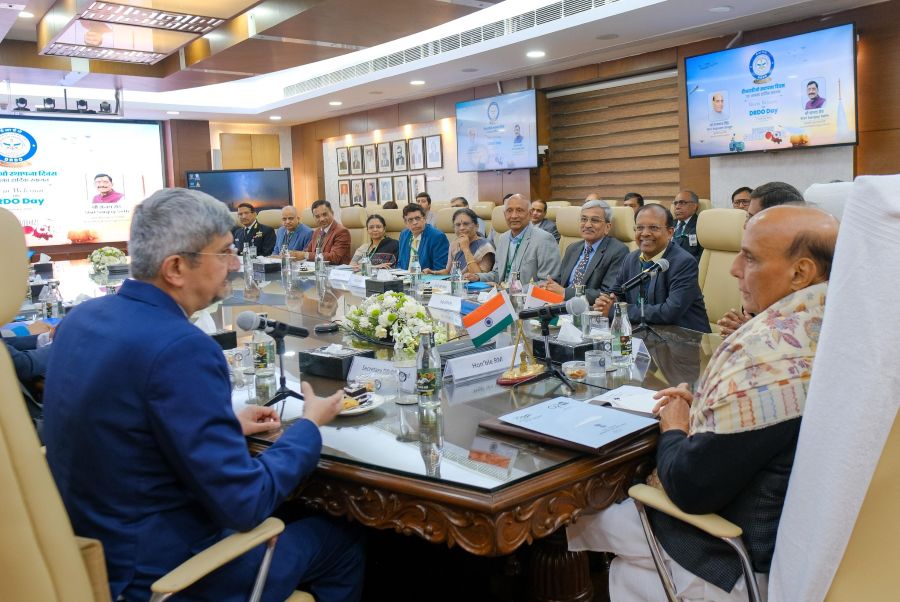
The Defence Research and Development Organisation (DRDO) achieved a record year in defence acquisitions. During a visit to the organisation’s headquarters to celebrate its 68th Foundation Day, Defence Minister Rajnath Singh reviewed DRDO’s performance for 2025 and set priorities for 2026.
DRDO Chairman and Secretary, Defence R&D, Dr Samir V Kamat, said that 22 Acceptance of Necessity (AoN) approvals worth about Rs 1.3 lakh crore were cleared by the Defence Acquisition Council (DAC) and the Services Procurement Board in 2025 for the induction of DRDO-developed systems, the highest value ever achieved in a single year. All the approved platforms will be manufactured domestically.
Among the systems cleared for induction are the Integrated Air Defence Weapon System, a Conventional Ballistic Missile System, the Quick Reaction Surface-to-Air Missile ‘Anant Shastra’, the Long Range Air-to-Surface Supersonic Cruise Missile, the Astra Mk-II air-to-air missile, upgraded drone detection systems, the AEW&C Mk-1A aircraft, and several naval and land warfare systems.
In parallel, 11 contracts worth Rs 26,000 crore were concluded with DRDO’s production partners last year. These cover systems include the Nag anti-tank missile, Ashwini radar, air defence fire control radars, Pinaka rocket system munitions, Mi-17 electronic warfare suites, area denial weapons and the ATAGS howitzer.
DRDO Chief said the user trials advanced significantly in 2025 across various strategic and conventional weapon programs, including the Pralay surface-to-surface missile, the Akash-NG air defence missile, MPATGM, the ER-ASR rocket, and new-generation radios and surveillance systems. Developmental trials also continued for platforms such as the light tank, VSHORADS missile, Rudram-2, long-range cruise missiles, naval anti-ship missiles and precision glide bombs, he informed.
DRDO Chief exuded confidence that many of these systems will be accepted for induction in 2026, further accelerating India’s journey toward defence self-reliance under the Atmanirbhar Bharat mission. He also highlighted the organisation’s expanding industrial base, which now includes over 2,200 technology transfer agreements, as well as growing collaboration with academia through 15 Centres of Excellence.
DRDO’s Weapon Systems Played Decisive Role in Operation Sindoor: Rajnath Singh
Rajnath Singh lauded DRDO scientists for their role during Operation Sindoor, saying indigenous weapons performed “decisively and flawlessly”, boosting troop morale and signalling the maturity of India’s defence technology ecosystem. He said the state-of-the-art technologies and equipment supplied to the armed forces performed seamlessly during the operation. He noted that their reliable performance boosted soldiers’ morale and demonstrated the growing maturity of India’s defence research ecosystem.
He said DRDO will be central to the rollout of the proposed ‘Sudarshan Chakra’ national air and missile defence shield over the coming decade. Under the Sudarshan Chakra initiative, the DRDO will equip critical installations across the country with advanced air defence systems for comprehensive aerial protection over the next decade.
The Minister called on DRDO to remain ahead of the global technology curve and deepen its work in artificial intelligence, cybersecurity, space systems, and other next-generation domains.
Team BharatShakti